
Submission errors in mechanical engineering projects cost professionals far more than time. In Singapore’s tightly regulated construction industry, a single missing compliance document or improperly formatted drawing can trigger a full review cycle with BCA, SCDF, or PUB, pushing project timelines back by weeks. This mechanical engineering submission guide addresses exactly that problem. Whether you are preparing design drawings for an M&E system approval or submitting a research paper to a peer-reviewed journal, the standards for documentation, formatting, and regulatory alignment are specific and unforgiving. The sections that follow cover prerequisites, formatting protocols, common pitfalls, and post-submission procedures in precise detail.
Table of Contents
- Key takeaways
- Your mechanical engineering submission guide: start here
- Prerequisites and documents you must have ready
- Step-by-step preparation and formatting for submission
- Common pitfalls and how to avoid them
- What to expect after you submit
- My perspective on submission discipline in Singapore’s construction industry
- How Aectechnicalsg supports your submission process
- FAQ
Key takeaways
| Point | Details |
|---|---|
| Prepare documents before submission | Assemble all mandatory drawings, compliance certificates, and risk assessments before initiating any submission. |
| Format to regulatory standards | Use prescribed file formats, drawing scales, and naming conventions aligned with BCA and SCDF requirements. |
| Avoid desk rejections early | Editors and authority reviewers make rejection decisions in under ten minutes based on scope, methodology, and ethics. |
| Keep similarity indexes low | Maintain document originality with a similarity index below 15% to pass plagiarism screening for conference and journal submissions. |
| Treat the guide as a live checklist | Revisit submission requirements at each project milestone rather than applying them once at the end. |
Your mechanical engineering submission guide: start here
Before any file goes to an authority or a journal editor, you need a clear picture of what is actually required. Singapore’s construction industry involves multiple regulatory bodies, each with distinct submission requirements. BCA governs structural and building plan approvals. SCDF handles fire protection and suppression systems. PUB oversees drainage and water supply documentation. JTC and LTA have their own sets of requirements for industrial and transportation infrastructure. Submitting to the wrong authority, or submitting to the right one with incomplete documents, produces the same outcome: rejection and delay.
The starting point for any Singapore compliance submission is understanding which regulatory body has jurisdiction over your specific scope of work. A mechanical engineer working on an ACMV system in a commercial building will face different submission triggers than one designing a fire suppression system in a JTC-managed industrial facility. Getting this distinction right before you prepare a single document is the most time-efficient decision you can make.
Prerequisites and documents you must have ready
Preparing a submission without the full document set is the most common cause of unnecessary delays. The following is what a properly assembled mechanical engineering submission package looks like for Singapore construction projects.
Mandatory documents and drawings:
- Mechanical and electrical design drawings, stamped by a Registered Professional Engineer (PE) where required
- Completed BCA Form of Acceptance or relevant authority submission forms
- Design for Safety (DfS) documentation, including a risk register and DfS report
- Mechanical Ventilation and Air Conditioning (ACMV) load calculations and system schematics
- Fire protection system drawings for SCDF submission, cross-referenced with the architectural plans
- Equipment specifications, data sheets, and manufacturer compliance certificates
- Energy efficiency compliance documentation under the Building Control (Environmental Sustainability) Regulations
- Structural interface drawings if mechanical systems penetrate or are anchored to structural elements
Standards and codes you must reference:
Singapore submissions operate under a specific regulatory framework. The Singapore Standard SS 553 governs ACMV installations. CP 13 covers fire protection. BCA’s Approved Document sets the benchmark for building services. Any design document that does not cite the applicable standard will face immediate scrutiny during the plan screening stage.

Pro Tip: Use BIM software such as Autodesk Revit MEP or OpenBIM tools to generate coordinated drawings that simultaneously satisfy geometric accuracy, clash detection requirements, and drawing output standards expected by authorities. A BIM model that has been coordinated across disciplines is far harder to reject on technical drawing grounds. The workflow advantages of BIM-based documentation extend well beyond aesthetics. They reduce the likelihood of dimensional conflicts that reviewers catch immediately during plan checking.
Step-by-step preparation and formatting for submission
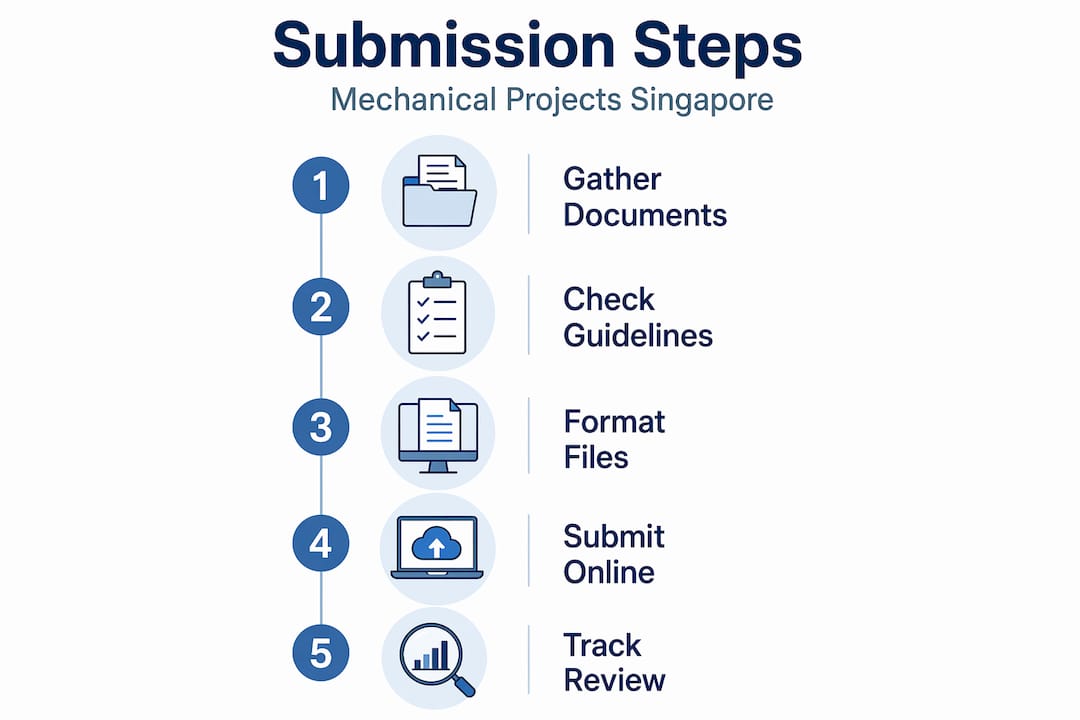
Once your document set is assembled, the formatting and organization of that package determines whether it moves forward or gets returned. Below is the process that consistently produces clean first submissions.
- Confirm the submission platform and file format. BCA’s CORENET X platform accepts IFC-based BIM files as of 2026. SCDF requires fire protection submissions through its own Fire Safety Submission System (FSSS). Know the platform before you format anything.
- Apply the correct drawing standards. Use Title Block formats that match the authority’s template. Drawing scales must be explicit and consistent. Layer naming conventions should follow SS ISO 13567 or the project’s BIM Execution Plan (BEP).
- Organize the submission package with a transmittal sheet. Every package submitted to a Singapore authority should include a document transmittal that lists every file, its revision number, and its purpose. This creates an audit trail and prevents disputes about what was submitted and when.
- Write a clear methodology section. For academic submissions, the methodology must be reproducible. For authority submissions, the design methodology section in a DfS report or ACMV report must trace every design decision back to a code requirement or a project-specific engineering judgment with supporting calculations.
- Include an explicit scope statement. Whether submitting to a journal or a regulatory body, the scope of work must be stated precisely. A submission must explicitly highlight what the design addresses and what it excludes. Ambiguity in scope is one of the fastest ways to invite a request for additional information (RAI).
- Perform a final document audit. Before submission, run every document against your checklist. Verify that all signatures are in place, all calculations are referenced to their source standards, and all drawings match the latest revision of the specifications.
The table below summarizes the core formatting requirements for common submission types in Singapore’s mechanical engineering context.
| Submission type | Platform | File format | Key requirement |
|---|---|---|---|
| Building plan (mechanical) | CORENET X | IFC / PDF | PE stamp, BIM model, DfS report |
| Fire protection system | FSSS (SCDF) | PDF / DWG | Cross-referenced architectural drawings |
| Journal / conference paper | Journal OJS / TSME portal | PDF, max 8MB | Similarity index below 15%, 10-page limit |
| ACMV compliance report | BCA GMIS | SS 553 references, load calculations | |
| DfS submission | CORENET X | Risk register, DfS coordinator sign-off |
Common pitfalls and how to avoid them
Even experienced engineers encounter avoidable rejections. The following issues appear repeatedly across both regulatory and academic submission processes.
Scope mismatch is the top rejection trigger. Editors of engineering journals make a desk rejection decision in under ten minutes, reviewing scope, novelty, methodology, and ethics. The same logic applies in regulatory submissions. A mechanical system that addresses fire protection but is submitted under a generic M&E category will be redirected, not reviewed. Match every submission to its exact category.
Insufficient methodological detail leads to information requests. The methodology section of any engineering document must function as a technical record, not a summary. If a reviewer cannot trace your design decisions from problem identification through to the final specification, you will receive a request for additional information. This extends timelines and damages credibility with reviewing authorities.
Plagiarism and document duplication create serious compliance issues. For academic submissions, conference proceedings require a similarity index below 15% excluding references. For authority submissions in Singapore, using specification clauses verbatim from another project without adaptation to the current project’s specific conditions is a quality control failure that PE signatories are accountable for.
Pro Tip: If your project involves a prototype or system that did not perform as designed, document it thoroughly rather than omitting it. Properly documented design failures demonstrate higher-level engineering thinking and analytical rigor, which reviewing bodies and academic examiners respond to positively.
- Review all cross-references between drawings and specifications before submission
- Confirm that revision clouds on drawings match the revision history in the transmittal
- Check that every calculation references the specific clause of the applicable standard
- Verify that the PE stamp is on every drawing that requires one under the Building Control Act
Treating the M&E submission workflow as a linear, one-time process is itself a pitfall. Submissions are iterative by nature. Building in review cycles before the submission date reduces the risk of last-minute errors that compress under time pressure.
What to expect after you submit
Understanding what happens after a submission goes in is as important as the preparation itself. The table below outlines realistic timeframes for different submission types relevant to mechanical engineering in Singapore and in academic contexts.
| Submission type | Typical review stage | Expected timeframe | Decision outcome |
|---|---|---|---|
| BCA building plan (mechanical) | Plan Screening and Plan Checking | 10 to 20 working days per cycle | Approved, RAI issued, or rejected |
| SCDF fire protection | Fire Safety Evaluation | 14 to 28 working days | Approval, Amendment Required, or Rejection |
| Academic journal (mechanical) | Desk review and peer review | Median 16 days to first decision for desk stage; 60 to 90 days for full review | Accept, Major Revision, Minor Revision, or Reject |
| Conference paper | Editorial screening | 2 to 6 weeks | Accept or Reject with comments |
When a Singapore authority issues a RAI or an amendment notice, the response must be structured as a formal reply. Each comment must be addressed individually, with specific reference to the revised drawing or document that resolves the issue. A vague response to a RAI will generate a second RAI.
For academic submissions, the review comment response follows a similar logic. Reviewers and examiners value fully answered, modest research questions over partial solutions to projects that were scoped beyond what the available data and time permitted. If the feedback identifies a scope issue, the response should address scope directly, not redirect to other parts of the document.
If your project requires a presentation or viva, prepare to explain every design decision verbally. Authorities conducting compliance inspections in Singapore will ask about specific parameters. The engineer responsible must be able to speak to the basis of design without referencing the document set.
My perspective on submission discipline in Singapore’s construction industry
I have reviewed enough engineering submissions to recognize a consistent pattern. The projects that sail through authority review are not always the most technically sophisticated ones. They are the ones where the engineer treated the submission requirements as a working framework throughout the project, not as an administrative task at the end.
What I have found repeatedly is that clear problem-outcome framing produces better responses from reviewers than a document that catalogs the tools and software used. Telling a BCA plan checker what system you designed and why it meets the code is more effective than walking them through your design process in chronological order.
The other lesson I would emphasize is on scope. Feasibility of the research question is a principle that applies equally to academic dissertations and to commercial engineering submissions. Submitting a DfS report for a system that was designed beyond the resource constraints of the project creates a document that reads as aspirational rather than executable. Reviewers notice this.
Treat every submission checklist as a live document. Return to it at design development, at coordination, and again before the submission date. This practice alone eliminates most of the avoidable errors that generate RAIs and desk rejections.
— Aman
How Aectechnicalsg supports your submission process
Navigating Singapore’s multi-authority submission process requires more than technical accuracy. It requires institutional knowledge of how BCA, SCDF, PUB, and JTC evaluate documentation, and what their plan checkers prioritize. Aectechnicalsg provides mechanical and electrical engineering consultancy services specifically structured around Singapore’s regulatory submission environment. From preparing DfS reports and ACMV compliance documentation to coordinating with professional engineers for stamped drawings, the firm’s advisory services reduce submission cycles and protect project timelines. For project teams that need expert guidance on design safety compliance or authority submissions, Aectechnicalsg offers the technical depth and regulatory familiarity that turns a complicated approval process into a structured, manageable workflow.
FAQ
What documents are mandatory for a mechanical engineering submission in Singapore?
Mandatory documents typically include PE-stamped mechanical design drawings, a DfS report with risk register, ACMV load calculations, equipment data sheets, and authority submission forms. The specific set depends on which regulatory body, BCA, SCDF, PUB, or JTC, has jurisdiction over the project.
How long does a BCA plan check take for mechanical engineering submissions?
BCA plan checking for mechanical systems generally takes 10 to 20 working days per review cycle. Projects that receive a Request for Additional Information will restart the review clock, making a complete first submission critical for timeline management.
What is the similarity index requirement for mechanical engineering conference papers?
Conference submissions typically require a similarity index below 15% excluding references to confirm originality. Exceeding this threshold results in automatic rejection before peer review begins.
How should design failures be handled in an engineering submission?
Design failures should be documented transparently with analytical explanation of what occurred and why. Documented design failures demonstrate engineering competency and analytical rigor, and reviewers in both academic and regulatory contexts respond more favorably to transparent documentation than to omission.
What is the fastest way to avoid a desk rejection in mechanical engineering?
Align your submission precisely with the scope category, include a methodology section detailed enough for reproducibility, and confirm ethical compliance before submitting. Editors make desk rejection decisions in under ten minutes, so the first page of your document must immediately signal relevance and rigor.