
The National Environment Agency (NEA) is Singapore’s statutory authority responsible for ensuring building approvals comply with environmental health and pollution control standards. Operating under the Ministry of Sustainability and the Environment, NEA enforces two core regulatory pillars across all construction projects: Pollution Control (PC) and Environmental Health (EH). The role of NEA in building approvals is not advisory. It is legally binding, and Qualified Persons (QPs) bear direct accountability for meeting NEA’s requirements before any plan reaches submission stage. Understanding this process is the difference between a smooth approval and a costly rejection.
What is the role of NEA in building approvals?
NEA’s regulatory authority in building approvals centers on two mandatory compliance tracks: pollution control and environmental health. QPs must verify plans against NEA’s general requirements checklist before submission to satisfy both tracks. This is not a post-submission review. The checklist verification happens upstream, before plans reach any authority.
NEA’s Development Control Department (DCD) manages plan assessments and acts as the primary point of contact for QPs navigating environmental requirements. The DCD reviews submissions for compliance with sanitation standards, public health safety, and pollution thresholds. Projects that skip this internal verification routinely face rejection at the plan submission stage.

The Environmental Health track specifically covers sanitation infrastructure, waste management provisions, and public health safeguards within building designs. A commercial development, for example, must demonstrate adequate grease trap sizing, refuse collection point placement, and toilet facility ratios before NEA will clear the plans. These are not discretionary design choices. They are statutory requirements.
Key NEA requirements QPs must address before submission include:
- Verification against NEA’s general and specific compliance checklists
- Pollution control provisions covering air, water, and noise emissions
- Environmental health provisions covering sanitation, waste, and public health safety
- Environmental Information (EI) application for major infrastructure projects, including MRT lines and road tunnels
- Declaration by the plan preparer confirming compliance with all applicable standards
Pro Tip: Book an appointment through NEA’s online consultation system before finalizing plans. The DCD offers pre-submission consultations that identify compliance gaps early, preventing plan rejection and saving weeks of rework.
How does NEA integrate with Singapore’s digital approval ecosystem?
Singapore’s building approval process runs on Corenet X, a digital submission platform co-led by the Building and Construction Authority (BCA) and the Urban Redevelopment Authority (URA). NEA participates as one of seven agencies reviewing concurrently within this platform, issuing coordinated feedback rather than sequential responses. That shift fundamentally changes how developers manage approval timelines.
Under the legacy process, agencies reviewed plans one after another. A comment from NEA could trigger a redesign that then required re-review by BCA or the Singapore Civil Defence Force (SCDF). Corenet X eliminates that loop by running all agency reviews in parallel. Project managers report approximately 20% reduction in approval time due to consolidated agency responses. That figure translates directly into reduced holding costs and earlier construction start dates.
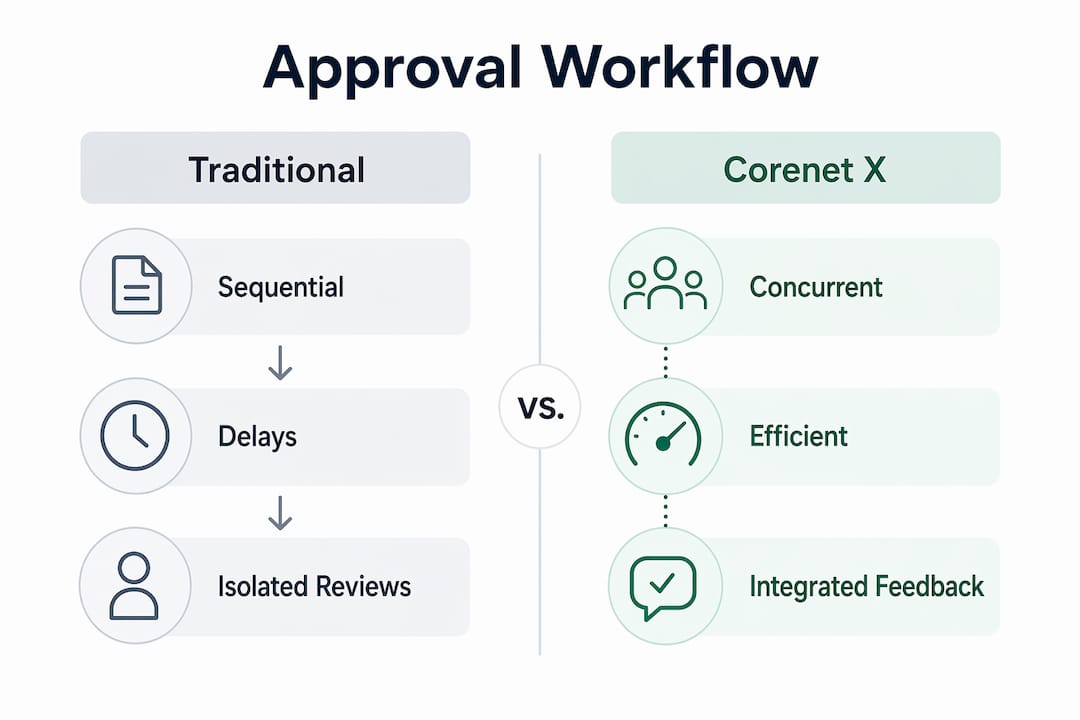
Industry stakeholders confirm that digital workflows like Corenet X have transformed regulatory interactions, enabling developers to make confident design decisions earlier in the project lifecycle. For QPs, this means environmental compliance decisions can no longer be deferred to later design stages. NEA’s requirements must be embedded from the concept stage onward.
| Approval aspect | Traditional process | Corenet X process |
|---|---|---|
| Agency review sequence | Sequential, one agency at a time | Concurrent, all agencies simultaneously |
| Feedback consolidation | Separate responses per agency | Single coordinated response |
| Approval timeline | Longer due to sequential loops | Approximately 20% faster |
| Plan deviation handling | Informal resubmission | Formal amended plan lodgement required |
| Developer certainty | Low until final clearance | Higher, earlier in the process |
Pro Tip: Submit plans through the construction approval workflow with all NEA checklists pre-verified. Incomplete environmental data is the most common reason for Corenet X plan returns.
What legal obligations does NEA impose on building professionals?
The Environmental Protection and Management (Exempted Controlled Works) Regulations 2023 defines the legal framework governing NEA’s role in construction compliance. Under this framework, environmental plans must be lodged with the NEA Director-General before works commence. The plan preparer must sign a mandatory declaration confirming that the lodged plans meet all applicable environmental standards.
The appointed person under the Building Control Act carries the operational compliance duty. Appointed persons are legally responsible for ensuring building works strictly follow lodged environmental plans throughout construction. This is not a delegable duty. The appointed person cannot transfer liability to a subcontractor or site supervisor.
Legal commentators note that administrative streamlining through the 2023 regulations does not reduce enforcement intensity. Compliance duties on appointed professionals remain strict. The streamlining applies to submission procedures, not to the substance of what must be complied with.
Change management is a critical compliance obligation that many professionals underestimate. The regulations require:
- Lodge amended plans with NEA before any deviation from the approved environmental plans occurs.
- Obtain written confirmation of the amended lodgement before proceeding with the changed works.
- Maintain a complete record of all lodged plans, amendments, and declarations on site.
- Ensure all site personnel are briefed on the current lodged plans, not earlier versions.
- Review contract documents to confirm that environmental compliance obligations are clearly allocated between the developer, main contractor, and appointed person.
Enforcement mechanisms include stop-work orders, financial penalties, and prosecution under the Environmental Protection and Management Act. Contract drafting must reflect these obligations explicitly. Developers who fail to allocate environmental compliance duties in their construction contracts expose themselves to disputes when deviations occur.
How do NEA’s environmental requirements shape project design?
NEA’s environmental constraints enter the design process earlier than most developers expect. An Environmental Information application is mandatory for projects near MRT lines and road tunnels, and strongly recommended for any major development. The EI application identifies site-specific constraints including building height limits, health buffer zones, and safety setback requirements before design work advances.
Failure to consider these constraints early can cause costly project redesigns at advanced stages. A development that reaches schematic design before discovering a 50-meter health buffer from an industrial facility may need to reduce gross floor area, relocate building entrances, or revise the entire site layout. That is not a minor adjustment. It is a fundamental redesign with direct cost and schedule consequences.
The table below summarizes common NEA environmental constraints and their typical design implications:
| Environmental constraint | Design implication |
|---|---|
| Health and safety buffer zones | Restricts building placement and usable site area |
| Building height limits near MRT infrastructure | Caps maximum floor count and gross floor area |
| Noise pollution thresholds | Requires facade treatment, window specifications, or layout changes |
| Air quality requirements | Influences mechanical ventilation design and exhaust placement |
| Sanitation and waste provisions | Determines refuse room sizing, grease trap placement, and toilet ratios |
Early EI applications also support urban planning and sustainability goals. NEA’s environmental requirements align with Singapore’s broader Green Plan 2030 objectives, meaning projects that address constraints proactively tend to perform better against sustainability benchmarks. Architects who treat NEA’s requirements as design inputs rather than compliance hurdles consistently produce more buildable and approvable schemes. For a structured overview of how building codes and regulations interact with environmental requirements, that context is worth reviewing before the EI application stage.
Key Takeaways
NEA’s role in building approvals is a legally binding compliance function that QPs and appointed persons must address from the earliest design stage, not at submission.
| Point | Details |
|---|---|
| NEA enforces two compliance tracks | Pollution Control and Environmental Health standards apply to every building approval in Singapore. |
| Pre-submission checklist is mandatory | QPs must verify plans against NEA’s general and specific checklists before lodging with any authority. |
| Corenet X enables concurrent review | Seven agencies, including NEA, review plans simultaneously, cutting approval time by approximately 20%. |
| Appointed persons carry legal duty | Under the 2023 Regulations and Building Control Act, appointed persons are accountable for all environmental plan deviations. |
| Early EI applications prevent redesigns | Identifying health buffers, height limits, and safety setbacks before schematic design avoids costly late-stage changes. |
Why early engagement with NEA is the most underused advantage in Singapore construction
From working across Singapore construction and infrastructure projects, the pattern is consistent. Teams that engage NEA’s Development Control Department before finalizing their design brief avoid the majority of compliance problems. Teams that treat NEA as a submission-stage checkpoint spend weeks resolving issues that a single pre-submission consultation would have surfaced in an afternoon.
The 2023 Exempted Controlled Works Regulations shifted the compliance model in a way that many professionals have not fully absorbed. Lodgement replaced formal approval for certain works, which sounds like a simplification. The accountability, however, moved entirely onto the appointed person. That is a significant shift in risk allocation. I have seen contracts that still reflect the old model, where environmental compliance was treated as a shared or ambiguous duty. Under the current framework, that ambiguity is a liability.
The Corenet X integration is genuinely transformative for project certainty. Concurrent agency review means NEA’s feedback arrives alongside BCA’s and URA’s, not weeks later. Developers who understand this can make design decisions with real regulatory confidence at the concept stage. Those who do not often discover NEA constraints after other agency approvals are already locked in, which creates a coordination problem with no clean solution.
The QP’s role in this ecosystem carries more weight than the title suggests. Verifying plans against NEA’s checklists is not a box-ticking exercise. It is the primary defense against rejection, enforcement action, and project delay. QPs who treat that verification as a genuine technical review, rather than an administrative formality, consistently produce cleaner submissions. For professionals managing NEA submission procedures directly, the pre-submission consultation system is the most underused resource available.
— Aman
How Aectechnicalsg supports NEA compliance and building approvals
Construction professionals and developers navigating NEA’s regulatory requirements need more than a checklist. They need consultancy that understands how environmental compliance integrates with structural, mechanical, and architectural design decisions across the full approval workflow.

Aectechnicalsg provides technical advisory services covering NEA building plan submissions, Environmental Information applications, and coordinated authority submissions across BCA, URA, SCDF, and NEA. The team supports QPs in pre-submission checklist verification, plan preparation, and change management under the 2023 Regulations. For developers managing complex projects with multiple environmental constraints, Aectechnicalsg’s engineering consultancy services cover the full scope from EI application through to construction compliance. Explore the construction compliance checklist to assess where your project currently stands.
FAQ
What does NEA review in the building approval process?
NEA reviews building plans for compliance with Pollution Control and Environmental Health standards, including sanitation provisions, waste management, air and water quality, and noise thresholds. Qualified Persons must verify plans against NEA’s checklists before submission.
When is an Environmental Information application required?
An EI application is mandatory for projects near MRT lines and road tunnels, and broadly recommended for major developments to identify building height limits, health buffers, and safety setback constraints before design is finalized.
Who is legally responsible for NEA environmental compliance on site?
The appointed person under the Building Control Act bears the legal duty to ensure all building works follow the lodged environmental plans. Any deviation requires a fresh plan lodgement with NEA before the changed works proceed.
How does Corenet X affect NEA’s role in building approvals?
Corenet X enables NEA and six other agencies to review building plans concurrently, issuing consolidated feedback. This parallel review process reduces approval timelines by approximately 20% compared to sequential agency reviews.
What happens if building works deviate from lodged NEA plans?
Under the Environmental Protection and Management (Exempted Controlled Works) Regulations 2023, amended plans must be lodged with NEA before any deviation occurs. Proceeding without lodgement exposes the appointed person to enforcement action, including stop-work orders and penalties.