
A building permit is the official government authorization required before any construction, structural alteration, or renovation work begins legally in Singapore. Without it, developers and contractors face fines, forced demolition orders, and disqualification from future public sector tenders. This guide to Singapore building permits covers every stage of the process: permit categories, application procedures, safety compliance under 2026 regulations, and the critical differences between HDB and private property requirements. The Building and Construction Authority (BCA) and the Housing and Development Board (HDB) are the two primary issuing authorities, and understanding which governs your project determines everything that follows.
What types of building permits does singapore require?
Singapore’s permit framework, established under the Building Control Regulations 2003, divides construction works into categories based on structural significance and project scope. Most permanent and structural works require formal approval. Minor repairs and cosmetic works may qualify for exemptions, but the threshold is narrow and should never be assumed without verification.
The main permit categories are:
- Residential building permits: Required for new residential construction, additions and alterations, and structural modifications to landed properties. BCA is the approving authority.
- HDB renovation permits: Mandatory for any renovation work within HDB flats, including hacking, installation of new fixtures, and electrical modifications. HDB administers these separately from BCA.
- Commercial building permits: Apply to offices, retail units, industrial facilities, and mixed-use developments. BCA oversees approval, often in coordination with URA for planning compliance.
- Structural and specialized permits: Cover geotechnical works, deep excavations, and mechanical and electrical (M&E) installations. Structural and architectural plans must be submitted to BCA before construction begins.
- Environmental sustainability compliance: Updated regulations effective 2025 impose energy audit and reporting requirements on existing buildings undergoing significant renovation, with gross floor area and building use determining the specific obligations.
The Singapore construction guidelines also require coordination with other agencies. Projects near MRT lines involve LTA. Works affecting drainage fall under PUB. Fire safety compliance is governed by SCDF. Developers working on JTC-managed industrial estates must additionally satisfy JTC’s own approval requirements.
Pro Tip: Confirm your project’s regulatory scope with a qualified Professional Engineer before submitting any application. Misclassifying a structural alteration as a cosmetic renovation is one of the most common and costly errors in the permit process.
How to submit a building permit application in singapore
The building permit application process follows a defined sequence. Deviating from the order, submitting incomplete documents, or engaging an unlicensed contractor will result in rejection and added delays.
- Define the scope of works. Prepare a detailed description of all proposed works, including structural changes, M&E modifications, and architectural alterations. Ambiguous scope is the leading cause of revision requests from BCA.
- Engage a licensed contractor. For HDB projects, the contractor must appear in HDB’s Directory of Renovation Contractors (DRC). For private and commercial projects, the contractor must hold the appropriate BCA registration grade for the project value.
- Prepare the required documents. Standard requirements include completed application forms, site plans, construction drawings, scope of work descriptions, proof of ownership or tenancy, and the contractor’s license details. For structural works, a qualified Professional Engineer must certify the drawings.
- Submit electronically. HDB renovation permits are submitted via the APEX system through My HDBPage. BCA submissions for private and commercial projects use BCA’s CORENET X platform. Applications are not processed if work has already started, making pre-submission timing critical.
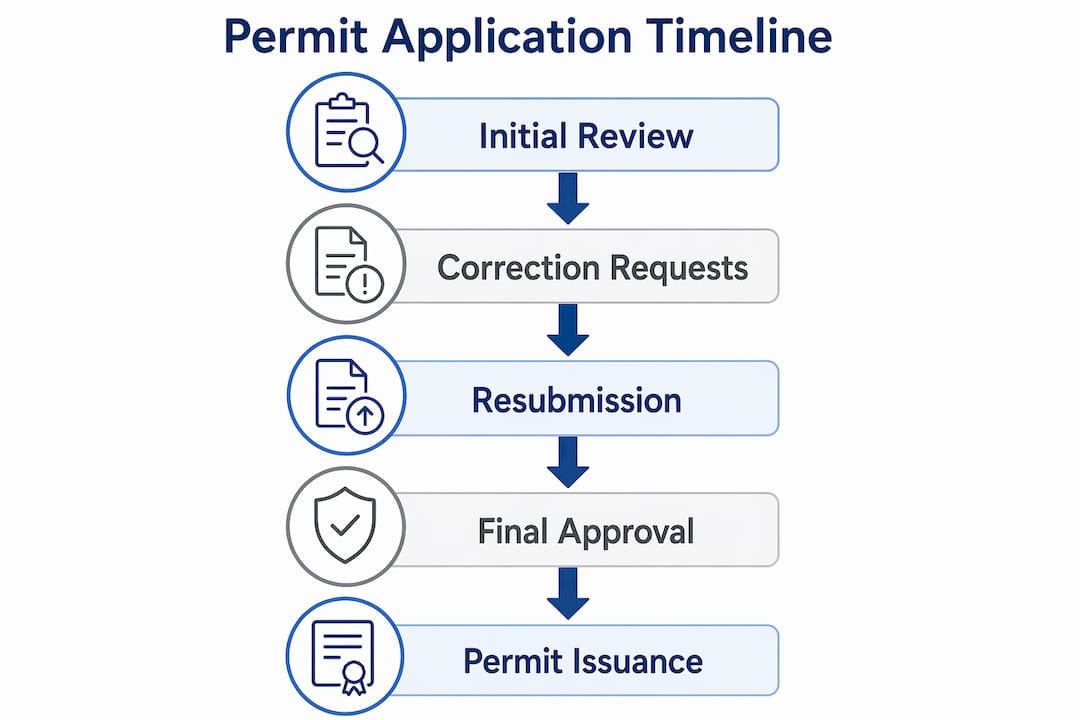
- Await approval and display the permit. Typical permit approval timelines range from 2 to 30 business days depending on project complexity. Revisions add 5–15 business days. Final approval takes 1–3 days. Once approved, a Notice of Renovation must be displayed outside the unit during all works.
| Stage | Typical Timeline |
|---|---|
| Initial application review | 2–30 business days |
| Revision processing | 5–15 business days |
| Final approval issuance | 1–3 business days |
| HDB APEX approval (renovation) | Up to 3 weeks |
For developers seeking to reduce approval time, the structural design submission process is the single greatest variable. Drawings that are complete, code-compliant, and certified on first submission consistently achieve faster approvals.
What safety and compliance requirements apply to permitted works?
Safety compliance is not a separate concern from the permit process. It is embedded within it. Since april 1, 2024, public sector construction projects valued at S$1 million or above must meet Workplace Safety and Health (WSH) requirements as a condition of contract, with safety criteria written directly into tender and contract documents. This represents a structural shift in how Singapore’s Ministry of Manpower (MOM) integrates safety into procurement.
The key compliance obligations under the current Singapore building regulations guide are:
- Mature WSH technology: Projects valued at S$3 million or above must deploy approved WSH technology solutions, such as sensor-based monitoring or digital safety management systems.
- WSH Bonus Scheme: Projects at S$50 million or above are eligible for safety performance bonuses, creating a financial incentive for contractors who exceed baseline safety standards.
- Periodic WSH reporting: All contractors on qualifying projects must submit regular safety performance reports and conduct documented risk assessments throughout the project lifecycle.
- Safety training obligations: Site supervisors and workers must hold current safety certifications relevant to their roles.
The Safety Disqualification (SDQ) Framework temporarily disqualifies contractors with poor safety records from public sector tenders where the project value exceeds S$90,000. This applies to both main contractors and subcontractors, making safety performance a direct commercial risk.
Developers should verify contractor SDQ status before engagement. A contractor disqualified mid-project creates permit complications, contract disputes, and project delays that are difficult and expensive to resolve. The construction compliance checklist published by Aectechnicalsg provides a structured method for verifying contractor eligibility before works commence.
Common challenges when obtaining building permits in singapore
The requirements for building permits are clear on paper. The difficulties arise in execution. These are the most frequent problems developers and contractors encounter.
Incomplete documentation is the primary cause of application rejection. Missing contractor license details, unsigned drawings, or absent proof of ownership each trigger a full revision cycle. Every document must be verified against the authority’s checklist before submission.
Unauthorized works carry serious consequences. For HDB flats, unauthorized renovation work can result in fines up to S$5,000. For private and commercial properties, BCA can issue stop-work orders and require full reinstatement at the owner’s cost. The financial exposure from unauthorized works consistently exceeds the cost of obtaining the permit correctly.
Contractor credential failures are more common than developers expect. Contractors who are not listed in the relevant authority’s approved registry, or whose registration has lapsed, invalidate the application entirely. Verifying credentials before signing any contract is non-negotiable.
Permit expiry and variation requests create additional risk. Permits are issued with defined validity periods. Works that extend beyond the permit period or deviate from the approved scope require formal variation applications. Failing to submit a variation before proceeding with changed works constitutes unauthorized construction.
Pro Tip: Assign a dedicated compliance coordinator on any project above S$500,000. This person’s sole responsibility is tracking permit validity dates, variation submissions, and authority correspondence. The cost of this role is negligible compared to the cost of a stop-work order.
For a complete overview of how permit approvals fit within the broader project lifecycle, the construction approval workflow guide from Aectechnicalsg maps each stage from planning to final inspection.
HDB renovation permits vs. private property permits: key differences
The procedures for how to obtain building permits in Singapore differ significantly between HDB flats and private properties. Understanding these differences prevents costly procedural errors.
| Factor | HDB Renovation Permit | Private Property Permit |
|---|---|---|
| Issuing authority | HDB | BCA |
| Submission platform | APEX via My HDBPage | CORENET X |
| Contractor requirement | Must be on HDB DRC | Must hold BCA registration |
| Typical approval time | Up to 3 weeks | 2–30 business days |
| Permit display requirement | Notice of Renovation outside flat | Site permit board at works location |
| Prohibited works | Structural hacking, wet areas, gas | Varies by property type and zone |
| Non-compliance penalty | Fines up to S$5,000 | Stop-work orders, reinstatement costs |
HDB’s APEX system requires that applications be submitted electronically before any work begins, with no exceptions. HDB also maintains a list of prohibited works within its estates, including removal of structural walls, modifications to wet areas beyond defined limits, and any works affecting the building’s external facade. Private property permits under BCA allow more flexibility in scope but require Professional Engineer certification for all structural works.
The 2025 energy sustainability amendments add a further layer of compliance for renovation and retrofit projects on existing buildings above specified gross floor area thresholds. Developers planning major retrofits must now factor energy audit requirements into their permit preparation timeline.
Key takeaways
Singapore’s building permit process is legally mandatory, authority-specific, and directly tied to contractor safety performance, making early preparation and credential verification the most effective risk controls available to developers.
| Point | Details |
|---|---|
| Permits are mandatory before works begin | Submitting after work starts results in automatic rejection and potential fines. |
| Authority depends on property type | BCA governs private and commercial works; HDB governs all HDB flat renovations via APEX. |
| Safety compliance affects tender eligibility | Contractors with poor WSH records face SDQ disqualification from public sector projects above S$90,000. |
| Documentation completeness drives approval speed | Incomplete submissions trigger revision cycles adding 5–15 business days to the timeline. |
| Unauthorized works carry compounding costs | Fines, stop-work orders, and reinstatement requirements consistently exceed the cost of proper permitting. |
What i’ve learned about permit timelines that most guides won’t tell you
Most articles on Singapore’s building permit process focus on what documents to prepare. That is necessary but insufficient. The real variable in approval speed is the quality of the Professional Engineer’s drawings, not the completeness of the administrative paperwork.
In practice, applications that arrive at BCA or HDB with drawings that are fully code-compliant, clearly annotated, and certified without qualification move through review faster than applications with technically complete paperwork but ambiguous structural details. Reviewers flag ambiguity. Every flag adds time.
The second underappreciated factor is contractor selection. Developers often select contractors on price, then discover mid-application that the contractor’s BCA registration grade does not cover the project value, or that their SDQ status has changed since the last check. Both scenarios require restarting the application with a new contractor. The cost in time is rarely recoverable on a fixed project schedule.
The third factor is the evolving regulatory environment. The 2025 energy sustainability amendments and the 2024 WSH requirements for public sector projects have added compliance layers that were not present two years ago. Developers who rely on permit checklists from 2023 or earlier are working from an incomplete picture. Staying current with Singapore building regulations is not optional for professionals operating at scale.
My consistent recommendation is to engage a qualified engineering consultancy at the pre-design stage, not after drawings are complete. The cost of early expert input is a fraction of the cost of a rejected application or a stop-work order.
— Aman
How Aectechnicalsg supports permit approvals for singapore developers
Navigating Singapore’s permit requirements demands more than administrative competence. It requires technical precision at every stage, from structural design certification to WSH compliance documentation.
Aectechnicalsg provides design for safety consultancy services specifically structured to meet BCA and MOM requirements for Singapore construction projects. The team supports developers through structural and geotechnical engineering submissions, authority coordination with BCA, URA, SCDF, JTC, LTA, PUB, and NEA, and full compliance verification against 2026 regulatory standards. For developers who need to reduce approval risk and accelerate project timelines, Aectechnicalsg offers tailored advisory engagements. Contact the team directly to discuss your project’s permit and compliance requirements.
FAQ
What is a building permit in singapore?
A building permit is official authorization from BCA or HDB required before commencing any construction, structural alteration, or renovation work in Singapore. It confirms that proposed works comply with the Building Control Act, zoning regulations, and applicable safety codes.
How long does a building permit take to approve in singapore?
Approval timelines range from 2 to 30 business days for standard applications, with revisions adding 5–15 business days. HDB renovation permits via APEX typically take up to three weeks from submission to approval.
What happens if you renovate without a permit in singapore?
Unauthorized renovation in HDB flats can result in fines up to S$5,000. For private and commercial properties, BCA can issue stop-work orders and require full reinstatement of unauthorized works at the owner’s expense.
Do all renovation works in singapore require a permit?
Not all works require a permit. The Building Control Regulations 2003 exempt minor repairs and insignificant works from formal approval. However, any structural, M&E, or permanent alteration work requires a permit, and the exemption threshold is narrow.
Who can submit a building permit application in singapore?
For HDB renovation permits, only contractors listed in HDB’s Directory of Renovation Contractors may submit applications via APEX. For BCA-governed works, a registered contractor holding the appropriate BCA grade must submit or co-sign the application alongside the appointed Professional Engineer.