
Civil tenders in Singapore are scored on a mix of Critical pass/fail checks and weighted quality-and-price criteria, and the price weighting for civil engineering works under BCA’s Price Quality Method commonly runs from 50% to 70%, with the remaining 30% to 50% allocated to quality.
Evaluators score against a published list of criteria set out in the tender documents. Skip any category on that list and you leave points on the table before a single dollar figure is compared.
The categories that recur across civil tenders are:
- Eligibility and qualification (licenses, registrations, financial standing)
- Technical merit (track record, methodology, key personnel)
- Price and fee structure
- Safety performance record
- Environmental and sustainability practice
- Programme and delivery timelines
- Quality assurance and workmanship systems
- Subcontracting and supply-chain management
- Commercial and contractual terms
Quick reference: typical weight ranges
Building works (PQM, CW01): price 40–60%, quality 40–60%. Consultancy tenders (QFM): quality 70–90%, fee 10–30%. These ranges only apply to public works, so a civil contractor bidding on a private developer’s project should not assume the same math automatically holds. But when a government agency runs the tender, these bands are your starting map for where to concentrate bid-writing effort.
Key Takeaways
Civil tenders reward bidders who treat quality documentation with the same rigor as pricing, because under PQM, quality can determine up to half the final combined score.
| Point | Details |
|---|---|
| Check Critical Criteria first | Build a pass/fail checklist from the Conditions of Tender before drafting any technical content. |
| Prioritize by weighting | Spend the most bid-writing effort on whichever criteria carry the highest published percentage, often price and technical merit. |
| Attend the briefing | Tender briefings and site show-rounds are frequently the only place agencies clarify ambiguous scoring terms. |
| Use the sample matrix | Copy the evaluation matrix template into a spreadsheet to model price and quality trade-offs before submitting. |
| Get technical documents reviewed | Aectechnicalsg’s authority submission and PE endorsement services help ensure evidence for technical merit and compliance criteria holds up under evaluation. |
Table of Contents
- What Do Procurement Rules Require Tender Documents to Disclose?
- Critical Criteria vs. Weighted Criteria: What Is the Difference?
- What Are the Detailed Evaluation Criteria for Civil Tenders?
- How Is Scoring Done and What Does a PQM Calculation Look Like?
- How Do You Prepare a Compliant, High-Scoring Bid?
- What Common Mistakes Cause Low Scores or Disqualification?
- Sample Evaluation Matrix for Civil Tender Bidders
- An Editorial Take on Preparing Civil Tenders
- How Aectechnicalsg Helps You Prepare a Stronger Civil Tender Submission
- Frequently Asked Questions
- Sources
What Do Procurement Rules Require Tender Documents to Disclose?
Singapore’s Government Procurement Regulations require contracting authorities to set out all evaluation criteria and, except where price is the sole factor, the relative importance of each criterion directly in the tender documentation. That is not a courtesy. It is a statutory obligation, and it means every serious bidder should treat the absence of clear weightings in a tender pack as a red flag worth raising with the procuring agency before submission.
The regulations go further than a vague mandate to “be transparent.” The Government Procurement Regulations (RG2) explicitly enumerate what evaluation criteria can include: price and other cost factors, quality, technical merit, environmental characteristics, and terms of delivery. If a tender scores you on something outside that list, or fails to disclose how much a listed criterion is worth, you have grounds to seek clarification.
GeBIZ, the government’s electronic procurement portal, reinforces this at the operational level. The GeBIZ Government Procurement Guide for Suppliers states plainly that once a tender is published, agencies do not change evaluation criteria during the evaluation window, and requirements are split into Critical and non-critical categories from the outset.
Agencies publish procurement requirements and evaluation criteria on GeBIZ, and evaluation criteria are not altered once evaluation begins. Suppliers are expected to verify Critical Criteria and submission requirements before the closing date, not after.
Before you draft a single paragraph of your technical proposal, pull these four documents from the tender package and read them in this order:
- The notice of procurement (states the criteria categories and, usually, the evaluation method)
- The Conditions of Tender (contains detailed submission and disqualification rules)
- The appendix on evaluation criteria (where weightings are itemized, similar in structure to JTC’s MP9 One-North tender appendix)
- Any addenda issued after the tender briefing, since these often clarify ambiguous terms
Critical Criteria vs. Weighted Criteria: What Is the Difference?
Critical Criteria are pass/fail gates. Miss one and your bid is out of contention regardless of how strong your pricing or technical narrative is elsewhere. Weighted criteria are scored on a sliding scale, and it is the combined weighted score, not price alone, that determines the winner. This distinction is the single most consequential thing a bid team can misunderstand, because it changes what “competitive” actually means.
Typical Critical Criteria in a civil tender include:
- Valid contractor license or registration (for example, BCA contractor registration in the relevant workhead and grade)
- Mandatory insurance and bonding certificates submitted in the required form
- Submission of all specified documents by the deadline, in the specified format
- Compliance with eligibility conditions such as minimum years of experience or minimum project value track record
- Signed declarations (conflict of interest, non-collusion, and similar statutory forms)
Weighted criteria, by contrast, feed into a combined score. This is where the value-for-money principle that MOF’s procurement overview describes comes into play: the objective is not the lowest price, but the best overall combination of quality, risk, timeliness, reliability, and total cost of ownership.
Pro Tip: Before you write a single line of the technical proposal, build a one-page Critical Criteria checklist straight from the Conditions of Tender. Tick off every mandatory document, certificate, and declaration against your draft submission 48 hours before the deadline. A missing signature or an expired certificate is the most common, and most avoidable, reason a technically excellent bid never gets scored at all.
What Are the Detailed Evaluation Criteria for Civil Tenders?
Civil tender evaluation criteria break down into nine categories that most agencies use in some combination, though the exact labels and weightings shift by agency and project scope. Each category has its own sub-items, and each sub-item needs a specific piece of evidence attached to it. A generic “we have extensive experience” paragraph scores nothing. A named project with a completion date, a contract value, and a client reference scores.
| Category | Typical sub-items scored | Evidence to attach |
|---|---|---|
| Eligibility/qualification | License grade, financial standing, years in operation | Registration certificates, audited financials |
| Technical merit | Relevant track record, proposed methodology, key personnel | Past project summaries with measurable outcomes, staff CVs with named roles |
| Price/fee | Lump sum or schedule of rates, pricing completeness | Fully priced bill of quantities, cost breakdown |
| Safety performance | Accident/incident history, safety management system | MOM demerit point record, safety plan, WSH certifications |
| Environmental/sustainability | Waste management, carbon or energy measures | Sustainability plan, green certification where applicable |
| Programme and timelines | Realistic sequencing, resource loading, milestone logic | Gantt chart, resourcing schedule, critical path notes |
| Quality assurance/workmanship | QA/QC system, inspection and testing plans | ISO certification, QA manual, sample inspection checklists |
| Subcontracting/supply chain | Subcontractor competence, supply continuity | Subcontractor list with credentials, material sourcing plan |
| Commercial/contractual terms | Compliance with contract conditions, exceptions taken | Marked-up conditions of contract, exception schedule |
Safety performance deserves particular attention because it is graded against an external, publicly tracked record rather than a self-reported narrative. The Ministry of Manpower’s demerit point system means an evaluator can check your firm’s safety history independently of anything you write in the proposal, so a mismatch between your claimed safety culture and your actual demerit record is easy for a reviewer to catch. Method statements built around genuine design for safety principles score better than generic safety policy boilerplate, because evaluators are looking for evidence the methodology was actually thought through for this specific site.
How Is Scoring Done and What Does a PQM Calculation Look Like?
Weighted scoring works by normalizing each bidder’s price against the lowest compliant price submitted, then combining that normalized price score with a separately assessed quality score using the tender’s published weightings. The bidder with the highest combined score wins the award, which is why a well-documented quality submission can beat a cheaper but thinner one.
Here is the mechanic in plain steps:
- Each bid’s price is normalized, typically by dividing the lowest compliant price by the bid’s own price and multiplying by 100, giving the lowest bidder a perfect price score.
- A technical panel independently scores each bid’s quality submission against the published rubric, usually out of 100.
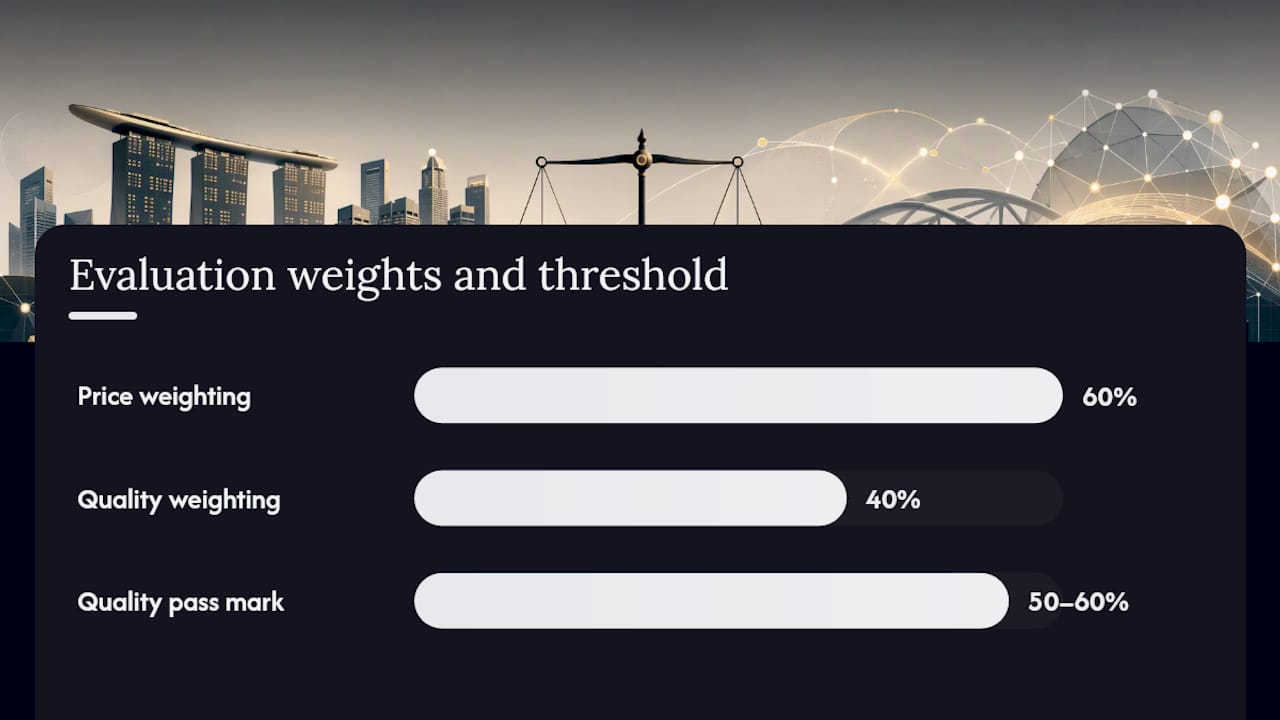
- Each score is multiplied by its published weighting (for example, price 60%, quality 40% for a civil works tender).
- The two weighted figures are summed into a combined score, and the highest combined score wins the award.
A worked example makes this concrete. Assume a civil tender uses a 60/40 price-quality split, consistent with the middle of BCA’s civil PQM band.
Notice that Bidder A submitted the cheapest compliant price and still finished last among the top three. That is the value-for-money principle in action, and it is exactly the outcome MOF’s procurement guidance is designed to produce: agencies are told explicitly not to default to the lowest price.
Some agencies layer in a minimum quality pass mark, often somewhere around 50 to 60 out of 100 on the technical score, below which a bid is excluded from price comparison entirely even if it is not a Critical Criteria failure. Check the tender’s evaluation appendix for language like “minimum acceptable score” or “quality threshold,” because this detail changes how much margin you have for a weak section elsewhere in the proposal.
How Do You Prepare a Compliant, High-Scoring Bid?
Treat the evaluation matrix as your outline, not your afterthought. Work through this sequence in order, and resist the temptation to start drafting before step three is done.
- Confirm every Critical Criterion and build your pass/fail checklist first, before writing any narrative content.
- Attend the tender briefing or site show-round in person, because this is often the only venue where agencies clarify ambiguous terms like “relevant track record” or “comparable scale.”
- Map the published evaluation matrix line by line, assigning a named internal owner to each scored item.
- Assemble the evidence package: CVs, certifications, past project records, method statements, and QA procedures, each tagged to its specific criterion.
- Cross-reference your submission against the matrix one final time, then quality-check formatting and page limits before you submit.
Formatting matters more than most bid teams assume. Label every document so it maps directly to the evaluation appendix: “Section 3.2 — Method Statement → File: 03_MethodStatement.pdf” is far easier for a reviewer to score under deadline pressure than a single 200-page combined PDF with no navigation. A one-page cross-reference table linking each criterion to its supporting document number can be the difference between a rushed skim and a fair read.
Pro Tip: Write your quality section like a technical design document, not a marketing brochure. Evaluators award points for demonstrable expertise, exact personnel roles, measurable past outcomes, and named certifications, not adjectives. Replace “our team has extensive geotechnical experience” with the actual project name, contract value, ground conditions encountered, and the specific staff member who led it.
If a discipline within your scope sits outside your core strength, whether that is M&E submissions or structural documentation, get that section reviewed by someone who has prepared structural submissions before, since a thin section in a high-weight category drags the whole combined score down disproportionately.
What Common Mistakes Cause Low Scores or Disqualification?
Most disqualifications and weak technical scores trace back to a small set of repeated, avoidable errors. Fix these before submission and you eliminate the majority of self-inflicted damage.
- Missing mandatory documents. A missing insurance certificate or an unsigned declaration is a Critical Criteria failure, not a minor omission. Remedy: run the pre-submission checklist against the Conditions of Tender line by line, not from memory.
- Mismatched or generic CVs. Submitting a CV that does not name the exact project role proposed for this specific tender is one of the fastest ways to lose technical merit points. Remedy: tailor each CV to the named role and cross-check the person is actually available for the project period.
- Ignoring tender briefing clarifications. Agencies frequently clarify how they interpret ambiguous terms only at the briefing or site show-round, and a bid that misses that clarification often scores lower on subjective criteria without knowing why. Remedy: send a team member to every briefing and circulate written notes internally within 24 hours.
- Non-compliance with a Critical Criterion buried in the fine print. A qualification requirement stated once in a footnote still counts. Remedy: have a second reviewer read the Conditions of Tender independently and compare notes.
- Vague method statements. Statements that describe generic best practice rather than a site-specific methodology score poorly on technical merit. Remedy: name the actual sequence, equipment, and resourcing plan for this project’s constraints.
- Unsupported past-performance claims. Claiming “over 50 completed projects” without naming any of them gives an evaluator nothing to verify. Remedy: attach completion certificates and client references for at least the claims that matter most to the scored criteria.
Reviewers on the procurement side also flag their own red flags worth knowing about: ambiguous pricing schedules where line items do not sum to the stated total, and subcontractor declarations that are inconsistent between the technical and commercial sections of the same bid. Both trigger deeper scrutiny and slow down, or sink, an otherwise strong submission.
Sample Evaluation Matrix for Civil Tender Bidders
A usable scoring template needs four columns at minimum: the criterion, its maximum points, its weighting, and a place to enter your own self-assessed score before submission. Here is a simplified version built around a hypothetical 60/40 civil works split.
To turn this into a working spreadsheet, set up one row per criterion with columns for max points, weighting percentage, your raw score, and a formula multiplying raw score by weighting to get the weighted contribution. That single exercise usually reveals whether your bid effort is better spent tightening the price or strengthening a specific technical section.
- Keep one tab per bid scenario so you can compare combined scores side by side.
- Lock the weighting cells so nobody accidentally overwrites the published percentages.
- Add a notes column next to each score to record exactly which document supports it.
An Editorial Take on Preparing Civil Tenders
Most bid teams spend the majority of their preparation time on the price schedule and treat the quality section as something to fill in afterward. That allocation is backward for civil works, where quality can carry up to half the score. The teams that consistently win are not necessarily the ones with the lowest price. They are the ones that put a senior engineer, not a proposals coordinator, in charge of translating technical capability into a scored document.
The honest advice here is to know your own limits before the tender briefing, not after the submission deadline. If your firm’s core strength is structural work but the tender carries meaningful weight on sustainability or complex geotechnical risk, bring in a specialist for that section rather than stretching your in-house team thin across a discipline it does not own. A quality score built on borrowed expertise, properly credited and documented, beats a quality score built on confident guesswork every time.
The other habit worth adopting is treating every claim as something an evaluator might actually check. Completion certificates, named client contacts, and dated project records carry weight precisely because they are verifiable. A glossy paragraph about “decades of combined experience” carries none, because there is nothing behind it a reviewer can confirm in the time they have to score your bid.
How Aectechnicalsg Helps You Prepare a Stronger Civil Tender Submission
Aectechnicalsg’s advantage for civil tender bidders is direct: the same engineers who prepare structural, geotechnical, and M&E authority submissions for BCA, SCDF, and LTA also build the technical evidence that tender evaluators are scoring, so the documents you submit for regulatory approval and the documents you submit for tender evaluation come from one coordinated source instead of being assembled piecemeal at deadline.

That overlap matters because a method statement, a QA/QC plan, or a PE-endorsed technical drawing is not marketing copy. It is evidence, and it needs to hold up to the same scrutiny an authority reviewer or a tender evaluation panel applies. Aectechnicalsg’s PE endorsement and authority submission services cover the exact categories that carry weight in a civil tender’s technical merit and quality assurance scoring, from structural and geotechnical documentation to regulatory compliance packaging that keeps your Critical Criteria intact. If your bid team is preparing a civil tender submission and wants a second set of engineering eyes on your technical evidence before the deadline, explore engineering consultancy services and request a tender readiness review before you finalize your submission.
Frequently Asked Questions
What is the typical price weighting in the Singapore civil tender evaluation criteria list under PQM?
For civil engineering works (CW02) with an estimated cost of S$3 million or more, BCA’s PQM framework typically sets price weighting between 50% and 70%, with quality making up the remainder.
What happens if a bid fails a Critical Criterion?
The bid is removed from further consideration regardless of its price or quality score elsewhere. GeBIZ’s supplier guidance confirms agencies treat Critical Criteria as non-negotiable pass/fail gates, separate from weighted scoring.
Can a higher-priced civil tender bid still win?
Yes. Since agencies score on a combined weighted basis rather than lowest price alone, a bid with a stronger technical, safety, or quality score can outscore a cheaper bid, consistent with the value-for-money objective MOF’s procurement guidance describes.
Where can bidders find the exact evaluation criteria and weightings for a specific tender?
They are required to appear in the tender documentation itself, typically in the notice of procurement and a dedicated evaluation criteria appendix, as required under the Government Procurement Regulations and published through GeBIZ.
How is quality assurance scored differently from technical merit in a civil tender?
Technical merit typically scores track record, methodology, and personnel, while quality assurance and workmanship scoring focuses on your QA/QC system, inspection and testing plans, and relevant certifications like ISO standards.
This article is general information, not a substitute for advice from a qualified lawyer. Consult a qualified legal professional about your own circumstances before acting on anything here.
Sources
Bid teams should keep these primary sources bookmarked and reread them before every new civil tender, since weightings and disclosure clauses can shift between projects even within the same agency.
- Price Quality Method (PQM) Framework | Building and Construction Authority
- Government Procurement Guide for Suppliers | GeBIZ
- Government procurement overview | Ministry of Finance