
To renew a practising certificate, a registered professional engineer must accumulate a minimum of 40 Professional Development Units (PDUs) during the qualifying period, with a prescribed minimum portion drawn from structured activities as set out in the Professional Engineers Rules (PEA1991-R1). This is a statutory precondition under the PE Act, not a discretionary best practice. Compliance is binary: either the PDU threshold is met before submission, or the practising certificate cannot be issued.
Two thresholds apply:
- Standard renewal: 40 PDUs per qualifying period, including the minimum number of structured PDUs specified in the Professional Engineers Rules.
- Lapsed certificate (3+ continuous years without a practising certificate): a higher number of PDUs with correspondingly higher structured minimums, as codified in the Professional Engineers Rules.
The Professional Engineers Board (PEB) publishes the list of qualifying activities and the PDU value assigned to each. Verify your total against that list before submitting.
Key Takeaways
Meeting the PDU threshold under the Professional Engineers Rules is a statutory precondition for practising certificate renewal, not a discretionary requirement, and structured activities must meet a prescribed minimum regardless of total PDU count.
| Point | Details |
|---|---|
| Standard PDU requirement | 40 PDUs per qualifying period, with a structured minimum per the Professional Engineers Rules. |
| Lapsed certificate threshold | a higher number of PDUs required if the practising certificate has not been held for 3 or more continuous years. |
| E-training cap | Online e-training with verifiable assessment is structured but limited to 10 PDUs per renewal cycle. |
| Organiser upload deadline | Course organisers must upload attendance files within a prescribed short period after the activity ends. |
| Aectechnicalsg support | Aectechnicalsg assists PEs with evidence assembly, organiser registration, and undertaking submissions. |
Table of Contents
- What does your Singapore PE continuing education checklist look like?
- What counts as structured vs. unstructured CPD activities?
- How are PDUs recorded, and what should you verify in the PEB system?
- What happens if your PDUs fall short or your certificate has lapsed?
- How do course organisers get CPD activities recognized by PEB?
- What documents should you keep, and for how long?
- When should you engage a consultancy for CPD compliance?
- Why early CPD planning is the only sensible approach
- Aectechnicalsg supports PEs with CPD documentation and organiser compliance
- Sources
What does your Singapore PE continuing education checklist look like?
Use this sequence to confirm compliance before you open the PEB portal.
This week:
- Log in to the PEB CPD application system and export your current PDU record.
- Count total PDUs accumulated during the qualifying period.
- Separate structured PDUs (Categories 1a, 1b, 1c) from unstructured PDUs (Categories A–D) and confirm the structured count meets the statutory minimum.
- Flag any online e-training entries and confirm they do not collectively exceed 10 PDUs for the cycle.
- Cross-check each activity against the PEB list of qualifying activities and PDU values.
This month:
- Contact course organisers for any activity where attendance has not yet appeared in the system. Organisers are required to upload attendance files within one month of the activity’s end date.
- Retrieve supporting evidence for every PDU claimed (certificates, attendance records, assessment reports).
- Confirm that all e-training entries carry a verifiable assessment record, not just a completion log.
Before portal submission:
- If total PDUs fall short, assess whether the shortfall can be made up before the renewal deadline or whether an undertaking application is required.
- Compile your evidence packet and retain copies in a secure, timestamped folder.
- Submit the renewal application through the PEB portal once all PDU entries are verified and evidence is on hand.
| Checkpoint | Minimum required |
|---|---|
| Total PDUs (standard renewal) | 40 PDUs per qualifying period |
| Structured PDUs | As specified in the Professional Engineers Rules |
| E-training PDUs (structured cap) | Maximum 10 PDUs per renewal cycle |
| Total PDUs (lapsed 3+ years) | a higher number of PDUs |
| Organiser upload deadline | Within 1 month after activity ends |
What counts as structured vs. unstructured CPD activities?
PEB divides CPD activities into two broad groups, each with sub-categories. Understanding the distinction is critical because the structured minimum is a hard floor, not a guideline.
Structured activities (Categories 1a, 1b, 1c) involve formal, organized learning with defined content and, typically, verifiable participation:
- Category 1a: Formal academic study, such as postgraduate modules or accredited short courses leading to a qualification.
- Category 1b: Lectures, seminars, conferences, workshops, and technical visits organized by recognized bodies.
- Category 1c: In-house training programs that meet PEB’s qualification criteria, including those registered by an employer as a course organiser.
Unstructured activities (Categories A–D) cover self-directed professional development:
- Self-study of technical literature, standards, or codes of practice.
- Informal technical discussions and peer knowledge exchange.
- Service on technical committees or professional body panels.
- Authoring or co-authoring published technical papers or articles.
The PEB Determination of PDU page lists specific examples under each category and the PDU credit rules that apply. One rule carries particular weight: online e-training with a verifiable assessment component qualifies as structured, but the total credit from e-training is capped at 10 PDUs per renewal cycle. Exceeding that cap does not generate additional structured PDUs; the surplus counts as unstructured or is disregarded entirely.
Pro Tip: Before registering for any online course, confirm that the platform issues an assessment report or certificate tied to a verifiable test, not merely a completion badge. Without that assessment record, PEB may reclassify the activity as unstructured, which can push you below the structured minimum even if your total PDU count looks adequate.
How are PDUs recorded, and what should you verify in the PEB system?
The recording process involves two parties: the course organiser and the PE. Both carry distinct obligations, and a gap on either side can delay renewal.
Organiser obligations:
- Register with PEB as a course organiser before submitting any activity for qualification.
- Use the official PEB attendance template to capture participant data. Non-standard templates are not accepted.
- Upload the completed attendance file to the PEB CPD application within one month after the activity ends.
- If no Singapore-registered PE attended the activity, upload a nil attendance file. Organisers must record only Singapore-registered PEs for PDU credit and are responsible for verifying registrant status.
PEB reserves the right to withdraw organiser registration for non-compliance with these obligations. Organiser administration errors, including missing uploads and incorrect templates, are among the most common causes of delayed or rejected PDUs.
What PEs must verify in the CPD system:
- Confirm each attended activity appears in the system with the correct category (structured or unstructured).
- Check that the PDU value assigned matches the PEB-published figure for that activity.
- For e-training, verify the entry is flagged as structured and that the assessment record is attached.
- If an entry is missing more than one month after the activity, contact the organiser directly and request confirmation of upload. The CPD write-up published by the government provides supplementary guidance on resolving administrative discrepancies.
What happens if your PDUs fall short or your certificate has lapsed?
The Professional Engineers Rules address two distinct shortfall scenarios, each with a different statutory pathway.
Scenario 1: Minor shortfall at renewal
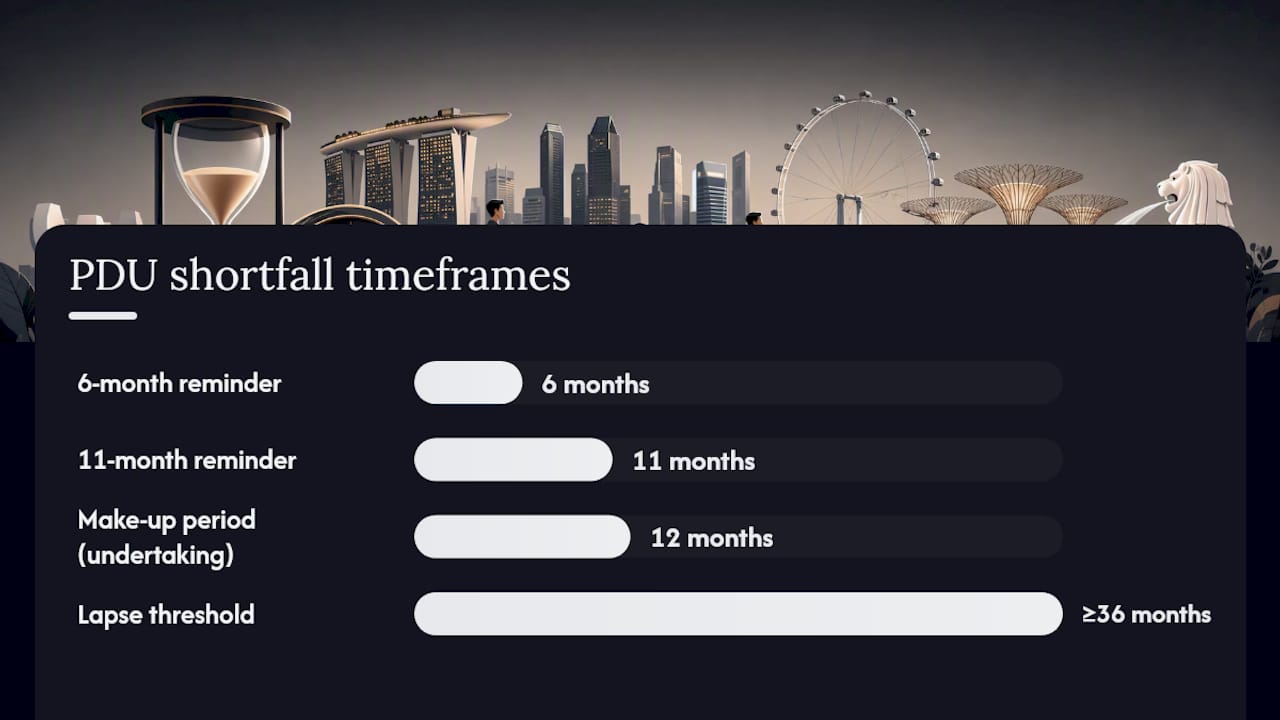
The Board has discretion to issue a practising certificate subject to an undertaking by the PE to make up the shortfall within 12 months. PDUs obtained during that 12-month make-up period apply to the next renewal application, not the current one. This is not an automatic entitlement; the Board assesses each case.
Scenario 2: Certificate lapsed for 3 or more continuous years
The statutory requirement doubles to a higher number of PDUs with higher structured minimums. This applies to any applicant who has not held a practising certificate for three or more continuous years, regardless of the reason for the lapse.
Practical steps if you discover a shortfall:
- Calculate the exact PDU gap and determine whether it can be closed before the renewal deadline through qualifying activities.
- If closure before the deadline is not feasible, prepare a formal undertaking application for submission to PEB, documenting the shortfall and a credible make-up plan.
- Schedule structured activities immediately to begin reducing the gap. Prioritize activities that yield the highest structured PDU credit.
- Retain all evidence for make-up activities from the date of the undertaking onward, as these records will be required for the next renewal cycle.
- Confirm the undertaking’s 12-month deadline in writing and set calendar reminders at the 6-month and 11-month marks.
Understanding the role of professional engineers in compliance makes clear why PEB treats lapsed certificates with heightened scrutiny. Competency gaps accumulate during inactive periods, and the higher PDU threshold reflects that reality.
How do course organisers get CPD activities recognized by PEB?
PEB operates a formal qualification process for course organisers. An activity cannot generate PDUs unless the organiser is registered and the activity has been approved.
Registration and application steps:
- Apply online to PEB for course organiser registration. The application must demonstrate the organiser’s capacity to administer CPD activities in compliance with PEB’s terms.
- Once registered, submit each proposed activity for qualification through the PEB online portal, providing the activity category, learning objectives, and speaker credentials where required.
- For e-training submissions, include details of the verifiable assessment mechanism. PEB will not qualify an online course as structured without a credible assessment component.
- Await PEB’s processing decision before promoting the activity as PDU-qualifying. Advertising unconfirmed PDU values to participants before approval is a compliance risk.
Post-qualification organiser responsibilities:
- Use only the official PEB attendance template for every session.
- Upload attendance files within one month of the activity’s conclusion, as required by PEB’s course organiser guidelines.
- Upload a nil attendance file for sessions where no Singapore-registered PE participated.
- Maintain records of speaker CVs, course outlines, and assessment results for audit purposes.
PEB publishes a list of qualifying activities and their PDU values; organisers should cross-reference their submissions against this list to confirm alignment before applying.
What documents should you keep, and for how long?
A PE who cannot produce evidence for a claimed PDU during an audit or dispute is effectively in the same position as a PE who never completed the activity. Retain the following for every CPD activity:
- Certificates of completion issued by the course organiser or institution.
- Attendance records showing name, date, activity title, and organiser details.
- Assessment reports for all e-training activities, including the score or pass/fail outcome.
- Meeting minutes or committee appointment letters for service on technical committees.
- Copies of published papers or articles, including the publication name, date, and author attribution.
- Course outlines and speaker CVs for in-house training sessions registered as structured activities.
Store all documents in a single, clearly labeled folder, organized by renewal cycle and activity date. A timestamped digital repository, whether a cloud drive or a structured local folder, is preferable to physical files alone. For firms managing multiple PEs, a digital records management approach that integrates attendance capture with document storage reduces the risk of missing evidence at renewal time.
Pro Tip: Compile a one-page evidence index for each renewal cycle: list every activity, its PDU value, its category, and the filename of the supporting document. If PEB queries a specific entry, you can locate and produce the evidence within minutes rather than searching through years of files.
When should you engage a consultancy for CPD compliance?
Most PEs manage their own CPD records without difficulty. Certain situations, however, create documentation complexity that a consultancy is better positioned to handle efficiently.
Use cases where professional support adds clear value:
- Assembling bulk PDU records after a lapsed certificate period, particularly when activities span multiple organisers and years.
- Registering recurring in-house training programs as structured CPD activities with PEB, including preparing speaker CVs, course outlines, and assessment frameworks.
- Resolving disputed or missing PDU entries where organiser non-compliance has created gaps in the PEB system.
- Preparing a formal undertaking submission to PEB, including the make-up activity plan and supporting documentation.
What a qualified consultancy can deliver:
- Attendance capture templates aligned with PEB’s official format.
- Organiser liaison with PEB for activity qualification and registration.
- Evidence assembly and indexing for audit response or dispute resolution.
- Review of CPD records against the statutory minimums before portal submission.
Criteria for selecting a consultancy:
- Demonstrated experience with PEB regulatory submissions and PE endorsement processes.
- Familiarity with the Professional Engineers Rules and the PE Act’s CPD provisions.
- Clear document handling practices, including secure storage and version control.
- A track record of authority submissions across Singapore regulatory bodies.
Why early CPD planning is the only sensible approach
The compliance framework for continuing professional development is straightforward on paper. In practice, PEs who leave PDU accumulation to the final months of a qualifying period consistently face the same problems: structured activity slots are full, organiser upload delays create last-minute gaps, and e-training options are exhausted against the 10-PDU cap before the total is reached.

Spreading structured activities across the qualifying period removes all of that pressure. A simple habit works well: block one calendar entry per quarter to review the CPD record, confirm organiser uploads are current, and identify the next qualifying activity. One central folder for evidence, updated immediately after each activity, means an audit response takes an hour rather than a week.
The CPD requirement exists because engineering competency is not static. The PE Act’s CPD mandate reflects a deliberate policy position: a practising certificate is a public trust instrument, and the PDU framework is the mechanism by which that trust is maintained. Treating CPD as professional risk management rather than a renewal formality is the more accurate framing, and it produces better outcomes.
Aectechnicalsg supports PEs with CPD documentation and organiser compliance
For PEs managing a lapsed certificate, a disputed PDU record, or an in-house training program that needs PEB registration, the administrative burden can be substantial. Aectechnicalsg provides direct support for CPD documentation tasks: attendance capture templates formatted to PEB’s requirements, organiser registration assistance, evidence assembly for audit response, and undertaking submission preparation.

The engagement model is straightforward. An initial scoping call establishes which records exist, what gaps are present, and which deliverables are needed before the renewal deadline. From there, Aectechnicalsg handles the documentation process, liaising with PEB where required and producing a structured evidence packet the PE can submit with confidence. The firm’s experience with PE endorsement and authority submissions across BCA, URA, SCDF, and other Singapore regulatory bodies means the compliance context is well understood. Contact Aectechnicalsg to confirm scope and begin the process before your renewal window closes.
Sources
The references below are the primary sources for all statutory requirements and administrative procedures described in this article. Use them directly for any formal application or dispute.
- Continuing Professional Development | Professional Engineers Board (PEB)
- Professional Engineers Act / Rules (PEA1991-R1) — SSO
This article is general information, not a substitute for advice from a qualified lawyer. Consult a qualified legal professional about your own circumstances before acting on anything here.