
Temporary works design approvals are the formal authorization process confirming that structures like scaffolding, formwork, and shoring are safe to load and use before construction proceeds. In Singapore, these approvals align with international frameworks such as BS 5975 and require Professional Engineer endorsement for many categories. The examples of temporary works design approvals covered here span scaffolding systems and falsework to complex bridge jacking assemblies, each illustrating how risk category, documentation, and multi-party review determine the approval path. Understanding these examples gives construction professionals a clear picture of what compliance actually requires on site.
1. Common examples of temporary works requiring design approvals
Temporary works requiring formal design approvals fall into well-defined structural categories. Each category carries specific documentation and check requirements before any loading or use is permitted.
The most frequently approved temporary works structures include:
- Scaffolding systems: Independent tied scaffolds, cantilevered scaffolds, and birdcage scaffolds over occupied areas all require design calculations and, in Singapore, PE endorsement for scaffolding above prescribed heights.
- Formwork and falsework: Concrete formwork supporting wet concrete loads requires design checks covering dead loads, live loads, and pour rates. Falsework supporting bridge decks or transfer structures is among the highest-risk categories.
- Shoring and propping systems: Temporary propping during structural alterations, basement construction, or underpinning requires staged design checks that account for load redistribution.
- Temporary bridges and road diversions: These structures require detailed design coordination to confirm permanent works remain unaffected, particularly where traffic or rail operations continue beneath.
- Hoarding and site boundary structures: Hoardings adjacent to public walkways require wind load calculations and foundation checks.
- Cantilevered structures over live infrastructure: Platforms or gantries cantilevering over live rail or road corridors represent the highest-risk category and require independent third-party checks.
- Excavation support systems: Sheet pile walls, soldier pile systems, and strutted excavations all require geotechnical and structural design approvals before excavation proceeds.
Each of these types of temporary works structures carries a different risk profile. That risk profile directly determines which check category applies.
2. How design check categories influence approval complexity
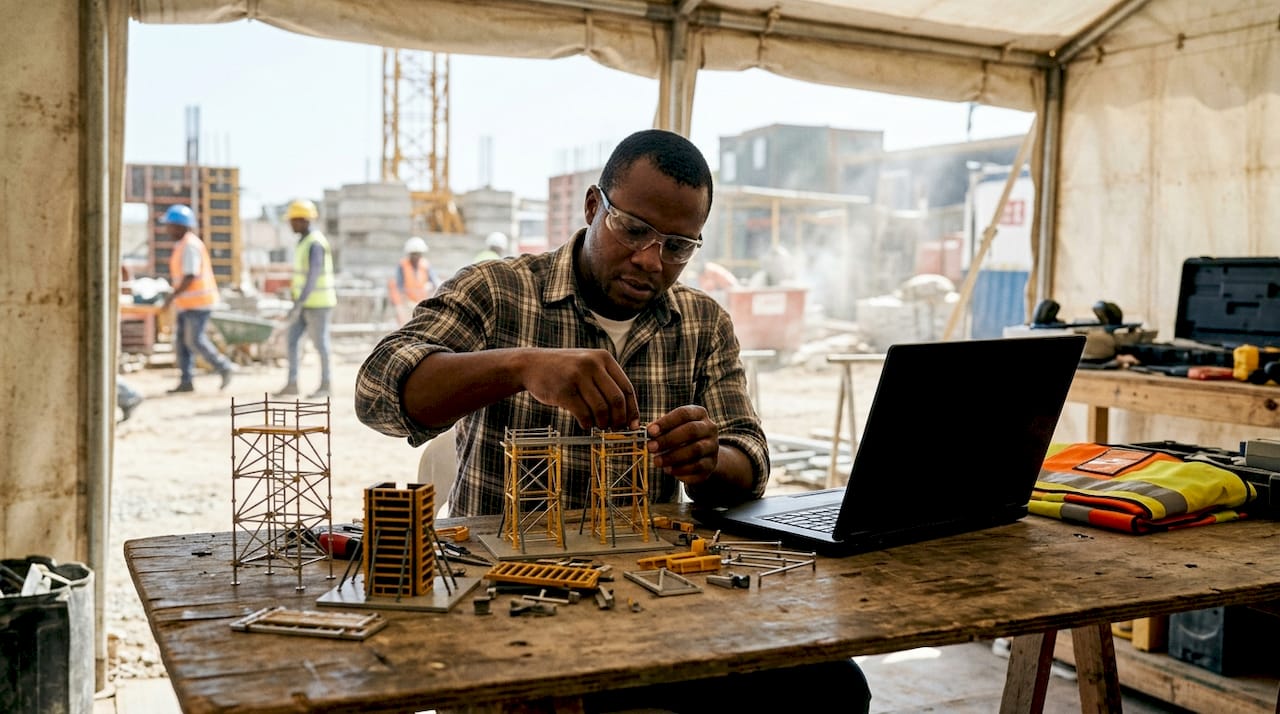
The temporary works approval process assigns every temporary works item a check category from 0 to 3. Category 3 is required for complex and high-risk temporary works such as structural supports over live infrastructure. This classification drives the entire approval workflow.
| Check category | Risk level | Typical examples | Independent check required? |
|---|---|---|---|
| Category 0 | Negligible | Standard proprietary systems used within manufacturer limits | No |
| Category 1 | Low | Simple scaffolding, basic formwork on low-rise structures | Internal checker only |
| Category 2 | Medium | Falsework for elevated slabs, shoring in occupied buildings | Yes, independent checker |
| Category 3 | High | Bridge falsework, cantilevered gantries, deep excavation support | Yes, independent third-party |
The Temporary Works Coordinator (TWC) assigns the check category at the design brief stage. This assignment is not administrative. It determines whether an independent engineer must review calculations before a permit is issued.
Category 2 and 3 approvals require an independent checker who has no prior involvement in the design. For Category 3 works, the client’s Technical Approval Authority often performs an additional review layer. Skipping or downgrading a category to reduce cost is a compliance failure with direct legal consequences.
Pro Tip: Assign check categories conservatively at the brief stage. Upgrading a category mid-design is far less disruptive than discovering an underestimated risk during an audit or inspection.
3. Key steps in the temporary works design approval process
The approval lifecycle for temporary works follows a structured sequence. Each step produces a document that feeds the next, creating an auditable chain from design intent to safe use.
-
Prepare the design brief: The TWC issues a written brief covering scope, loads, ground conditions, interfaces with permanent works, and the assigned check category. An incomplete brief is the most common cause of approval delays.
-
Produce design calculations and drawings: The designer prepares calculations, drawings, and a method statement. For Category 2 and 3 works, these must be formally checked by an independent engineer.
-
Submit a Design Risk Assessment (DRA): The DRA for temporary works must explicitly address site conditions, load cases, construction sequencing, and environmental factors. Independent checkers review the DRA alongside the calculations.
-
Obtain Technical Approval Authority sign-off: On major infrastructure projects, the client’s Technical Approval Authority reviews the design package and issues hold points before critical construction phases begin.
-
Issue the Permit to Load: The Permit to Load is the decisive authorization confirming the as-built temporary works match design assumptions and are safe to load. No temporary works should be loaded without this formal documented authorization.
-
Record in the Temporary Works Register: Every item, its check category, approval status, and permit history must be logged in the Temporary Works Register. Neglecting this register causes costly delays during inspections and audits.
-
Monitor, inspect, and close out: Temporary works require periodic inspection during use. Removal requires a separate permit confirming the permanent works can sustain loads independently.
Pro Tip: Issue the Permit to Load only after a physical site inspection confirms the as-built condition matches the approved design. Issuing it from the office based on drawings alone is a common and serious error.
4. Specialized temporary works examples with unique approval requirements
Specialized temporary works carry approval requirements that go beyond standard structural checks. These structures require Design Risk Assessments that differentiate system behaviors and define exclusion zones to satisfy safety auditors.
Key examples include:
- Fall restraint systems: These designs must align with BS EN 795 and BS 5975-1:2024 for approval compliance. A fall restraint system prevents a worker from reaching a fall edge, while a fall arrest system stops a fall in progress. Confusing the two in a DRA is a disqualifying error during review. Specialist height safety system design expertise is often required for these approvals.
- Industrial support frames for plant and equipment: Temporary frames supporting heavy plant during installation or maintenance require load path analysis, connection design, and staged approval tied to the installation sequence.
- Temporary works over live rail corridors: These require Network Rail or equivalent authority approval in addition to the standard design check process. Possession windows, track clearance envelopes, and emergency egress all form part of the approval submission.
- Temporary retaining structures in restricted sites: Urban excavations adjacent to existing buildings require geotechnical design reports and often Approval in Principle submissions before detailed design proceeds.
“Successful temporary works designs require considering staged construction effects and stiffness matching with permanent works to avoid unexpected load paths or deflections.”
Modern approvals increasingly rely on 3D modeling and digital coordination to identify clashes early and accelerate approval times by providing auditable documentation. This approach aids coordination with technical assurance bodies and clients, particularly on congested urban sites.
5. Managing multi-party approvals in major infrastructure projects
Large-scale infrastructure projects require approval structures that go well beyond a single design check. Multi-party collaboration involving Category 3 independent checks, Technical Approval Authority reviews, and specific submission documents is standard practice on bridge, rail, and highway projects.
| Approval layer | Responsible party | Key document |
|---|---|---|
| Design production | Temporary works designer | Calculations, drawings, method statement |
| Independent check | Third-party checker (Category 3) | Checked calculation package |
| Technical Approval Authority | Client or infrastructure owner | Approval in Principle, Geotechnical Design Report |
| Hold point confirmation | Technical Approval Authority | Hold point release certificate |
| Permit to Load | Temporary Works Coordinator | Signed permit document |
Bridge bearing replacement works illustrate this process clearly. Temporary jacking assemblies and lateral restraint systems require detailed designs with mock-ups and staged approvals prior to construction. The sequence covers scaffold access, traffic management, jacking operations, bearing removal, and reinstatement, all coordinated with permanent works designers to prevent load path conflicts.
Technical approval authorities perform hold points on critical construction moves such as heavy lifts. These gatekeeping hold points confirm all design, check, and interface requirements are met before work proceeds.
Key takeaways
Temporary works design approvals require a structured, documented process tied to risk-based check categories, with no loading permitted until a formal Permit to Load is issued.
| Point | Details |
|---|---|
| Check categories drive approval complexity | Assign Category 0–3 at the brief stage; Categories 2 and 3 require independent checkers. |
| Permit to Load is non-negotiable | No temporary works should be loaded without a signed, site-verified Permit to Load. |
| Temporary Works Register prevents audit failures | Log every item, approval, and permit history to avoid costly delays during inspections. |
| Multi-party approvals apply to high-risk projects | Infrastructure projects require Technical Approval Authority sign-off and hold point releases. |
| 3D modeling accelerates approvals | Digital coordination reduces clashes and provides auditable documentation for stakeholder reviews. |
What I have learned about temporary works approvals after years on complex projects
The single most consistent failure I see is the Temporary Works Coordinator being appointed in name only. The TWC role is a safety-critical function that requires formal appointment, clear authority to halt unsafe works, and genuine competence in structural principles. Treating it as an administrative title creates gaps that auditors and incidents both expose.
The second failure is issuing the Permit to Load before the physical inspection. I have seen projects where permits were signed in the site office based on drawings, with the actual installation differing from the design in ways that mattered structurally. The permit exists precisely to catch that gap.
On the positive side, teams that adopt 3D modeling early in the temporary works design process consistently move through approvals faster. The model creates a shared reference that reduces back-and-forth between designers, checkers, and Technical Approval Authorities. It also produces the clash detection records that assurance bodies want to see.
My strongest advice for Singapore professionals: treat the construction approval workflow as a quality system, not a paperwork exercise. The register, the DRA, the permit, and the check certificate are not bureaucratic outputs. They are the evidence that your temporary works will not fail.
— Aman
How Aectechnicalsg supports temporary works approvals in Singapore
Temporary works approvals in Singapore require Professional Engineer endorsement, authority submissions, and documentation that meets BCA and site-specific requirements. Getting that process wrong delays projects and creates legal exposure.
Aectechnicalsg provides structural and geotechnical engineering consultancy covering PE endorsement and authority submissions for temporary works including scaffolding, formwork, shoring, and excavation support. The team handles design documentation, independent check coordination, and submission to authorities such as BCA, LTA, and JTC. For project-specific advice on temporary works design approvals, contact Aectechnicalsg directly through the engineering consultancy services page.
FAQ
What are the most common examples of temporary works needing approvals?
Scaffolding, formwork, falsework, shoring, temporary bridges, and excavation support systems are the most common temporary works requiring formal design approvals. Each requires a design brief, risk-based check category assignment, and a Permit to Load before use.
What is a Permit to Load in temporary works?
The Permit to Load is the formal authorization confirming that temporary works are installed as designed and safe to load. No temporary works should be loaded or used without this signed document.
When is an independent design check required?
An independent design check is required for Category 2 and Category 3 temporary works. Category 3 applies to complex or high-risk structures such as bridge falsework, deep excavation support, and cantilevered gantries over live infrastructure.
What does a Temporary Works Coordinator do?
The Temporary Works Coordinator assigns check categories, manages the design brief, coordinates independent checks, and issues Permits to Load. The role requires formal appointment and authority to halt unsafe works on site.
Do temporary works in Singapore require PE endorsement?
Yes. Singapore requires Professional Engineer endorsement for temporary works such as scaffolding above prescribed heights, hoarding, and excavation support. Submissions are made to authorities including BCA and LTA depending on the project type.