
Material testing standards are issued by a defined set of bodies, and knowing which one governs your contract is the first decision that determines whether your results are defensible. The principal issuing organizations are ASTM International, the International Organization for Standardization (ISO), CEN/EN (European Committee for Standardization), the American Concrete Institute (ACI), AASHTO, SAE International, ASME, and ASNT for nondestructive testing personnel and procedures. Laboratory accreditation falls under ISO/IEC 17025.
At the highest level, types of material testing standards divide into two families: destructive testing, where specimens are loaded to failure to measure tensile strength, hardness, impact toughness, or fatigue life, and non-destructive testing (NDT), which inspects parts without damaging them using ultrasonic, radiographic, magnetic particle, liquid penetrant, or eddy-current methods. Materials testing covers mechanical, thermal, electrical, corrosion, and NDT categories, with a recognized standard method governing each one.
Quick reference by test and issuing body:
- Tensile testing, metals: ASTM E8 (US/global) / ISO 6892-1 (international)
- Tensile testing, plastics: ASTM D638 / ISO 527
- Concrete compressive strength: ASTM C39
- Rockwell hardness: ASTM E18
- Charpy impact: ASTM E23 / ISO 148-1
- Ultrasonic and radiographic NDT: ASTM E164 / ASTM E1742 (ASNT guidance applies)
- Lab accreditation: ISO/IEC 17025
- NDT personnel certification: ISO 9712 / ASNT schemes
Key Takeaways
Selecting the correct material testing standard and documenting it properly are the two actions that determine whether test results are contractually and regulatorily defensible.
| Point | Details |
|---|---|
| Name the issuing body and revision | Contracts must specify the standard number and revision date (e.g., ASTM E8/E8M-22), not just the test category. |
| Separate test method from acceptance criteria | A test method defines how to measure; the project specification or code defines what result is acceptable. |
| Require ISO/IEC 17025 accreditation | Lab accreditation scope must explicitly cover the specific test method being performed, confirmed at tender stage. |
| Match tests to service loading modes | Tensile strength does not predict fatigue or impact performance; combine test methods when components face mixed loading. |
| Maintain a corporate standards clause | A standing procurement clause requiring accreditation, calibration certificates, and standard revision on every report prevents disputes. |
Table of Contents
- What are the major material testing standards organizations?
- How are testing standards documents organized by type?
- Test categories mapped to representative standards by material
- Destructive vs non-destructive testing: when does each apply?
- How to choose the right standard for a contract or project
- What labs must provide: accreditation, calibration, and traceability
- Where to obtain official standards
- Common mistakes and best practices in professional testing programs
- Why precise standards and strict reporting are not optional
- Working with Aectechnicalsg on testing documentation and authority submissions
- Sources
What are the major material testing standards organizations?
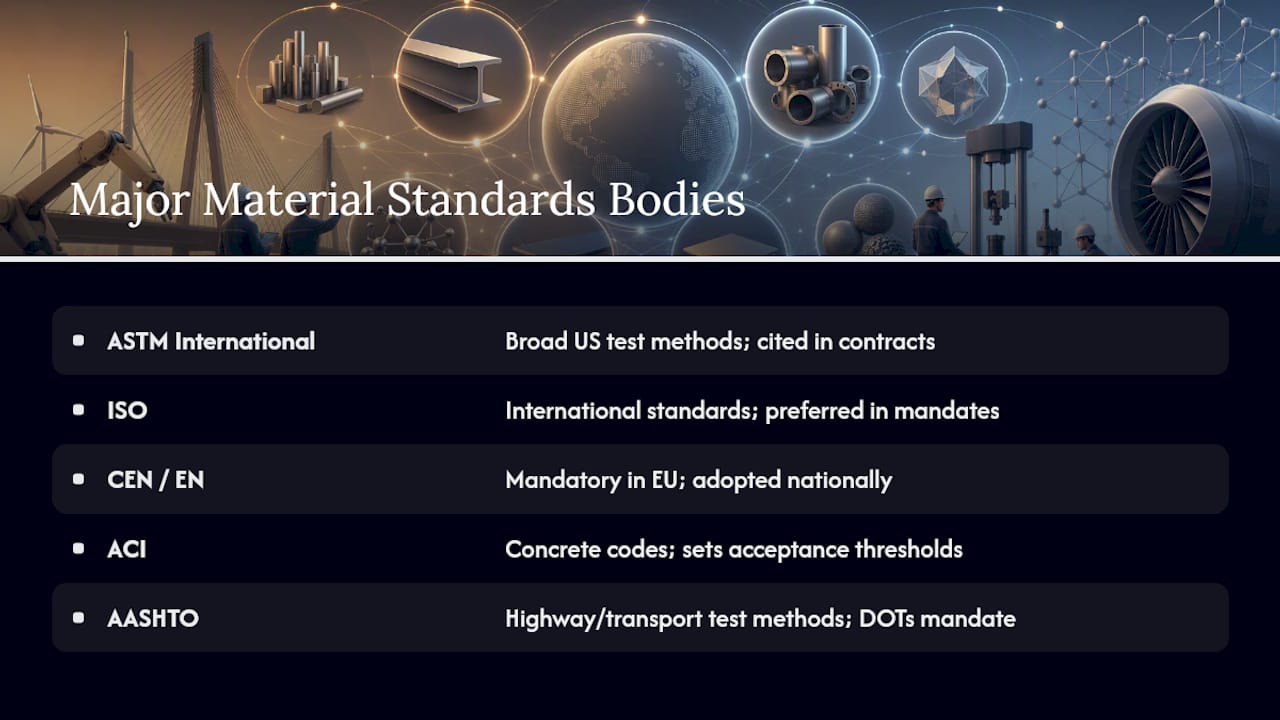
Seven organizations account for the vast majority of testing standards referenced in US and international construction, manufacturing, and infrastructure contracts. Each has a distinct scope and geographic weight.
ASTM International publishes the broadest catalog of test methods used in US practice. Its standards cover metals, polymers, concrete, asphalt, composites, and NDT methods, and they appear by name in most American construction contracts, procurement specifications, and regulatory submissions. ASTM E8 for tensile testing of metals, ASTM E18 for Rockwell hardness, and ASTM E23 for Charpy impact are among the most frequently cited. ASTM standards are developed by technical committees and revised on a defined cycle, with the revision year appended to the standard number (e.g., ASTM E8/E8M-22).
ISO maintains a parallel catalog of internationally harmonized standards. ISO 6892-1 covers tensile testing of metals at room temperature; ISO 148-1 covers Charpy impact. When a project involves a multinational supply chain or a client in a jurisdiction that mandates ISO documents, ISO versions take precedence. ISO and ASTM versions of nominally similar tests often differ in specimen geometry and strain rate, which can produce different numerical results on the same material.
CEN/EN standards are issued by the European Committee for Standardization and are mandatory in EU member states. They are frequently adopted as national standards by individual countries (e.g., BS EN in the UK, DIN EN in Germany). Projects using Eurocodes for structural design will reference EN test methods for material qualification.
ACI (American Concrete Institute) publishes codes and guides governing concrete materials, mix design, and construction practice. ACI 318 is the primary structural concrete building code in the US; it references ASTM test methods (such as ASTM C39 for compressive strength) for acceptance criteria. ACI does not itself publish test methods but sets the acceptance thresholds that test results must meet.
AASHTO (American Association of State Highway and Transportation Officials) publishes test methods and specifications specifically for highway and transportation materials, including aggregates, soils, asphalt, and concrete. State DOTs routinely mandate AASHTO methods alongside or instead of ASTM equivalents.
SAE International and ASME cover mechanical and automotive engineering and pressure vessel applications, respectively. SAE standards govern material qualification for automotive components; ASME Boiler and Pressure Vessel Code (BPVC) sections specify material testing requirements for pressure-retaining equipment.
ASNT (American Society for Nondestructive Testing) is the primary US body for NDT personnel certification and recommended practices. ASNT SNT-TC-1A and CP-189 govern technician qualification levels (Level I, II, III). ASNT does not publish test methods in the same sense as ASTM, but its recommended practices define how NDT procedures should be written and qualified.
ISO/IEC 17025 is the accreditation standard that testing laboratories must satisfy for their results to be contractually and legally defensible. Accreditation to ISO/IEC 17025 by a recognized accreditation body (such as A2LA or NVLAP in the US) confirms that a lab’s measurement systems, calibration chain, and reporting procedures meet a defined competence threshold.
How are testing standards documents organized by type?
Not every document a standards body publishes does the same job. Misreading document type is one of the most common sources of contract disputes, because a test method alone never tells you whether a material passes or fails.
- Test method: Defines the procedure for measuring a property. It specifies specimen geometry, conditioning, equipment, and calculation. ASTM E8 is a test method. It tells you how to run a tensile test; it does not tell you what tensile strength is acceptable.
- Specification: Sets acceptance criteria for a material or product. It may reference a test method to define how the property is measured, then state the minimum or maximum value required. ASTM A615 (deformed steel bars) is a material specification that references tensile and bend test methods and states the required yield strength.
- Practice: Describes a recommended procedure without requiring a specific numerical outcome. ASTM E1444 (magnetic particle testing) is classified as a practice.
- Guide: Provides background, options, and information without mandating a single procedure. Guides are informational and are not cited as contractual requirements.
- Code: A regulatory or contractual document that carries legal or contractual authority. ACI 318 and the International Building Code (IBC) are codes. They set acceptance criteria and reference test methods and specifications by name.
The practical implication: when a contract says “test per ASTM C39,” it is specifying the measurement procedure. The acceptance criterion (minimum compressive strength) lives in the project specification or the governing code, not in ASTM C39 itself. Confusing these two document types leads to reports that measure the right property by the right method but cannot be evaluated for compliance because no acceptance threshold was stated.
ISO’s catalog follows a similar taxonomy, distinguishing International Standards (IS), Technical Specifications (TS), Technical Reports (TR), and Publicly Available Specifications (PAS). For contract purposes, only International Standards (IS) carry the full weight of a normative requirement.
Test categories mapped to representative standards by material
Common material testing methods span tensile, compression, flexural, hardness, impact, fatigue, creep, fracture toughness, thermal analysis, and NDT. The table below maps each category to representative standard numbers, the issuing body, material coverage, and typical application.
Key mismatches to watch for:
- ASTM E8 and ISO 6892-1 use different specimen geometries and strain rate controls. Results on the same material can differ by a measurable margin, which matters when a specification sets a tight minimum.
- ASTM C39 requires a specific capping or grinding procedure for concrete cylinder ends; omitting this step introduces eccentric loading and artificially low results.
- Charpy specimens under ASTM E23 and ISO 148-1 are nominally the same geometry, but notch tolerances and test temperature verification procedures differ. Always confirm which version the contract requires.
- NDT methods under ASTM and ISO carry different procedure qualification requirements. A lab accredited to ASTM E164 is not automatically qualified to ISO 17640 without scope verification.
For projects requiring pile load testing methods, the same principle applies: the loading mode in the test must reflect the actual service condition, whether tension, compression, or lateral.
Destructive vs non-destructive testing: when does each apply?
The choice between destructive testing and NDT is not simply a matter of cost. It depends on whether the tested item must remain in service, what stage of the lifecycle it is at, and what the contract or authority requires.
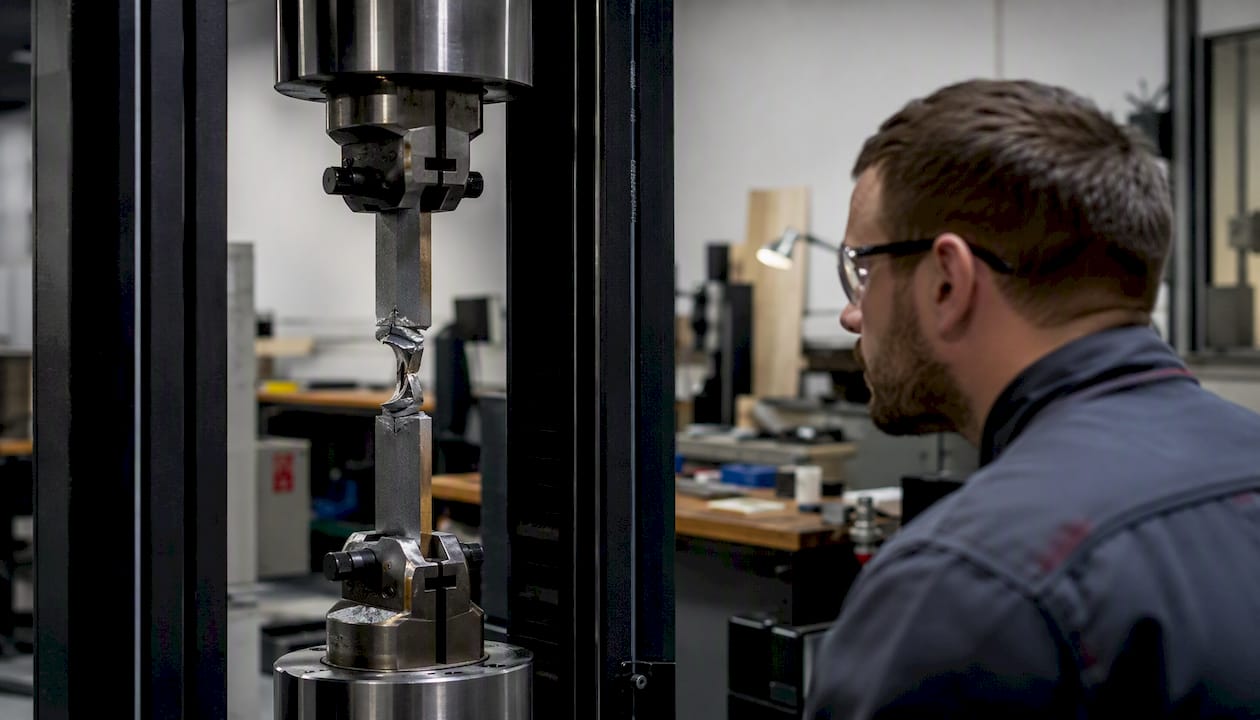
Destructive testing takes specimens to failure to measure a defined property. The specimen is consumed in the process. This is appropriate for:
- Incoming material qualification (verifying a batch of steel meets yield strength requirements before fabrication)
- Weld procedure qualification (demonstrating that a welding procedure produces joints meeting tensile and bend requirements)
- Concrete mix design acceptance (confirming that a proposed mix achieves the specified 28-day compressive strength per ASTM C39)
- Quality control sampling during production
Common destructive methods and their governing standards include tensile testing per ASTM E8 or ISO 6892-1, hardness testing per ASTM E18, and impact testing per ASTM E23 or ISO 148-1. University-level materials testing tutorials consistently identify these three as the foundational destructive methods for metals.
Non-destructive testing (NDT) inspects a part or structure without impairing its fitness for service. NDT is required when:
- The component is already installed or in service (structural welds, pressure vessel shells, bridge members)
- The item is unique or high-value and cannot be sacrificed for sampling
- Periodic in-service inspection is mandated by code or regulation
Common NDT methods:
- Ultrasonic testing (UT): Detects internal flaws in welds and base metal; governed by ASTM E164 and ISO 17640. Requires qualified operators (ASNT Level II or equivalent).
- Radiographic testing (RT): Produces a permanent image of internal discontinuities; governed by ASTM E1742 and ISO 17636. Radiation safety regulations apply.
- Magnetic particle testing (MT): Detects surface and near-surface flaws in ferromagnetic materials; governed by ASTM E1444.
- Liquid penetrant testing (PT): Detects surface-breaking flaws in non-porous materials; governed by ASTM E1417.
- Eddy current testing (ET): Detects surface flaws and measures conductivity in conductive metals; governed by ASTM E309.
ASNT’s SNT-TC-1A and CP-189 schemes define the qualification levels for NDT personnel. For any NDT result to be contractually defensible, the technician’s certification level must match the method and scope of the inspection.
Combination testing is often necessary. A structural steel weld may require UT for internal flaws and MT for surface cracks, plus tensile and bend testing of procedure qualification coupons. A polymer component may require tensile testing per ASTM D638 alongside DSC thermal analysis to confirm material identity. Matching the test suite to the actual loading modes and failure modes in service is the engineering judgment that no standard can substitute.
How to choose the right standard for a contract or project
Selecting the correct standard before ordering tests prevents costly retesting and authority rejections. Work through this checklist in order.
- Identify the contracting document’s specified standard. The project specification, purchase order, or authority submission requirement will name the issuing body and, ideally, the standard number. Start there, not with a general internet search.
- Confirm the document type. Is the reference a test method, a specification, or a code? If it is a test method only, locate the governing specification or code that sets acceptance criteria.
- Confirm the revision date. Standards are revised periodically. ASTM appends the revision year (e.g., ASTM E8/E8M-22). Referencing an outdated revision is a common contract trap that can invalidate results if the current version changed a critical procedure.
- Confirm specimen geometry and conditioning requirements. Specimen dimensions, surface finish, and conditioning (temperature, humidity, soak time) are specified in the standard. Deviations introduce stress concentrations that invalidate comparisons.
- Confirm environmental and temperature requirements. Impact testing, in particular, requires precise temperature control. Charpy tests at sub-zero temperatures require verified cooling baths and documented temperature measurement.
- Confirm acceptance criteria. Locate the minimum or maximum value in the project specification or governing code, not in the test method document.
- Verify lab accreditation. Require ISO/IEC 17025 accreditation with a scope that explicitly covers the test method being performed. Accreditation to a broad category does not automatically cover every specific method.
- Verify personnel certification for NDT. Require ISO 9712 or ASNT certification documentation for the specific NDT method and level.
- Confirm machine calibration. Universal testing machines must be verified per ASTM E4 or ISO 7500-1. Require current calibration certificates traceable to national standards.
For AQL sampling in incoming material inspection, the same discipline applies: the sampling plan, acceptance number, and inspection level must be stated in the contract, not left to the lab’s discretion.
Pro Tip: When both an ASTM and an ISO version of a test exist, state the chosen version explicitly in the contract and require the lab to include the standard number, revision date, and issuing body on every test report. Verbal agreements about which version applies do not survive a dispute.
What labs must provide: accreditation, calibration, and traceability
A test result is only as defensible as the documentation behind it. Requiring the right evidence at the time of tender, not after results are disputed, is the professional standard.
ISO/IEC 17025 accreditation is the baseline requirement for any test result that must withstand contractual or regulatory scrutiny. Require the lab to provide its current accreditation certificate and the scope of accreditation. The scope must explicitly list the test method (by standard number) being performed. A lab accredited for tensile testing of metals is not automatically accredited for tensile testing of polymers.
Machine calibration certificates must be traceable to national measurement standards (NIST in the US). For universal testing machines, calibration must follow ASTM E4 or ISO 7500-1. Calibration certificates should state the calibration date, the next due date, and the calibration body’s accreditation status.
Personnel certification is required for NDT. Require ISO 9712 or ASNT CP-189 certificates for the specific method (UT, RT, MT, PT, ET) and the level (II or III for independent interpretation of results). The certificate must be current and within its validity period.
Test reports must include:
- Standard number and revision date
- Specimen identification and preparation notes (including machining method and surface condition)
- Environmental conditions during testing (temperature, humidity)
- Raw data: load-displacement curves for tensile tests, energy absorption values for impact tests
- Statement of conformity: whether the result meets or does not meet the specified acceptance criterion
- Calibration certificate reference numbers for the equipment used
ASTM’s physical and mechanical testing standards include detailed requirements for metallography, indentation hardness, impact testing, residual stress measurement, and specimen preparation, all of which feed directly into what a compliant test report must document.
For projects requiring authority submissions, the construction approval workflow demands that lab reports be traceable and complete before submission. Missing calibration references or absent accreditation scope documents are among the most frequent causes of submission rejection.
Where to obtain official standards
Standards are copyrighted documents. Distributing a standard to project stakeholders without a site license is a licensing violation, regardless of how the document was originally purchased.
Primary purchasing channels:
- ASTM Compass (compass.astm.org): ASTM’s subscription platform for individual standards and full-volume access. Pay-per-standard purchase is also available through the ASTM store.
- ISO Store (store.iso.org): Individual standard purchase; no general subscription model for external users. National standards bodies (ANSI in the US) resell ISO standards.
- ANSI Webstore: A major US reseller for ASTM, ISO, IEC, and other standards. Useful for purchasing multiple standards from different bodies in a single transaction.
- ACI Store (store.concrete.org): ACI codes, guides, and committee reports.
- AASHTO Store (store.transportation.org): AASHTO test methods and specifications for highway materials.
- ASNT Store (asnt.org): NDT recommended practices, personnel qualification documents, and training materials.
Practical guidance:
- Purchase the specific standards referenced in your contracts, not general-topic collections. A contract that references ASTM E8/E8M-22 requires that exact revision.
- Keep a log of purchased standards and their revision dates for audit purposes.
- For large firms, institutional subscriptions (ASTM Compass enterprise, ISO national body licenses) reduce per-standard costs and provide automatic notification of revisions.
- National adoptions of EN standards (e.g., BS EN in the UK, DIN EN in Germany) are sold through the respective national body, not directly through CEN.
Common mistakes and best practices in professional testing programs
Practitioner-level errors in material testing rarely involve the test itself. They occur in the documentation surrounding it.
Common mistakes:
- Specifying a test method without a revision date. A standard number without a year (e.g., “ASTM E8” rather than “ASTM E8/E8M-22”) creates ambiguity when the standard has been revised since the contract was written.
- Confusing test method with acceptance criteria. ASTM C39 tells you how to measure concrete compressive strength. It does not tell you what strength is acceptable. That threshold lives in the project specification or ACI 318.
- Poor specimen preparation. Specimen geometry, surface finish, and machining tolerances are normative requirements, not suggestions. A specimen with machining marks at the gauge section will fail at a lower load than a correctly prepared one, producing a result that appears to indicate a material deficiency when the deficiency is actually in the preparation.
- Accepting reports without calibration or accreditation evidence. A test report without a calibration certificate reference and an accreditation scope document is not contractually defensible, regardless of the numerical result.
- Using the wrong version of a standard. ASTM and ISO revise standards on cycles ranging from a few years to over a decade. A contract that references an older revision may require a test procedure that has since changed materially.
Best practices:
- Always specify the standard number and revision date in procurement documents and lab orders.
- Require ISO/IEC 17025 scope documentation at the time of tender, not after results are delivered.
- Include specimen preparation photographs in the final test report for critical tests (fracture toughness, fatigue).
- Require raw data files (load-displacement curves, energy values) for all mechanical tests, not just summary tables.
- Match the test suite to the actual service loading modes. A material’s tensile strength does not predict its fatigue performance; a component subject to cyclic loading requires fatigue testing per ASTM E466 or E606 in addition to static tensile qualification.
Pro Tip: Maintain a corporate “standards clause” template for all procurement and laboratory contracts. The clause should mandate that the lab attach its current ISO/IEC 17025 accreditation certificate, the relevant calibration certificates, and the exact standard number with revision date to every test report. This single document reduces disputes and speeds authority submissions.
Why precise standards and strict reporting are not optional
The consequences of ambiguous standard references are concrete and costly. A structural steel fabricator that delivers mill certificates referencing an outdated ASTM A36 revision may face rejection at the authority submission stage, requiring re-testing of already-installed material. A concrete pour accepted on the basis of test reports that lack calibration evidence may be challenged during a building inspection, triggering core sampling and potential demolition orders.
Tight traceability does more than satisfy a bureaucratic requirement. It resolves disputes between contractors, clients, and authorities before they escalate. When a test report includes the standard number and revision, the specimen preparation record, the calibration certificate reference, and the lab’s accreditation scope, there is no ambiguity about what was measured, how it was measured, or whether the equipment was fit for purpose. The result stands on its own.
The checklist in the selection section above is not a theoretical exercise. Used as a contract clause, it shifts the burden of documentation to the lab at the time of tender, when the cost of compliance is lowest. Requiring accreditation evidence after a dispute has already started is expensive and often inconclusive.
For projects where testing results feed directly into regulatory compliance and authority submissions, the standard of documentation required is not negotiable. Authorities reviewing structural submissions expect test reports that are traceable, complete, and referenced to current standard revisions. Anything less creates a gap that delays approval.
Working with Aectechnicalsg on testing documentation and authority submissions
For engineering and construction projects where material testing results must support authority submissions, Aectechnicalsg provides technical advisory services covering standard selection, lab brief preparation, and full documentation review. The firm’s PE endorsement and authority submission services include verification that test reports meet the accreditation, calibration, and traceability requirements expected by Singapore’s BCA, URA, SCDF, and other regulatory bodies.
For developers and contractors who need to align testing programs with project submission requirements, Aectechnicalsg’s consultants can review lab scopes, confirm standard revision currency, and prepare the documentation package required for approval.
Sources
The following primary sources and reference portals provide authoritative access to the full text of standards, purchasing options, and educational background on material testing methods.
- ASTM International
- International Organization for Standardization (ISO)
- Materials testing | UNSW Sydney (tutorials)
- Material Testing Standards – ANSI Webstore
Official standards webstores are the authoritative sources for full text and licensing terms. Always purchase the specific revision referenced in your contract documents.