
Building codes in Singapore are widely misunderstood as a single rulebook developers must consult before breaking ground. That assumption leads to costly mistakes. Understanding building codes Singapore professionals must navigate involves multiple statutory layers: enabling legislation, agency-issued technical codes, urban design guidelines, and quality assessment frameworks that interact across every project type. This guide clarifies those layers, defines the roles of qualified persons and regulatory agencies, and delivers practical compliance workflows that will serve both first-time developers and seasoned construction professionals managing projects under 2026 regulatory conditions.
Table of Contents
- Key takeaways
- Understanding building codes in Singapore: the statutory framework
- Core technical codes and standards in Singapore construction
- Quality frameworks and compliance workflows
- Navigating ongoing code evolution and project-specific compliance
- Practical strategies for applying Singapore’s building codes
- My perspective on Singapore’s compliance culture
- Expert compliance support for Singapore developers
- FAQ
Key takeaways
| Point | Details |
|---|---|
| Building codes are layered | Singapore’s regulatory system spans statutes, technical codes, and quality frameworks that must all be addressed together. |
| Qualified persons carry statutory weight | QPs are legally responsible for sign-off and endorsement, making early engagement a compliance necessity. |
| Mandatory vs. advisory requirements differ | Distinguishing binding provisions from advisory guidance prevents over-design and avoids compliance gaps. |
| Codes evolve continuously | Recent updates such as the Code on Accessibility 2025 require teams to reassess compliance whenever project scope changes. |
| Documentation drives approvals | Submission packages including buildability scores, QA/QC records, and endorsed drawings are what authorities actually review. |
Understanding building codes in Singapore: the statutory framework
Most professionals entering a Singapore construction project for the first time treat the Building Control Act as the finish line. It is actually the starting point. The Act establishes the legal authority under which all other building regulations, technical codes, and quality schemes derive their force. It authorizes the Commissioner of Building Control, administered through the Building and Construction Authority (BCA), to enforce compliance and reject non-conforming submissions.
The Building Control (Buildability and Productivity) Regulations 2011 came into effect on July 15, 2011, and represent one of the clearest examples of how Singapore separates enabling law from technical mandates. The regulations assign specific statutory obligations to both qualified persons (QPs) and developers, covering productivity benchmarks and design standards that must be demonstrated before approval is granted.
Key actors and their responsibilities under Singapore’s building control regime include:
- Qualified Persons (QPs): Registered architects or professional engineers who are legally responsible for certifying that designs comply with all applicable codes and submitting plans to the Commissioner.
- Developers and building owners: Required to appoint QPs, submit complete compliance documentation, and maintain records throughout construction and occupation.
- BCA: The primary regulatory authority that reviews submissions, issues approvals, conducts inspections, and enforces sanctions for non-compliance.
- Other agencies: URA governs land use and urban design, SCDF enforces fire safety, LTA handles transportation-related structures, and NEA oversees environmental and energy standards.
The statutory separation between the Act and its subsidiary regulations means that QP statutory responsibilities cannot be delegated or informally assigned. Developers who assume their contractors will manage compliance documentation without formal QP oversight routinely face submission rejections and project delays.
Core technical codes and standards in Singapore construction
Once the statutory foundation is clear, the next layer consists of the technical codes of practice. These are the documents that specify exactly how buildings must perform, how materials must be rated, and how spaces must be configured. They are not laws in themselves, but non-compliance with them constitutes a failure to meet the statutory requirements they support.

The Fire Safety (Building Fire Safety) Regulations define the Fire Code as a dynamic set of standards approved by the Commissioner of Civil Defence. This includes all amendments over time, covering fire resistance ratings, means of escape, fire emergency plans, and hardware specifications. Compliance teams must track the latest Fire Code amendments to confirm that current standards are met beyond the base regulations alone. This is a point many project teams miss, especially on renovation or addition-and-alteration (A&A) works where the original design was approved under an older version of the Code.
The 2026 BCA Circular on the Code on Accessibility 2025 streamlines requirements by focusing the mandatory code on non-negotiable baseline standards, while a companion guide contains non-mandatory recommendations. This separation is deliberate. Separating mandatory code requirements from advisory guidance prevents scope creep and supports focused compliance planning, which is particularly relevant for mixed-use developments where accessibility provisions interact with fit-out decisions.
Other significant technical codes include:
- Green Mark and energy efficiency codes: Governing building envelope performance, mechanical and electrical system efficiency, and sustainability targets, particularly for projects seeking BCA Green Mark certification.
- Structural Eurocodes (SS EN series): Adopted progressively in Singapore, these govern structural design calculations and load assumptions for concrete, steel, and foundation systems.
- SS 646 and related M&E standards: Setting requirements for mechanical and electrical system design and installation within buildings.
Pro Tip: When reviewing any technical code, always check the BCA website and relevant authority portals for the latest circulars before finalizing design assumptions. Singapore authorities issue circulars that modify code interpretation without formally amending the code text itself.
Quality frameworks and compliance workflows
Passing a design review is not the same as achieving compliance. This is where many developers discover that building compliance Singapore requires attention well beyond the drawing board.
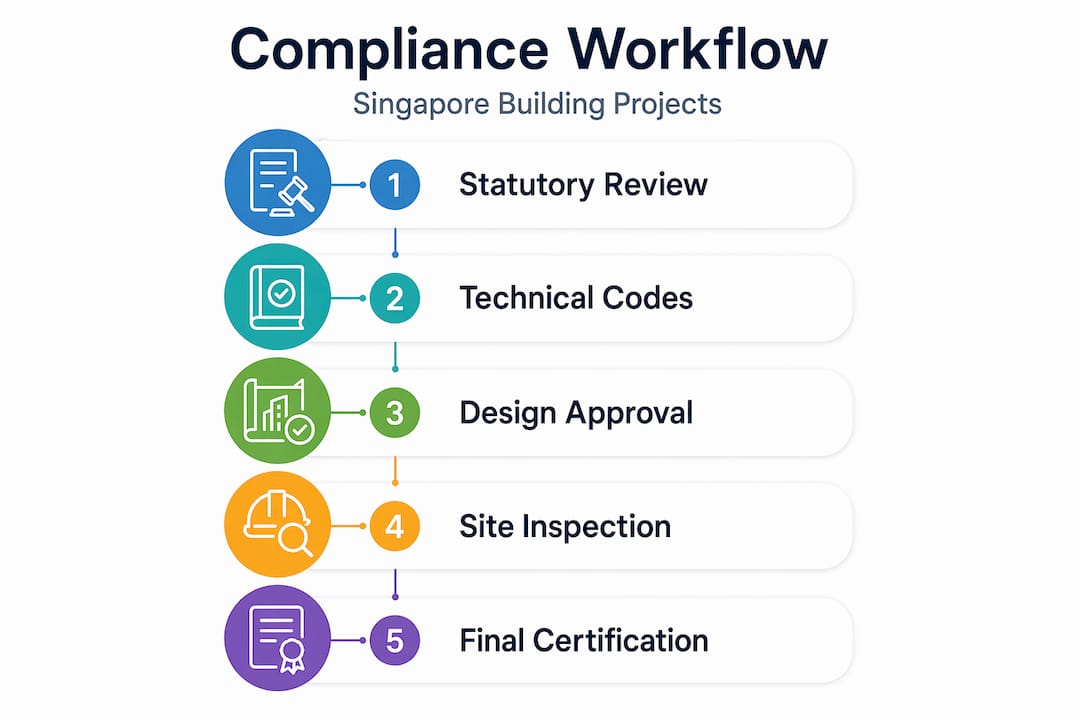
CONQUAS® is Singapore’s national standard for assessing construction workmanship quality, introduced by BCA in 1989. It was not designed as a marketing tool. Project teams use CONQUAS® as a practical inspection framework linking QA/QC hold points, inspection records, and workmanship assessments to the regulatory compliance audit trail. Proactively aligning inspection schedules and record keeping to BCA’s CONQUAS® criteria facilitates smoother quality audits and reduces costly rework during final compliance validation.
A compliant project documentation package typically follows this sequence:
- Architectural and engineering plans submission: Endorsed by QPs, including buildability scores, constructability assessments, and compliance declarations submitted to the Commissioner of Building Control.
- Fire safety plan submission to SCDF: Including fire compartmentation layouts, egress calculations, fire emergency plans, and equipment schedules approved by the Commissioner of Civil Defence.
- QA/QC documentation during construction: Inspection records, material test certificates, and hold-point sign-offs that create an auditable paper trail for CONQUAS® scoring and BCA inspections.
- Temporary Occupation Permit (TOP) documentation: Final compliance certificates, QP endorsements, and statutory declarations compiled before occupation is permitted.
- Certificate of Statutory Completion (CSC): The terminal milestone confirming that all conditions of approval and post-construction compliance checks have been satisfied.
Pro Tip: Treating the CONQUAS® inspection framework as a design output rather than a construction afterthought reduces the risk of defects being flagged during final audits. QPs who embed hold-point requirements into the project program from the start consistently achieve cleaner TOP submissions.
Common pitfalls in documentation management include late QP appointments, missing material certifications for fire-rated assemblies, and submission packages that address the current code text without accounting for the specific circular amendments applicable to that project type.
Navigating ongoing code evolution and project-specific compliance
Building codes are not static. Understanding construction laws in Singapore requires accepting that the regulatory environment is continuously updated, and that a project approved two years ago may not meet current requirements if scope changes are introduced.
The compliance review must adjust for changes in building typology, compartmentation, and fit-out scope even if the regulatory texts have not changed. If a commercial tenant replaces a single occupancy with multiple sub-tenancies, the fire compartmentation strategy, egress calculations, and accessibility provisions may all require reassessment under the current code version, not the version in force at the time of the original building approval.
The table below illustrates how the same regulatory area produces different compliance requirements depending on project context:
| Scenario | Applicable code version | Key compliance trigger |
|---|---|---|
| New building construction | Current code at submission date | Full compliance to all current technical codes |
| A&A works affecting fire compartments | Current Fire Code | Reassessment of fire strategy for affected zones |
| Change of use from office to retail | Current code at notification date | Accessibility, fire, and M&E compliance review |
| Fit-out within approved shell | Tenant fit-out requirements | Compliance with shell approval conditions |
Singapore’s urban design guidelines add another dimension for projects within designated areas such as the Downtown Core Planning Area, where height, facade treatment, and pedestrian connectivity requirements impose constraints that interact with structural and M&E compliance decisions. These are not optional aesthetic preferences. They are statutory conditions attached to planning permissions.
For teams managing multiple projects simultaneously, a layered mapping approach is the most reliable method. This involves documenting which requirements come from enabling legislation, which from technical codes, and which from project-specific approval conditions or circular amendments. That structured mapping prevents requirements from slipping through category boundaries.
Practical strategies for applying Singapore’s building codes
Knowing where to find a regulation and knowing how to apply it are different skills. The following practices separate compliant project teams from those who learn compliance lessons through rejection notices:
- Develop a tiered compliance matrix at project inception: Separate mandatory requirements from advisory guidance across all applicable codes, and assign each item to the QP or consultant responsible for confirming compliance in the submission package.
- Engage QPs during the concept design stage: Professional engineers’ roles in Singapore’s building compliance system are statutory, not advisory. Waiting until detailed design is complete before confirming QP scope often requires expensive redesign.
- Monitor BCA circulars monthly: BCA and URA regularly issue circulars that change how existing code provisions are interpreted or applied. Subscribe to BCA’s e-newsletter and check the URA e-Advisor portal before finalizing any submission.
- Align project programs with CONQUAS® inspection hold points: Treat inspection scheduling as a design deliverable, not a construction phase afterthought, to keep quality documentation current with site progress.
- Use BIM mandates to structure compliance documentation: BIM models required for larger projects can be configured to tag elements against specific code requirements, making it easier to demonstrate compliance to reviewers.
First-time readers of Singapore’s codes often err by assuming the code is a single document. Best practices include creating internal checklists categorizing requirements to prevent over-designing for advisory provisions while under-addressing mandatory ones. That discipline alone saves significant design time and avoids submission rejections that delay project timelines.
My perspective on Singapore’s compliance culture
I’ve watched project teams spend months developing designs that were technically sophisticated but practically non-compliant, not because they ignored the codes, but because they misread the compliance structure. They treated the Building Control Act as the code rather than the authority framework behind the codes. Everything downstream got compressed.
What I’ve found consistently is that the professionals who handle Singapore compliance most effectively are not necessarily the most experienced technical designers. They are the ones who map their obligations across statutory, technical, and quality layers from the first week of a project. When you treat a BCA circular update on accessibility the same way you treat a client scope change, meaning you formally document the impact and assign responsibility for the design response, you stop reactive firefighting.
The introduction of the Code on Accessibility 2025 companion guide is a genuine improvement. It gives project teams permission to separate what they must do from what is recommended, which reduces design paralysis on projects with constrained floor plates or heritage constraints. The teams that will struggle are those who read the companion guide without first reading the mandatory code, which inverts the compliance logic entirely.
Singapore’s building compliance culture is moving toward greater specificity and accountability. Expect future updates to the Green Mark framework and energy efficiency codes to follow the same pattern: clearer mandatory thresholds, supported by separate advisory documents. Professionals who build that structure into their project intake process now will be well positioned for whatever the next circular brings.
— Aman
Expert compliance support for Singapore developers
Singapore’s layered regulatory framework requires more than reading the right documents. It requires professionals who can map statutory obligations, technical codes, and quality frameworks simultaneously while managing submission timelines across BCA, SCDF, URA, and other authorities.
Aectechnicalsg provides engineering consultancy and technical advisory services covering structural, geotechnical, and M&E engineering, along with PE endorsement and authority submissions to BCA, SCDF, URA, JTC, LTA, PUB, and NEA. Whether you are managing a new development, an A&A project, or a change-of-use application, Aectechnicalsg’s team supports compliant, well-documented submissions that stand up to regulatory scrutiny. Contact Aectechnicalsg to discuss your project’s specific compliance requirements and avoid the most common submission rejection scenarios before they cost you time and money.
FAQ
What are building codes in Singapore?
Building codes in Singapore are a layered system comprising the Building Control Act, subsidiary regulations, agency-issued technical codes of practice, and quality frameworks such as CONQUAS®. They are not a single document but a set of interdependent statutory and technical standards.
Who is responsible for building code compliance in Singapore?
Qualified Persons (registered architects or professional engineers) carry statutory responsibility for certifying compliance and submitting endorsed plans to the Commissioner of Building Control. Developers and building owners are required to appoint QPs and maintain full compliance documentation.
What is the difference between mandatory and advisory code provisions?
Mandatory provisions are legally binding requirements that all designs must satisfy to receive approval. Advisory provisions, such as those in the companion guide to the Code on Accessibility 2025, offer recommended design approaches that go beyond the minimum legal standard.
Do building codes in Singapore change frequently?
Yes. BCA and other agencies issue circulars that modify how existing code provisions are interpreted or applied, sometimes without formally amending the code text. Compliance teams must monitor these circulars regularly to maintain current project compliance.
When does a project need to reassess its compliance with Singapore’s building codes?
Any change in building typology, compartmentation strategy, fit-out scope, or building use triggers a reassessment of compliance under the code version current at the date of the new submission or notification, even if the underlying regulatory text has not changed.