
Any federally funded project that causes acquisition, rehabilitation, or demolition triggering displacement must comply with the Uniform Relocation Assistance and Real Property Acquisition Policies Act (URA), codified at 42 U.S.C. § 4601 et seq., with implementing regulations at 49 CFR Part 24. The single most important rule: treat every project as displacement-triggered until a formal occupant survey and trigger analysis proves otherwise. Waiting until construction documents are finalized to assess URA obligations is one of the most common and costly mistakes a project team can make.
The primary references every project team must have on hand are HUD Handbook 1378, which consolidates statutory requirements, HUD policy guidance, sample notices, and guideforms, and HUD’s relocation guidance pages, which also reference the Final Rule effective June 3, 2024. Singapore-based firms executing or funding U.S. projects should note that the U.S. URA is a distinct federal statute; for authority submissions in Singapore, see URA roles and functions for the Urban Redevelopment Authority context.
- Confirm federal funding source before any acquisition or construction activity begins.
- Run a preliminary occupant survey to identify all residential and commercial tenants.
- Retain a qualified Relocation Specialist before issuing any notices.
- File the General Information Notice (GIN) before submitting a funding application.
Pro Tip: Notify the project owner, grant administrator, and legal counsel simultaneously the moment federal funding is confirmed. Hiring a Relocation Specialist at that stage, rather than post-award, prevents notice timing failures that can void eligibility determinations.
Table of Contents
- When Does URA Apply to Your Project?
- What Notices and Advisory Services Are Required?
- How Are Relocation Payments Calculated?
- How to Plan Real Property Acquisition Under URA
- Documentation and Audit Readiness for URA Claims
- How to Build a URA-Compliant Relocation Plan
- Common URA Compliance Mistakes and How to Avoid Them
- Key Takeaways
- Why URA Compliance Demands a Proactive Approach
- Primary Sources, Templates, and Further Reading
When Does URA Apply to Your Project?
Understanding URA planning guidelines begins with identifying the precise trigger. URA coverage is activated when a federally funded program or project involves real property acquisition, rehabilitation requiring tenant vacancy, or demolition. Critically, if any phase of a project receives federal funds, the entire project must comply with URA standards.

A displaced person is any individual, family, business, farm, or nonprofit organization that moves from real property as a direct result of a covered program activity. Residential tenants, owner-occupants, and business occupants all qualify under specific conditions. Voluntary moves made before the General Information Notice is issued can still trigger eligibility if the agency failed to provide timely notice.
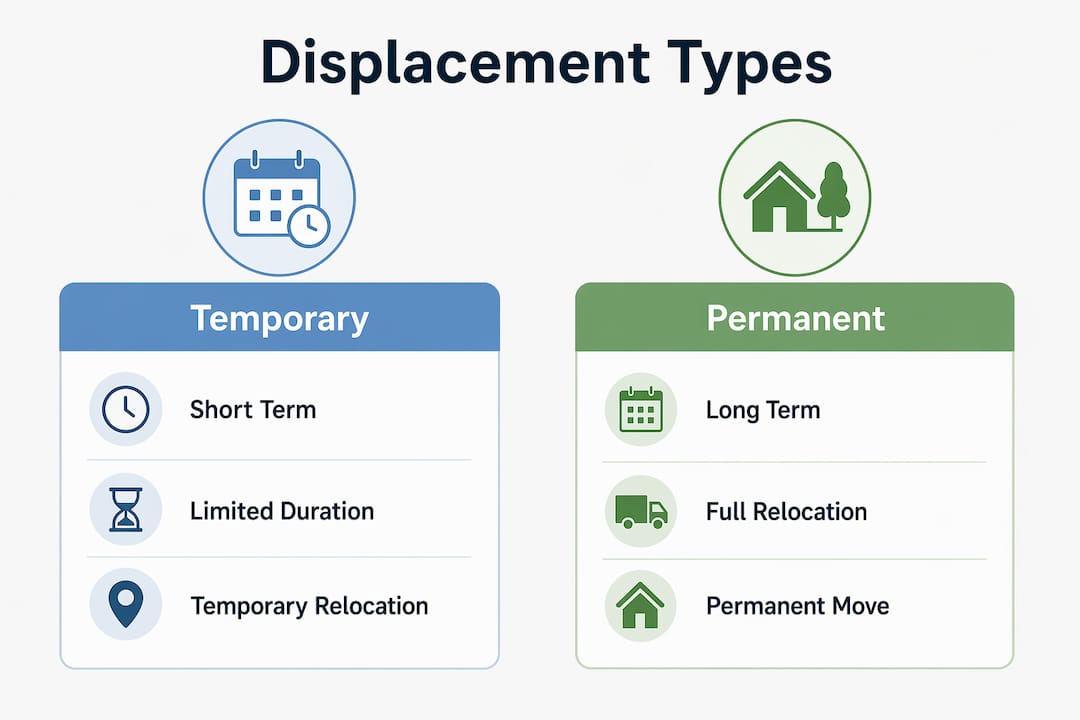
Temporary vs. permanent displacement is a critical distinction. Temporary relocation is limited by federal standards to a defined maximum duration; it requires reimbursement for reasonable out-of-pocket expenses and placement in a decent, safe, and sanitary dwelling. If the move extends beyond 12 months, the tenant is treated as permanently displaced and becomes eligible for the full suite of permanent relocation benefits. Eligibility begins at the initiation of negotiations or a binding written agreement, whichever comes first, so teams must treat that date conservatively.
Trigger scenario examples: Minor repairs that do not require tenants to vacate do not trigger URA. Substantial rehabilitation requiring vacancy, even temporarily, does trigger URA. Acquisition of an occupied property using CDBG-DR funds triggers full URA compliance for every occupant.
What Notices and Advisory Services Are Required?
Four core notices govern URA compliance, each with specific timing and content requirements:
- General Information Notice (GIN): Delivered before funding application submission; informs occupants of the intent to apply federal funds and their potential rights.
- Notice of Relocation Eligibility (NOE/NORE): Issued once eligibility is confirmed; starts the clock on relocation benefits.
- 90-Day Notice to Vacate: Must be delivered at least 90 days before the required move date; no occupant may be required to move without it.
- Notice of Temporary Displacement: Issued when a temporary move is required; must specify the duration, temporary housing location, and reimbursement process.
Every notice must be written in plain language. Persons with limited English proficiency or disabilities must receive translation, interpretation, or alternative-format assistance. Delivery must be by hand or certified mail with return receipt; the 2024 Final Rule now also permits electronic delivery when the agency can document receipt. All delivery receipts must be retained in the tenant’s relocation file.
Relocation advisory services go beyond notice delivery. They include needs assessment interviews, replacement housing search assistance, referrals to social services, and documentation support for claims. TDHCA requires draft notices to be submitted with the Relocation Plan for state review before issuance to tenants.
Pro Tip: Build a notice delivery log in a shared project folder from day one. Record the date, method, recipient name, and file the signed receipt or certified mail confirmation immediately. Auditors treat an undocumented notice as a notice that was never sent.
How Are Relocation Payments Calculated?
Eligibility for payments begins when a person qualifies as displaced under 49 CFR Part 24. Residential tenants, owner-occupants, and certain businesses each have distinct payment categories.
| Payment Category | Eligible Persons | Key Inputs |
|---|---|---|
| Moving cost reimbursement | Residents and businesses | Actual cost or FHWA Fixed Moving Cost Schedule |
| Replacement housing payment | Displaced residential tenants | Rent differential over several years |
| Temporary relocation reimbursement | Temporarily displaced tenants | Actual out-of-pocket expenses |
| Reestablishment expenses | Displaced businesses | Actual costs, subject to regulatory caps |
HUD Form 40061 is the standard tool for selecting the most representative comparable replacement dwelling and computing a rental assistance payment. The FHWA Fixed Residential Moving Cost Schedule provides a schedule-based alternative to actual-cost moving reimbursements, which simplifies budgeting and claims processing.
A worked example: A tenant pays $900/month in rent. The most comparable available replacement unit rents for $1,200/month. The monthly rent differential is $300. The total replacement housing payment is calculated by multiplying the monthly rent differential by the applicable period (typically 42 months for tenants under standard URA rules), resulting in a payment of $12,600. That figure must be documented using Form 40061 and supported by at least three comparable unit listings.
Relocation payments are not considered income for federal income tax purposes under 26 U.S.C. § 216, which is a point worth communicating clearly to displaced households during advisory services. Budgeting for relocation early prevents project viability issues; relocation costs can materially affect feasibility and must be included in pre-award budgets.
How to Plan Real Property Acquisition Under URA
Acquisition planning under the URA follows a defined sequence. Effective relocation planning requires early occupant surveys, realistic budget projections, and dedicated staffing for notices and claims administration.
| URA Milestone | Typical Duration | Decision Point |
|---|---|---|
| Property identification and occupant survey | 2–4 weeks | Confirms trigger and occupant count |
| Appraisal and title review | 4 weeks | Establishes just compensation basis |
| Environmental review / AUGF clearance | 4–12 weeks | Must precede binding acquisition commitment |
| GIN distribution | Before funding application | Triggers eligibility clock |
| Offer and negotiation | 4 weeks | Initiates negotiations; starts eligibility |
| 90-day notice issuance | At least 90 days before move | Required before any required vacancy |
| Closing and relocation payments | Concurrent with construction | Claims filed and paid per approved plan |
Project teams consistently underestimate the environmental review window and the time required to locate comparable replacement housing in tight markets. For projects where replacement housing is scarce, the Relocation Plan must include “housing of last resort” provisions and a corresponding budget line item.
Acquisition budget line items must include: purchase at fair market value, closing costs, appraisal fees, environmental review costs, relocation payments (moving, replacement housing, temporary reimbursements), advisory services staffing, and a contingency reserve. HUD advises agencies to minimize displacement through project phasing where feasible, such as staging rehabilitation to allow tenants to remain in unaffected units.
Documentation and Audit Readiness for URA Claims
A URA claims file that cannot survive a monitoring visit is a liability, not a record. Core records to retain for every displaced person include:
- Signed and dated GIN with proof of delivery
- Completed needs assessment interview notes
- Rent roll at application and updated rent rolls through project close
- Signed NOE/NORE and 90-day notice with delivery receipts
- Comparable replacement housing documentation (Form 40061 or equivalent)
- Moving cost receipts or FHWA schedule election form
- Claim worksheets with supporting calculations
- Payment approval records and disbursement documentation
- Appeals correspondence, if any
The Relocation Specialist reviews and signs off on each claim before payment. The grant recipient or subrecipient retains ultimate responsibility for compliance; CDBG-DR recipients are liable for the actions of their subrecipients, which means a weak subrecipient file becomes the grantee’s audit finding.
Pro Tip: Organize each tenant’s relocation file as a numbered folder (physical or digital) with a cover sheet listing every required document and its completion date. Auditors move faster through organized files, and a complete cover sheet signals a well-managed program before a single page is reviewed.
How to Build a URA-Compliant Relocation Plan
A Relocation Plan must be scaled to project complexity and include, at minimum, estimated relocation costs and the number of households affected. HUD guideforms in Appendix 2 of HUD Handbook 1378 are the recommended starting point.
- Trigger assessment: Confirm federal funding source and identify all program activities that could cause displacement.
- Occupant survey: Document every residential and commercial occupant, their lease terms, income, and special needs.
- Budget development: Calculate replacement housing payments, moving costs, advisory services, and a contingency reserve.
- Notices schedule: Map each required notice to its trigger date and assign delivery responsibility.
- Advisory services assignment: Designate or contract a Relocation Specialist; define scope and reporting lines.
- Claims process setup: Establish the claims workflow, approval authority, and file structure before any notices are issued.
- Monitoring and updates: Schedule plan reviews at key project milestones and update cost estimates as market rents change.
Roles: The project developer owns the plan and budget. The grant recipient or subrecipient is legally responsible for compliance. The Relocation Specialist drafts notices, conducts interviews, and processes claims. Legal counsel reviews trigger determinations and any contested eligibility decisions.
State templates accelerate drafting. TDHCA’s Relocation Handbook provides notice templates, rent roll formats, and budget worksheets calibrated to Texas HOME and HTF programs. For multi-state or multi-funder projects, confirm with the cognizant HUD field office which template set governs. Submit the draft Relocation Plan to the funding agency for review before issuing any notices to tenants.
Common URA Compliance Mistakes and How to Avoid Them
Most URA audit findings trace back to a small set of recurring errors. Recognizing them before submission is far less costly than correcting them under a monitoring finding.
- Failing to identify occupants before funding: Any tenant who moves after the GIN is issued may claim eligibility. Missing occupants at application creates retroactive liability.
- Late or inadequate notices: A GIN issued after funding application submission, or a 90-day notice with missing contact information, is a defective notice and may restart the clock.
- Underbudgeted replacement housing: Replacement housing payments are calculated on market comparables at the time of displacement, not at project underwriting. Rising rents between application and construction can significantly increase costs.
- Skipped advisory services: Advisory services are not optional. Failing to conduct needs assessment interviews or provide housing search assistance is a standalone compliance failure.
- Weak documentation: Missing receipts, unsigned notices, and undocumented rent comparisons are the top findings in HUD monitoring reviews.
“One of the key requirements for ensuring CDBG-DR funds are used appropriately in accordance with the URA is implementing a recordkeeping policy that is clear, consistent, and chronological.”
— Texas GLO URA Brief
Pro Tip: Before submitting a funding application, run a one-page compliance checklist against the five items above. If any box is unchecked, resolve it before submission. Funders increasingly flag incomplete relocation plans at the application stage, which delays award.
Key Takeaways
The most critical URA compliance action is confirming the federal funding trigger and distributing the General Information Notice before submitting a funding application, because eligibility obligations begin at that point and cannot be retroactively corrected.
| Point | Details |
|---|---|
| Confirm the funding trigger first | Any federal funding in any project phase activates full URA compliance for the entire project. |
| Issue the GIN before application | Tenants who move after GIN distribution may claim eligibility; late GINs create retroactive liability. |
| Budget relocation before award | Replacement housing payments, moving costs, and advisory services must appear in pre-award budgets. |
| Appoint a Relocation Specialist early | Specialists prevent notice timing failures and build the claims file structure from day one. |
| Retain complete, chronological records | Auditors treat an undocumented notice or missing receipt as a compliance failure, regardless of intent. |
Why URA Compliance Demands a Proactive Approach
The most persistent misconception about URA compliance is that it is primarily a paperwork exercise, something to address after the design and financing are locked. That framing consistently produces the same outcome: a project team scrambling to reconstruct occupant histories, backdate advisory service records, or renegotiate budgets after a monitoring visit has already flagged deficiencies.
The statute’s logic runs in the opposite direction. URA obligations attach at the moment federal funding is confirmed, not at construction commencement. A project that distributes the GIN late, skips the occupant survey, or fails to budget replacement housing payments at application is already non-compliant before a shovel enters the ground. The 2024 Final Rule’s updates to payment caps and electronic notice delivery make this even more consequential: teams operating under outdated policies may be calculating benefits incorrectly across an entire program.
The practical implication is straightforward. Treat URA compliance as a pre-design workstream, not a pre-construction checklist. The trigger screen and occupant survey should run in parallel with the environmental review, not after it. Relocation Specialists should be contracted at the same time as the design team. For Singapore-based developers coordinating multi-jurisdiction projects, integrating regulatory compliance planning across U.S. federal requirements and local authority submissions is where projects most often lose schedule.
Primary Sources, Templates, and Further Reading
The sources below are the authoritative references for URA compliance. Download the forms and templates before drafting any project-specific notices or relocation plans.
- HUD Handbook 1378: The primary reference for all URA requirements, sample notices, guideforms (including the Relocation Plan guideform in Appendix 2), and Form 40061 for comparable replacement dwelling selection.
- HUD Real Estate Acquisition and Relocation page: Summary of the URA, 49 CFR Part 24, and the 2024 Final Rule; links to FHWA as the designated Federal Lead Agency.
- FHWA Fixed Residential Moving Cost Schedule: Standard schedule for moving cost reimbursements; use as an alternative to actual-cost documentation.
- TDHCA Relocation Handbook (2020 Edition): State-level templates for notices, rent rolls, and budget worksheets; useful for HOME and HTF-funded projects.
- New Jersey DCA URA Policy Manual Version 2.0: Detailed state policy manual covering triggers, temporary relocation rules, and notice requirements.
- OpportunityIowa URA Guidance Document: Acquisition planning steps, occupant survey methodology, and Relocation Plan content requirements.
- Texas GLO URA Brief: Concise summary of URA guiding principles, voluntary acquisition rules, and common compliance issues for CDBG-DR programs.
| Template | Primary Use | Source |
|---|---|---|
| HUD Relocation Plan Guideform (Appendix 2, HUD Handbook 1378) | Drafting or reviewing a project Relocation Plan | HUD Handbook 1378 |
| HUD Form 40061 | Selecting comparable replacement dwelling and computing rental assistance payment | HUD / FHWA Uniform Act resources |
| FHWA Fixed Moving Cost Schedule | Moving cost reimbursement without actual-cost receipts | FHWA Uniform Act page |
| TDHCA Rent Roll and Notice Templates | State-funded projects; rent roll formatting at application | TDHCA Relocation Handbook |