
M&E engineering sits at the operational core of virtually every building you enter, yet the term itself causes persistent confusion among developers, students, and construction professionals alike. What is M&E engineering, exactly, and why does getting the definition right matter so much in practice? M&E stands for Mechanical and Electrical services, covering the full spectrum of systems that manage essential building functions from ventilation and power distribution to fire alarms and plumbing. This guide unpacks the discipline from foundational definitions through to lifecycle management, compliance obligations, and emerging best practices.
Table of Contents
- Key Takeaways
- What is M&E engineering: definition and scope
- The role of M&E engineers in project delivery
- M&E vs. MEP: understanding the terminology
- The operational importance of M&E in building lifecycle
- M&E engineering best practices and emerging trends
- My perspective on M&E engineering’s evolving role
- How Aectechnicalsg supports your M&E engineering projects
- FAQ
Key Takeaways
| Point | Details |
|---|---|
| M&E covers two core disciplines | Mechanical and Electrical systems are designed and managed together to deliver safe, functional buildings. |
| M&E is not the same as MEP | MEP explicitly separates plumbing as its own discipline; M&E scope varies by region and contract. |
| M&E engineers own the full lifecycle | Their responsibilities span design, coordination, commissioning, compliance, and ongoing maintenance. |
| Poor maintenance has measurable costs | Neglected M&E systems can increase energy consumption by up to 30%, raising operational costs significantly. |
| Early coordination prevents costly clashes | Resolving mechanical and electrical system conflicts during design is far less expensive than fixing them on site. |
What is M&E engineering: definition and scope
At its most direct, M&E engineering is the discipline that designs, installs, commissions, and maintains the mechanical and electrical systems that make a building function. M&E work focuses on coordination rather than treating these two disciplines as isolated silos, which is the key distinction most introductory definitions miss. A building without functioning HVAC, reliable power, or compliant fire detection is not a building anyone can safely occupy. M&E engineering is what prevents that outcome.
The mechanical side of M&E covers systems that involve physical movement, fluid dynamics, and thermal management. These include heating, ventilation, and air conditioning (HVAC), cold and hot water plumbing, pumps and pressurization systems, lifts and escalators, and exhaust or smoke control systems. The electrical side covers power distribution, low-voltage switchgear, interior and exterior lighting, emergency and exit lighting, fire alarm and detection systems, data and communications cabling, and building controls. Together, these systems account for a substantial portion of total construction cost and, more critically, nearly all ongoing operational expenditure in a completed building.
Mechanical vs. electrical: key systems compared
The table below illustrates how mechanical and electrical systems differ in function while sharing common performance goals within a building.
| Category | Mechanical Systems | Electrical Systems |
|---|---|---|
| Primary function | Thermal control, fluid movement, ventilation | Power supply, lighting, communications, controls |
| Key examples | HVAC, pumps, lifts, plumbing, smoke extract | Switchboards, lighting, fire alarms, data cabling |
| Design tools used | Hydraulic calculations, CFD modeling, load schedules | Single-line diagrams, load calculations, cable schedules |
| Regulatory focus | Energy efficiency, indoor air quality, water safety | Electrical safety, protection coordination, code compliance |
| Overlap areas | BMS integration, emergency systems, energy metering | BMS integration, emergency systems, energy metering |
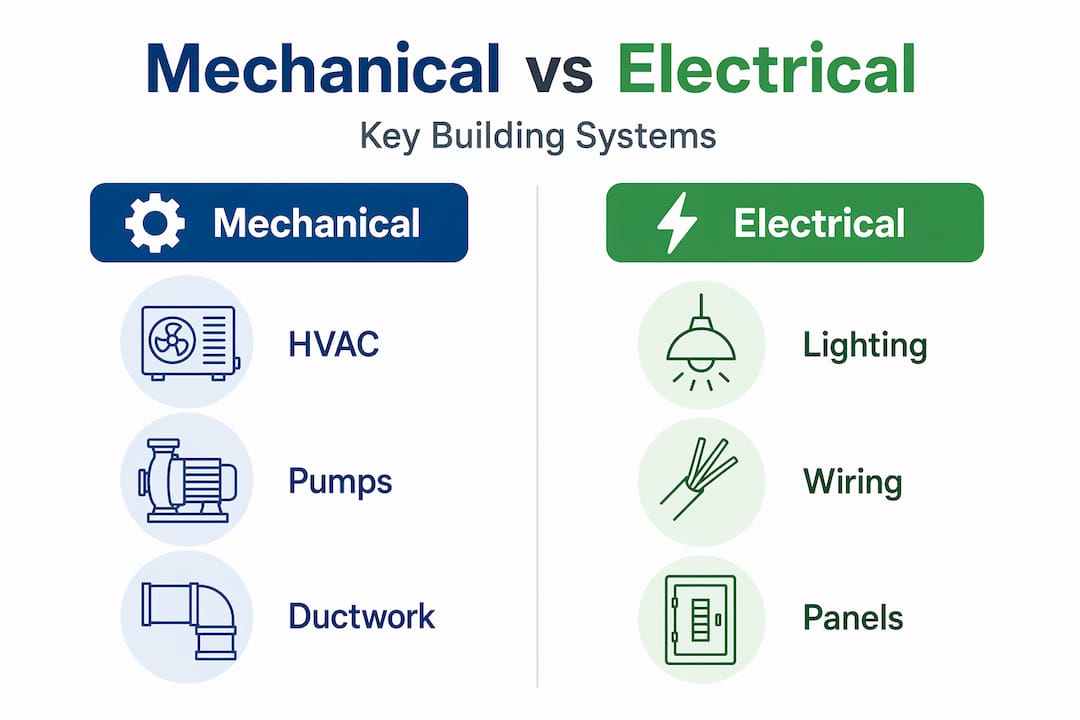
The overlap row in that table is not trivial. Building management systems (BMS), emergency power, and energy metering require both mechanical plant and electrical controls to function as one coordinated system. That integration point is precisely where M&E engineering provides its highest value and where poorly coordinated projects encounter the most expensive problems.
The role of M&E engineers in project delivery
M&E engineers oversee design, installation, compliance, commissioning, and lifecycle management across the full span of a construction project. Their involvement is not limited to drawing up specifications in an office. It extends from the earliest design workshops through to post-occupancy performance verification.
The following outlines the core responsibilities that define the role of M&E engineering across a typical project lifecycle:
- Concept design and load estimation. M&E engineers calculate heating and cooling loads, electrical demand, water flow rates, and fire protection requirements based on the building’s intended use and occupancy.
- Detailed design and specifications. They produce technical drawings, equipment schedules, and performance specifications that contractors use to price and install systems.
- Clash detection and coordination. Using BIM coordination workflows, M&E engineers identify where mechanical ductwork, pipework, and cable trays conflict with structural elements or each other before any physical installation begins.
- Contractor oversight and site inspections. M&E engineers review shop drawings, attend site inspections, and issue technical instructions when installed conditions deviate from design intent.
- Commissioning and testing. They verify that all mechanical and electrical systems operate at their designed parameters, producing commissioning reports that form the basis of regulatory submissions.
- Regulatory submissions and authority approvals. In Singapore, this includes submissions to SCDF for fire protection, BCA for building services compliance, and PUB for water and drainage systems.
- Handover and as-built documentation. Complete operation and maintenance manuals, as-built drawings, and equipment warranties are compiled for the building owner or facilities management team.
Pro Tip: When reviewing an M&E consultant’s scope of services at the start of a project, confirm explicitly whether commissioning and authority submission support are included. Many scopes end at detailed design, leaving developers to manage approvals independently, which frequently causes delays.
Understanding the importance of M&E engineering in Singapore’s regulatory environment is especially relevant for developers submitting to multiple agencies simultaneously. A single M&E submission package may need to satisfy BCA, SCDF, PUB, and NEA requirements concurrently, each with distinct technical standards and submission formats.
M&E vs. MEP: understanding the terminology
One of the most consistent sources of confusion in construction procurement is the difference between M&E and MEP. Terminology varies, so clarifying scope is crucial in project planning. Getting this wrong at the tendering stage leads to pricing gaps, scope disputes, and delays.
Here is what the distinction actually means in practice:
- MEP stands for Mechanical, Electrical, and Plumbing. It treats plumbing as a fully separate discipline with its own design engineer, documentation, and regulatory submissions.
- M&E may or may not include plumbing, depending on the contract, the regional market, and the convention used by the project team. In many UK and Singapore projects, plumbing sits within the mechanical scope under M&E.
- In some contracts, the term building services is used interchangeably with both M&E and MEP, adding another layer of ambiguity.
- In the United States and parts of the Middle East, MEP is the dominant term. In the UK, Singapore, and much of Southeast Asia, M&E is more commonly used, though often with plumbing included under mechanical.
- Fire protection services may appear under either mechanical or a separate specialist discipline, depending on project size and authority requirements.
Pro Tip: Before signing any M&E or MEP consultancy agreement, request an explicit scope of services matrix that lists every system by name and confirms which discipline owns its design, documentation, and commissioning. This single step prevents the majority of scope disputes that arise during construction.
Clarifying what falls inside mechanical vs. electrical scope prevents costly misunderstandings in budgeting and project delivery. A project that budgets for M&E but excludes plumbing can face a substantial uncosted gap when the contractor’s tender comes back.
The operational importance of M&E in building lifecycle
M&E engineering does not end at practical completion. The systems designed and installed during construction require structured maintenance programs to perform safely and efficiently throughout the building’s operational life. M&E systems should be treated as connected assets, requiring coordinated maintenance to avoid failures and unnecessary system conflicts.

Building services account for approximately 45% of total energy use in UK commercial buildings, and comparable figures apply across Singapore’s commercial and industrial sectors. This figure reflects why facilities managers and building owners cannot afford to treat M&E maintenance as a reactive, fix-it-when-it-breaks activity.
The table below summarizes the measurable impact of well-managed versus poorly maintained M&E systems:
| Maintenance Approach | Energy Impact | Cost Impact | Safety Risk |
|---|---|---|---|
| Planned preventive maintenance | Optimized consumption, up to 30% savings | Reduced lifecycle costs, fewer emergency repairs | Regulatory compliance maintained |
| Reactive maintenance only | Energy consumption increases by up to 30% | Higher emergency repair costs, unplanned downtime | Increased risk of system failure and regulatory non-compliance |
| No formal maintenance program | Significant degradation in system performance | High capital replacement costs earlier than expected | Serious safety and legal exposure |
Facilities teams managing M&E as connected assets reduce repeat failures by treating HVAC controls, BMS signal integrity, and mechanical plant as interdependent rather than independent systems. A chiller that repeatedly trips may not indicate a mechanical fault. It may be a BMS control signal issue, an electrical protection miscoordination, or a cooling tower water treatment failure. Diagnosing it correctly requires an integrated view.
Common planned maintenance activities across M&E disciplines include:
- Quarterly HVAC filter replacement and coil inspections
- Annual testing of emergency lighting and fire detection systems
- Biannual inspection of electrical distribution boards and protection relay settings
- Routine calibration of BMS sensors and actuators
- Annual thermographic scanning of electrical switchgear to identify hot spots before failure
M&E engineering best practices and emerging trends
The integration of smart technologies, sustainable engineering practices, and digital tools like BIM and CFD modeling is reshaping how M&E systems are designed and maintained. These are not peripheral developments. They are changing the baseline standard of what a well-executed M&E project looks like.
Current M&E engineering best practices reflect both proven coordination principles and newer technology-driven methodologies:
- Coordinate early in design. M&E coordination workshops conducted during the schematic design phase resolve system clashes before they become expensive installation problems. This is consistently where project budgets are protected or eroded.
- Adopt BIM level 2 coordination. Full 3D coordination of mechanical ductwork, pipework, cable trays, and structural elements reduces site variations and improves installation quality.
- Specify sustainability targets from day one. Green Mark certification in Singapore, and equivalent sustainability ratings elsewhere, requires M&E systems to meet specific energy performance benchmarks. These targets must be embedded in the design brief, not added retrospectively.
- Integrate BMS with IoT sensors. Real-time monitoring of HVAC performance, power quality, and water consumption enables predictive maintenance and reduces energy waste.
- Use digital twins for lifecycle management. A building’s digital twin, linked to live sensor data, allows facilities managers to model the impact of operational changes before implementing them physically.
Pro Tip: When procuring M&E design services for a Singapore project, confirm that the consultant’s BIM deliverables meet BCA’s required Level of Development specifications. Submitting a model that does not meet LOD requirements will result in resubmission delays.
My perspective on M&E engineering’s evolving role
In my experience working across construction and infrastructure projects in Singapore, the single most persistent problem with M&E engineering is not technical incompetence. It is structural undervaluation. Developers frequently treat M&E as a cost to be minimized rather than an investment that determines building performance for the next 30 years.
I have seen projects where M&E consultants were appointed months after the architectural design was effectively frozen. The result is always the same: costly design revisions, installation clashes on site, and commissioning programs that run weeks over schedule because systems that were never coordinated in design simply do not perform as specified during testing. The financial damage from that sequence consistently exceeds what early M&E appointment would have cost.
What I find most encouraging in the current environment is the growing adoption of integrated project delivery workflows that bring M&E engineers into the design process at the concept stage, not as a downstream check. Singapore’s regulatory framework, with its requirements for coordinated submissions across multiple authorities, is actually pushing the industry in the right direction. Compliance pressure is creating coordination discipline that pure professional practice alone has not always achieved.
For students and professionals entering this field: the greatest competitive advantage you can build is fluency in both mechanical and electrical disciplines simultaneously. The engineers who can speak credibly across both domains, understand the BMS integration layer, and navigate Singapore’s authority submission requirements are consistently the most valuable on any project team.
— Aman
How Aectechnicalsg supports your M&E engineering projects
For developers and construction firms working through Singapore’s complex multi-authority approval process, having the right M&E engineering consultancy matters as much as having the right design.

Aectechnicalsg provides technical advisory and engineering consultancy services that cover M&E engineering from design through regulatory submissions to agencies including SCDF, BCA, PUB, and NEA. The team’s engineering consultancy services for Singapore developers are structured to address the full project lifecycle, from concept coordination to PE endorsement and authority submissions. Whether you are managing a new development, a major refurbishment, or a change-of-use project with complex building services requirements, Aectechnicalsg offers the technical depth and regulatory experience to move your project forward without unnecessary delays.
FAQ
What does M&E stand for in engineering?
M&E stands for Mechanical and Electrical, referring to the combined discipline that covers building systems including HVAC, plumbing, power distribution, lighting, fire detection, and controls. These systems are typically designed and managed together to deliver coordinated building performance.
What is the difference between M&E and MEP?
MEP explicitly includes plumbing as a separate discipline alongside mechanical and electrical engineering, while M&E may or may not include plumbing depending on the contract scope and regional convention. In Singapore and the UK, plumbing is often grouped within the mechanical scope under an M&E appointment.
What do M&E engineers do on a construction project?
M&E engineers manage design, installation, compliance, commissioning, and lifecycle management across all mechanical and electrical building systems. Their responsibilities include reviewing proposals, resolving system clashes, coordinating authority submissions, and verifying that installed systems meet performance specifications.
Why is M&E engineering important for building operations?
Poorly maintained M&E systems directly impact safety and operating costs. Building services represent a major share of a building’s total energy consumption, and neglected systems can increase energy use by up to 30%, creating both financial and regulatory exposure for building owners.
How does M&E engineering relate to Singapore’s regulatory submissions?
In Singapore, M&E engineering designs require coordinated submissions to multiple authorities including SCDF for fire protection, BCA for building services compliance, and PUB for water and sanitary systems. Engaging a qualified M&E consultant with experience in Singapore’s building codes is necessary to navigate these parallel approval processes correctly.