
Structural submission is defined as the formal process of providing documented structural design evidence, calculations, and endorsements to a regulatory authority for approval before construction work begins. In Singapore, the Building and Construction Authority (BCA) governs this process, requiring developers and engineers to demonstrate that a proposed structure meets all safety, code compliance, and technical standards before any permit is issued. Without an approved structural submission, no structural work can legally commence on site. For construction professionals and property developers operating in Singapore, understanding the definition of structural submission is not optional. It is the foundation of every compliant project.
What is structural submission and why does it matter?
Structural submission is the industry term for the formal documentation package submitted to a regulatory authority to obtain structural plan approval. The process encompasses design drawings, engineering calculations, Professional Engineer (PE) endorsements, and evidence of construction controls, all organized to demonstrate that a building’s structure is safe and code-compliant.
The importance of structural submission extends beyond paperwork. It is the primary mechanism by which BCA and other agencies verify that structural design decisions are technically sound before they are built into permanent works. A rejected or delayed submission directly delays the issuance of a permit to commence structural works, which cascades into program delays and cost overruns.

Singapore’s regulatory framework also requires that PE endorsements are obtained from qualified Qualified Persons (QPs), typically Professional Engineers registered with the Professional Engineers Board (PEB). These endorsements confirm accountability for the design and are a non-negotiable component of every structural submission. The QP takes legal responsibility for the accuracy and adequacy of the submitted documents.
International frameworks reinforce this logic. The Institution of Structural Engineers published guidance confirming that structural submissions function as formal verification steps before construction phases proceed, covering statutory frameworks, documentation standards, quality control, and procurement impact. Singapore’s BCA framework operates on the same principle, with the submission serving as a stop-and-verify gate before structural work starts.
What documents are required in a structural submission?
A complete structural submission is not a single document. It is an organized package of interrelated technical records, each serving a specific verification purpose. The following components are required in a typical Singapore structural submission:
- Structural design drawings. These include plan layouts, sections, elevations, and details at sufficient scale for review. Where Building Information Modeling (BIM) is used, IFC files may be required alongside 2D drawings to support model-based coordination.
- Structural calculation schedules. These are the engineering calculations that justify member sizes, load paths, foundation design, and material specifications. Calculations must be clearly referenced to the corresponding drawing elements.
- Technical specifications. These define material grades, construction tolerances, testing requirements, and workmanship standards. Specifications must align with Singapore Standards and, where applicable, Eurocodes adopted under SS EN 1992 and SS EN 1993.
- PE endorsement and competence statements. The QP must sign and stamp all key submission documents. Competence statements confirm that the engineer holds the appropriate registration and experience for the scope of work.
- Change management documentation. Any design changes after initial submission must be formally recorded, with version-controlled revisions clearly identified. Version control is a common pain point. Ensuring that IFC files, drawings, and calculation files carry synchronized version numbers prevents regulator queries that stall approvals.
- Construction phase controls. These include inspection and testing plans, hold points, and quality control procedures that demonstrate how structural safety will be maintained during construction.
Pro Tip: Cross-reference every calculation schedule entry to its corresponding drawing reference number. Regulators at BCA prioritize traceability. A submission where calculations and drawings cannot be matched quickly will generate clarification requests that add weeks to the review timeline.
Deferred submittal procedures also apply in Singapore for complex components not finalized at initial submission. Deferred submittals require prior approval from the reviewing authority and must match the approved design intent. This is common for post-tensioning systems, prefabricated structural elements, and specialist facade connections.
How does the structural submission process work in Singapore?
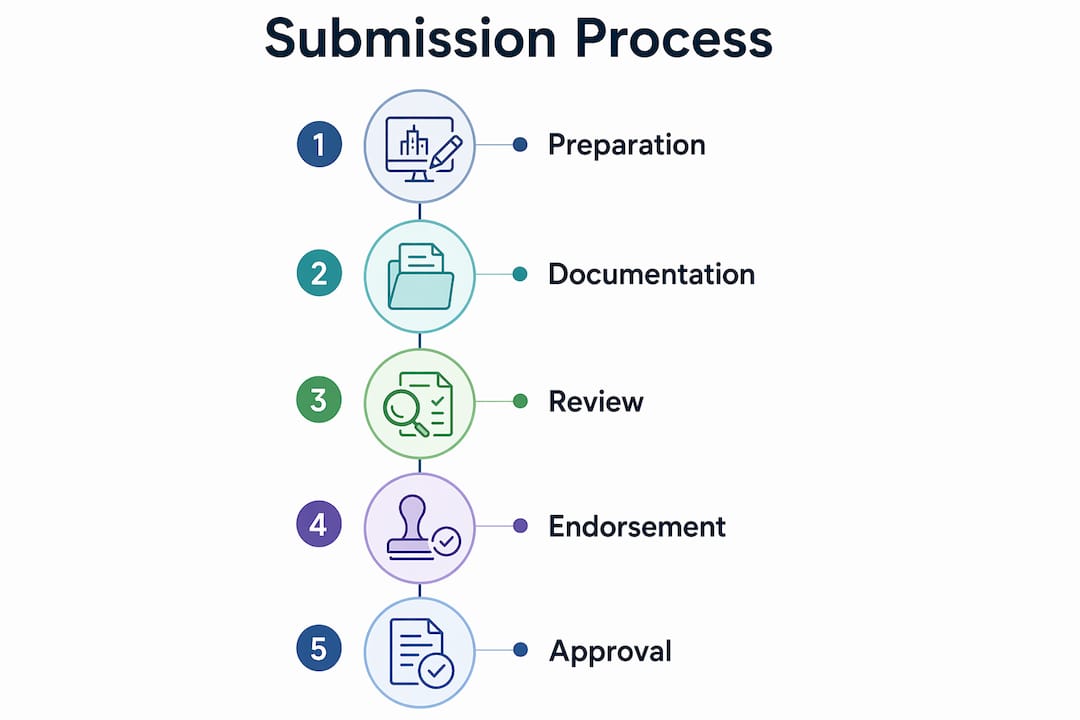
The structural submission process in Singapore follows a defined sequence of steps, each with specific responsibilities assigned to the QP, developer, and contractor. Understanding this workflow prevents procedural errors that cause unnecessary delays.
- Appoint a Qualified Person (QP). The developer must appoint a PE registered with PEB as the QP for structural works. The QP is legally responsible for the submission and all endorsed documents. This appointment must be formalized before any submission is lodged.
- Prepare and coordinate submission documents. The QP coordinates with the architectural QP, M&E engineers, and geotechnical consultants to produce a complete, coordinated package. Structural drawings must be consistent with architectural plans and site boundary conditions.
- Lodge the submission via BCA’s CORENET system. Singapore uses the CORENET e-Submission System for electronic lodgment of structural plans. Documents are uploaded, fees are paid, and the submission is assigned a reference number for tracking.
- Respond to BCA queries. BCA’s plan checkers review the submission and may issue Requests for Information (RFIs) or technical queries. The QP must respond within the stipulated timeframe. Assigning clear RACI roles for query responses within digital platforms prevents delays by establishing accountability and traceability.
- Obtain structural plan approval. Once BCA is satisfied, structural plan approval is granted. This approval is a prerequisite for the issuance of a permit to commence structural works.
- Manage construction phase submissions. During construction, the QP supervises structural works and submits progress reports, inspection records, and any approved design amendments. At project completion, a structural completion certificate is submitted to BCA.
The construction approval workflow in Singapore also involves coordination with other agencies. Depending on the project type, submissions may be required to JTC for industrial developments, LTA for projects near roads or MRT infrastructure, and PUB for drainage and sewerage impacts. Each agency has its own review timeline and technical requirements, making early coordination with all relevant bodies a critical success factor.
What causes delays and rejections in structural submissions?
Delays and rejections in structural submissions share a consistent set of root causes. Identifying these early allows project teams to address them before lodgment rather than after.
- Uncoordinated models and drawings. When structural drawings conflict with architectural plans or the BIM model does not match the 2D submission set, BCA plan checkers raise queries that require full document revisions. Regulators prioritize clarity and consistency over large document volumes. A smaller, well-coordinated package outperforms a large, inconsistent one every time.
- Insufficient PE competence evidence. Submissions that lack clear PE registration details, scope of endorsement, or evidence of relevant experience for specialized structural systems are routinely queried. This is particularly relevant for projects involving transfer structures, deep basements, or post-tensioned slabs.
- Poor version control. Submitting documents with mismatched revision numbers, undated drawings, or superseded calculations is one of the most common causes of BCA queries. Every document in the package must carry a consistent revision identifier.
- Weak construction phase controls. BCA expects to see how structural safety will be maintained during construction, not just in design. Submissions that omit inspection and testing plans or fail to define hold points for critical structural elements are frequently returned for revision.
- Inadequate change management records. When design changes occur between submission and construction, the amendment process must be formally documented and re-endorsed by the QP. Undocumented changes discovered during site inspections can result in stop-work orders.
Pro Tip: Before lodging any submission, conduct an internal pre-submission audit using BCA’s published checklist. Assign one team member specifically to cross-check document version numbers across all files. This single step eliminates the most common category of BCA queries.
How to prepare an effective structural submission
Treating the structural submission as an integrated information product rather than a collection of documents is the single most effective shift a project team can make. Successful submissions cross-reference models, drawings, and calculation schedules with clear ownership assignments and digital change control processes, enabling rapid regulator responses.
The table below outlines the key preparation practices and their direct impact on submission quality:
| Preparation Practice | Purpose | Outcome |
|---|---|---|
| Common Data Environment (CDE) | Centralizes all documents with version control and access logs | Eliminates mismatched revisions across disciplines |
| Cross-reference table | Links each calculation reference to its drawing and specification clause | Enables BCA plan checkers to verify compliance quickly |
| RACI matrix for queries | Assigns responsibility for each document type and query category | Reduces response time to BCA RFIs |
| Coordinated structural and fire safety strategy | Integrates structural and fire safety documentation within one submission | Improves regulatory confidence and reduces cross-agency queries |
| Pre-submission internal audit | Reviews all documents against BCA checklist before lodgment | Catches errors before they become formal queries |
Digital coordination environments and Common Data Environments are central to managing structural submission documents for version control and traceability. Platforms that link BIM models, calculation schedules, and coordinated drawings in a single environment minimize errors and improve regulatory review speed. Singapore’s BCA has progressively encouraged BIM adoption, and projects above certain gross floor area thresholds already require BIM submissions.
Coordinating structural and fire safety strategies within the same submission package also improves regulatory confidence. When BCA and SCDF can see that structural and fire safety design decisions are mutually consistent, the likelihood of cross-agency queries drops significantly. This coordination is particularly important for buildings with complex structural systems such as transfer floors, atria, or large-span roofs.
Key takeaways
Structural submission is the mandatory documentation gate that protects both public safety and project timelines. Treating it as an organized information product, with coordinated documents, clear PE endorsements, and version-controlled change management, is the most reliable path to timely BCA approval.
| Point | Details |
|---|---|
| Regulatory authority | BCA governs structural submissions in Singapore; PE endorsement by a registered QP is mandatory. |
| Core document package | Submissions must include design drawings, calculation schedules, specifications, PE endorsements, and construction controls. |
| Version control | Synchronized revision numbers across IFC files, drawings, and calculations prevent the most common BCA queries. |
| Process sequence | Submissions follow a defined workflow from QP appointment through CORENET lodgment to structural plan approval. |
| Integrated approach | Treating the submission as a cross-referenced information product, not a document dump, accelerates regulatory review. |
The case for treating submission as a discipline, not a deadline
From my experience working across Singapore construction projects, the teams that struggle most with structural submissions share one characteristic. They treat the submission as a final task to complete before construction, rather than as a discipline that runs parallel to design from day one. By the time they are assembling the package, drawings have been revised multiple times without formal change records, calculation files carry inconsistent revision numbers, and the PE endorsement scope has never been formally defined. The result is a submission that generates a long list of BCA queries, each requiring a coordinated response across multiple consultants.
The teams that consistently achieve first-round approvals do the opposite. They establish a Common Data Environment at project inception, define the QP’s endorsement scope in the appointment letter, and run internal submission audits at each design stage gate. They also coordinate structural and fire safety strategies early, which eliminates a significant source of cross-agency friction. Singapore’s construction sector is moving toward greater digital integration, and the BCA’s progressive BIM requirements signal that this direction will only accelerate. Professionals who build submission discipline into their project workflows now will find the transition to more rigorous digital submission requirements far less disruptive than those who continue to treat it as a last-minute exercise.
The structural submission process rewards preparation and penalizes improvisation. That is not a bureaucratic inconvenience. It is a safety mechanism that protects the public and, ultimately, the professional reputation of every engineer and developer who signs off on a building.
— Aman
How Aectechnicalsg supports your structural submission
Aectechnicalsg provides end-to-end engineering consultancy for construction professionals and property developers navigating Singapore’s structural submission requirements. From PE endorsement and BCA plan submission to multi-agency coordination with JTC, LTA, and SCDF, the team brings direct regulatory experience to every project stage.
Whether you are preparing a first structural submission or managing amendments on a complex development, Aectechnicalsg’s consultants can audit your document package, coordinate BIM-based submissions, and manage query responses to keep your project on schedule. Explore the full range of engineering consultancy services available for Singapore developers, or review the specific PE endorsement and authority submission services to understand how professional accountability is managed from design through completion.
FAQ
What is structural submission in Singapore?
Structural submission is the formal process of lodging structural design drawings, engineering calculations, and PE-endorsed documents with BCA via the CORENET system to obtain structural plan approval before construction begins. BCA enforces this requirement to verify that all structural works meet Singapore’s building safety codes.
Who is responsible for preparing a structural submission?
A Qualified Person (QP) registered as a Professional Engineer with the Professional Engineers Board (PEB) is legally responsible for preparing, endorsing, and lodging the structural submission. The QP takes accountability for the technical accuracy of all submitted documents.
What are the most common reasons for structural submission rejection?
Delays and rejections most commonly result from uncoordinated drawings and models, mismatched document revision numbers, insufficient PE competence evidence, and missing construction phase control documentation. Addressing these before lodgment through an internal pre-submission audit significantly reduces BCA query rates.
What is a deferred submittal in structural submissions?
A deferred submittal covers design details not finalized at the time of initial submission, such as post-tensioning systems or specialist connections. These require prior regulatory approval and must conform to the approved design intent when submitted for review at a later stage.
How does BIM affect the structural submission process in Singapore?
BCA requires BIM submissions for projects above specified gross floor area thresholds, with IFC files submitted alongside 2D drawings. A coordinated digital environment that links BIM models, calculation schedules, and drawings in a single platform reduces version control errors and accelerates regulatory review.