Submission consultancy is defined as the expert management of regulatory and tender submission processes to secure timely, compliant approvals for construction projects. For project managers, developers, and construction firms operating under Singapore’s regulatory framework, this service covers everything from documentation preparation and authority coordination to strategic compliance planning with bodies such as URA, BCA, SCDF, LTA, PUB, and NEA. Professional submission management achieves up to 87% win rates in complex contracts by handling end-to-end processes. That figure reflects not luck, but structured methodology applied at every stage of the submission lifecycle.
What is submission consultancy and how does it work?

Submission consultancy is the professional discipline of planning, preparing, and managing application packages submitted to regulatory authorities or procurement bodies on behalf of a client. In construction, this means coordinating technical drawings, compliance reports, engineering certifications, and statutory declarations into a single, authority-ready package. The consultant acts as the primary coordinator between the project team and the reviewing agency, reducing the risk of miscommunication or incomplete submissions.
The process follows four distinct stages:
-
Opportunity and pathway assessment. The consultant reviews the project scope, identifies the relevant regulatory pathway, and confirms which authorities require submissions. For a mixed-use development in Singapore, this may involve simultaneous submissions to URA for planning permission, BCA for structural plan approval, and SCDF for fire safety compliance. Misidentifying the correct pathway at this stage causes delays that compound throughout the project timeline.
-
Documentation preparation and review. The consultant compiles all required documents, coordinates with structural engineers, M&E consultants, and architects, and verifies that every attachment meets the authority’s format and content requirements. Pre-submission checklists catch missing documents that would otherwise cause disqualification. A single missing fire safety declaration, for example, can halt a BCA submission entirely.
-
Submission management and tracking. Once the package is submitted, the consultant monitors the review status, responds to queries from the authority, and manages any requests for additional information. Assigning named individuals accountability for each stage reduces the risk of oversight during this phase. This is where many unmanaged projects stall, because no single person owns the follow-through.
-
Post-submission debrief and compliance tracking. After approval or rejection, the consultant documents outcomes, identifies lessons learned, and tracks any conditions attached to the approval. This stage feeds directly into the next submission cycle, improving accuracy over time.
Pro Tip: The most common disqualification triggers are formatting errors and missing attachments, not technical deficiencies. Build a submission checklist specific to each authority before the package leaves your office.
What are the key benefits of engaging submission consultancy services?
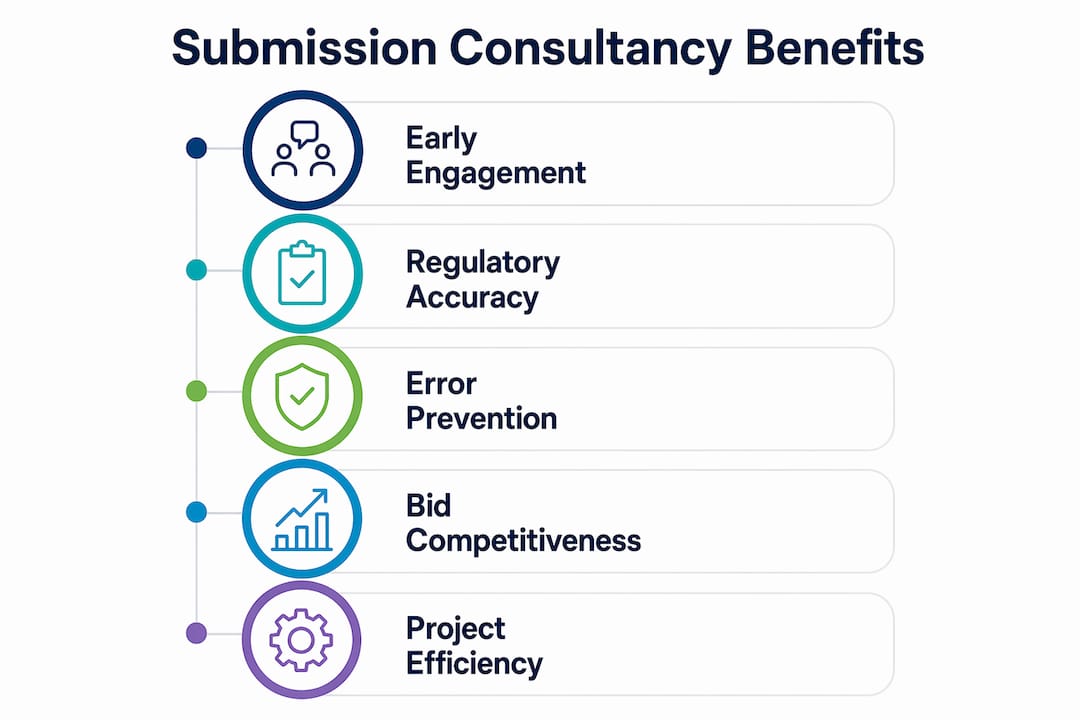
The benefits of submission consultancy extend well beyond document handling. Construction professionals who engage submission consulting services early in a project report measurably better outcomes across compliance, timeline, and cost dimensions.
-
Higher approval rates through structured preparation. Engaging consultants early during opportunity assessment improves submission quality and regulatory compliance. A consultant who understands BCA’s plan approval requirements, for instance, will flag non-compliant structural details before they reach the reviewing engineer, not after a rejection notice arrives.
-
Reduced risk of costly project delays. Early identification of the correct submission classification prevents project setbacks that can run into weeks or months. In Singapore’s construction sector, a delayed planning approval from URA can push a project’s construction start date by an entire quarter, affecting financing schedules and contractor commitments.
-
Expert navigation of complex, multi-authority requirements. Projects requiring concurrent submissions to LTA, PUB, and NEA involve overlapping technical standards and separate review timelines. A submission consultant maps these dependencies and sequences submissions to avoid bottlenecks.
-
Improved coordination between project stakeholders. Architects, structural engineers, geotechnical consultants, and M&E engineers each produce documents that must align before submission. The submission consultant acts as the coordination hub, reconciling inconsistencies before they become rejection grounds.
-
Cost efficiency through process knowledge. Effective submission consultants improve not only compliance but also project timelines and cost efficiency through their process knowledge. Avoiding a single resubmission cycle on a major development can save weeks of professional fees and delay-related costs.
“Submission consultancy success often hinges on proactive engagement and strategic oversight rather than reactive document filling.” — FDA Pre-Submission Consulting: The Ultimate Guide
This principle applies directly to construction. Consultants who wait for a complete design package before beginning submission planning consistently produce slower, lower-quality outcomes than those who engage at the concept stage.
How does submission consultancy differ from architectural or design consultancy?
Construction professionals frequently conflate submission consultancy with architectural or design consultancy. The distinction matters because engaging the wrong specialist at the wrong stage produces gaps in project delivery.
| Dimension | Submission consultancy | Architectural or design consultancy |
|---|---|---|
| Primary focus | Regulatory and tender submission management | Design creation, spatial planning, and aesthetics |
| Core deliverable | Approved application package | Architectural drawings and design documentation |
| Authority interaction | Direct liaison with URA, BCA, SCDF, LTA, PUB, NEA | Design compliance input to submission process |
| Role in project team | Strategist and document coordinator | Lead designer and technical author |
| Engagement timing | From opportunity assessment through post-approval | From concept through construction documentation |
An architectural consultant designs the building and produces the drawings. A submission consultant takes those drawings, verifies their compliance with authority requirements, assembles the full application package, and manages the approval process. On large projects, these are separate roles performed by separate specialists. On smaller projects, an architectural firm may absorb both functions, but the submission management discipline remains distinct from the design function.
Understanding this distinction helps project managers at firms like Aectechnicalsg allocate responsibilities correctly and avoid the common error of assuming that producing compliant drawings is the same as managing a compliant submission. The construction approval workflow in Singapore involves multiple parallel tracks that require dedicated submission oversight.
What are the common challenges in submission consultancy?
Construction submissions fail for predictable reasons. Recognizing these patterns is the first step toward mitigating them.
-
Documentation errors and formatting non-compliance. Submissions lacking required documentation or proper formatting face high rejection risks. BCA, for example, requires specific file naming conventions and drawing scales that, if incorrect, trigger an automatic return of the submission package.
-
Misclassification of the regulatory pathway. Submitting a project under the wrong use category or development type results in rejection and requires a full resubmission under the correct classification. This error is particularly common in mixed-use or change-of-use projects where zoning boundaries are ambiguous.
-
Missed deadlines and incomplete packages. Regulatory authorities in Singapore operate on fixed review windows. A submission received after the cut-off date for a particular review cycle may wait weeks for the next available slot, delaying the entire project program.
-
Inconsistency between consultant documents. When structural drawings, architectural plans, and M&E schematics contain conflicting dimensions or specifications, the reviewing authority will reject the package and request reconciliation. This is a coordination failure, not a technical one, and it is entirely preventable.
-
Underestimating authority-specific requirements. NEA submissions for air and water quality compliance carry different technical standards than SCDF fire safety submissions. Treating all authority submissions as interchangeable is a consistent source of rejection.
Regulatory pathway mapping and pre-submission review meetings address most of these challenges before the package reaches the authority. Consultants who conduct structured pre-submission reviews with the project team catch the majority of errors that would otherwise cause delays. The value of consultancy firms in Singapore’s construction sector lies precisely in this preventive function.
Pro Tip: Schedule a pre-submission review meeting with all contributing consultants at least two weeks before the submission deadline. Cross-check every document against the authority’s current submission requirements checklist, not last year’s version.
Key takeaways
Submission consultancy is the structured management of regulatory and tender submissions, and engaging a specialist consultant early in a construction project is the single most effective way to reduce approval delays and rejection risk.
| Point | Details |
|---|---|
| Definition of submission consultancy | Expert management of regulatory and tender submission processes to secure compliant, timely approvals. |
| Four-stage process | Pathway assessment, documentation preparation, submission management, and post-submission debrief form the core workflow. |
| Primary benefit | Early consultant engagement reduces rejection risk and prevents costly project delays across multi-authority submissions. |
| Key distinction from design consultancy | Submission consultants coordinate and manage approval packages; design consultants create the technical drawings within them. |
| Most common failure point | Documentation errors, formatting non-compliance, and missed deadlines cause the majority of submission rejections. |
Why submission consultancy is more strategic than most teams realize
From my experience working across Singapore’s construction approval environment, the most persistent misconception I encounter is that submission consultancy is a clerical function. Project managers often assume that once the design team has produced compliant drawings, the submission is essentially done. That assumption is the source of a significant number of avoidable rejections.
Many construction firms mistakenly view submission consultants as paperwork processors rather than strategic partners. The reality is that the consultant’s most valuable contribution happens before a single document is drafted. Pathway mapping, authority pre-consultation, and submission sequencing decisions made at the concept stage determine whether a project moves through the approval system in weeks or months.
I have seen projects where a developer’s team produced technically excellent drawings that were rejected because the submission was routed to the wrong authority division, or because a concurrent PUB drainage submission was filed two weeks after the BCA structural submission, creating a dependency conflict. Neither failure had anything to do with design quality. Both were submission management failures.
The firms that consistently achieve faster approvals treat submission consultancy as a project management discipline with its own timeline, accountability structure, and risk register. They engage submission specialists at the same time they engage architects, not after the design is complete. That sequencing change alone produces measurably better outcomes. For project developers and construction managers who want to reduce approval cycle times, the question is not whether to engage submission consulting services, but when.
— Aman
How Aectechnicalsg supports your submission process
Aectechnicalsg provides submission process guidance for construction projects across Singapore’s full regulatory authority landscape, including URA, BCA, SCDF, LTA, PUB, and NEA. The firm’s submission consulting services cover documentation preparation, regulatory pathway mapping, authority liaison, and compliance verification for both new developments and existing building works. For developers and project managers managing concurrent multi-authority submissions, Aectechnicalsg’s technical team coordinates across structural, geotechnical, architectural, and M&E disciplines to produce authority-ready packages. If your project requires NEA submission support for air quality, water discharge, or qualified environmental control professional compliance, Aectechnicalsg’s specialists manage the full submission cycle from initial assessment through approval. Contact the team to discuss your project’s submission requirements and timeline.
FAQ
What does submission consultancy do for a construction project?
Submission consultancy manages the preparation, coordination, and lodgment of regulatory and tender application packages on behalf of a construction project team. The consultant handles documentation, authority liaison, compliance verification, and post-submission tracking to secure approvals efficiently.
How early should a submission consultant be engaged?
Engaging consultants early during opportunity assessment or concept design produces the best outcomes. Early engagement allows the consultant to map the correct regulatory pathway and identify compliance requirements before documentation is produced.
What is the difference between submission consultancy and regulatory consultancy?
Submission consultancy focuses specifically on preparing and managing application packages for authority review. Regulatory consultancy is a broader term that may include policy interpretation, compliance auditing, and ongoing regulatory strategy beyond the submission process itself.
Why do construction submissions get rejected?
Submissions lacking required documentation or proper formatting face the highest rejection risk. Misclassification of the regulatory pathway, inconsistencies between consultant documents, and missed submission deadlines are the other primary causes of rejection in Singapore’s construction approval system.
How does submission consultancy improve bid accuracy in tender processes?
Submission consultants apply structured review processes and pre-submission checklists that catch errors before a tender package is lodged. This discipline directly improves the technical quality and compliance of bid submissions, which correlates with higher evaluation scores and award rates.