
The Urban Redevelopment Authority (URA) is defined as Singapore’s national statutory urban planning authority, responsible for land use planning, development control, and urban conservation across the entire city-state. Established on April 1, 1974, URA manages Singapore’s 55 planning areas and enforces the regulatory framework that shapes every building, neighborhood, and public space in the country. For developers, architects, property owners, and construction professionals, understanding what URA does is not optional. It is the foundation of every compliant project in Singapore.
What is URA in singapore and why does it matter?
URA is the statutory board under Singapore’s Ministry of National Development that holds legal authority over land use and physical development. Its core mandate is to optimize Singapore’s limited land resources through precise zoning, development intensity controls, and long-term planning frameworks. That mandate carries real weight. Singapore’s high urban density means that poor land allocation creates compounding problems across housing, transport, commerce, and green space.
URA operates through two primary planning instruments: the Concept Plan and the Master Plan. The Concept Plan is a long-term, non-statutory blueprint covering a 40–50 year horizon. The Master Plan is the legally binding, medium-term document that professionals must follow for any development decision. Understanding the legal distinction between both plans is the first thing any developer or architect should do before initiating a project.
URA also administers heritage conservation programs, manages urban design guidelines for key precincts like Marina Bay and Orchard Road, and operates public-facing digital platforms that provide real-time planning data. Its authority touches every stage of a construction or development project, from initial feasibility to final approval.

What is the URA master plan and how does it guide development?
The Master Plan is URA’s statutory land-use blueprint, updated every five years and legally binding under the Planning Act. It defines how every parcel of land in Singapore may be used, how intensively it can be developed, and what building types are permitted. Master Plan 2025 is the current version, finalized after the largest public engagement exercise in URA’s history. That scale of consultation signals a deliberate shift toward planning that reflects community priorities, not just economic targets.
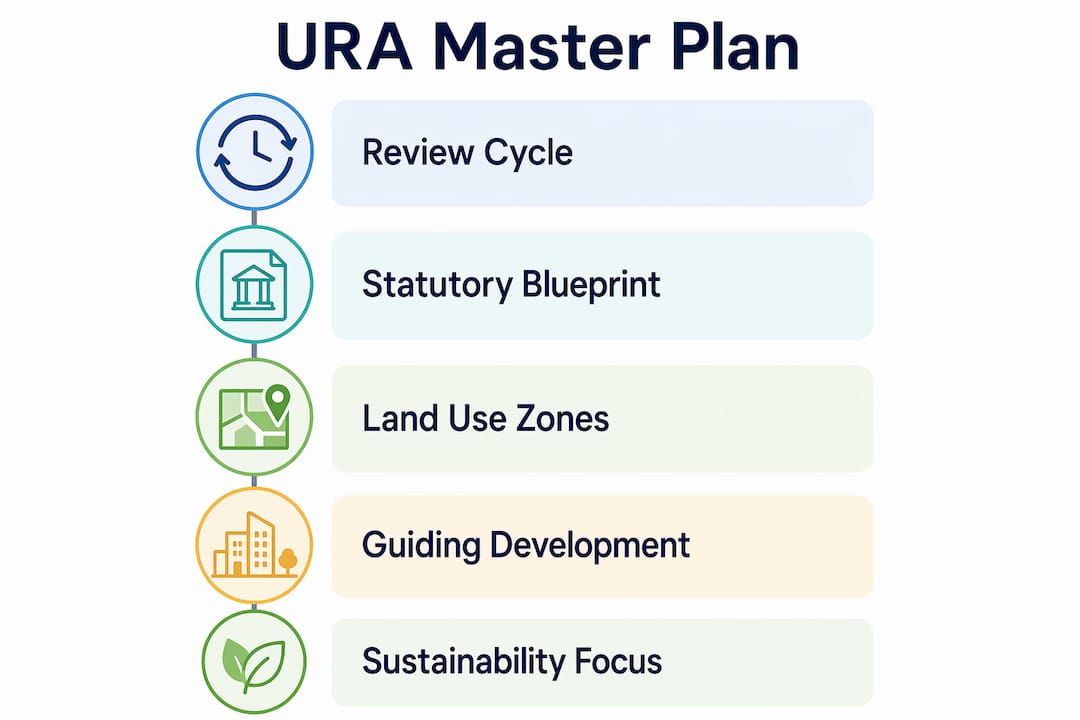
The Master Plan assigns each land parcel a zoning category such as residential, commercial, industrial, or mixed-use, and a Gross Plot Ratio (GPR). GPR is the key measurement defining the maximum development intensity permitted on a site. A higher GPR means more buildable floor area relative to the land area, which directly affects land value and redevelopment potential. This makes the Master Plan a critical price-setting mechanism for Singapore’s property market.
Here is what professionals and property owners need to know about reading and using the Master Plan:
- Zoning categories determine permitted land uses. Residential zones prohibit commercial operations; mixed-use zones allow both under specific conditions.
- GPR controls cap the total floor area a developer can build. Exceeding the GPR requires a formal amendment, which URA rarely grants without strong justification.
- Height controls work alongside GPR to regulate building form in sensitive areas, particularly near airports, heritage districts, and waterfronts.
- Amendment cycles mean the Master Plan can change between its five-year reviews. A site’s zoning today may differ from its zoning in 18 months.
Pro Tip: Always verify a site’s current Master Plan zoning directly on the URA SPACE portal before committing to any feasibility study or land acquisition. Relying on outdated documents or third-party summaries has caused costly errors for developers who assumed zoning remained unchanged between review cycles.
The Master Plan also carries direct implications for architectural planning in Singapore. Any design that exceeds the permitted GPR or violates zoning categories will not receive Written Permission, regardless of how well the building is designed.
What regulatory functions does URA perform for developers?
URA’s regulatory role centers on development control, the system by which it evaluates and approves or rejects proposed developments. Every project that involves a change of land use, a new building, or a significant alteration to an existing structure requires Written Permission from URA under the Planning Act. Written Permission is a mandatory regulatory hurdle that precedes any BCA building plan approval or construction commencement.
The process for obtaining Written Permission follows a structured sequence:
- Pre-application consultation. Developers and architects submit a concept proposal to URA before formal submission. This step identifies potential issues early and reduces the risk of rejection.
- Formal submission. A qualified person, typically a registered architect, submits detailed plans through the Government’s electronic submission system. Plans must comply with URA’s Development Control Guidelines on height, setbacks, GPR, and use.
- URA evaluation. URA assesses the submission against the Master Plan, development control parameters, and any site-specific conditions. It may consult other agencies such as LTA, PUB, or SCDF.
- Grant or refusal. URA issues Written Permission with conditions, or a refusal with reasons. Conditions must be satisfied before construction begins.
- Compliance monitoring. URA inspects completed developments to confirm they match approved plans. Unauthorized deviations can result in enforcement action, including demolition orders.
Pro Tip: Check whether a site is subject to any Outline Permission or Conservation Area guidelines before preparing your submission. These overlays impose additional constraints that are not always visible in a standard Master Plan search.
Professionals managing construction approval workflows in Singapore must also account for the fact that the Master Plan can be amended between full five-year reviews. URA publishes these amendments, but teams that do not monitor updates risk designing to parameters that are no longer current. Continuous verification is not optional. It is a professional obligation.
URA’s URA SPACE portal and Data Service APIs provide real-time land-use data, planning boundaries, and development parameters. These tools are the authoritative source for any planning query and should be the first stop for any professional conducting due diligence.
How does URA balance urban growth with sustainability?
URA’s planning mandate extends beyond zoning and approvals. It is responsible for ensuring Singapore’s urban growth remains economically productive, socially inclusive, and environmentally responsible. Master Plan 2025 followed a two-year public engagement process that incorporated feedback from residents, businesses, and community groups. That process produced a plan that reflects a broader range of stakeholder priorities than any previous edition.
“URA’s inclusive planning approach recognizes that sustainable urban development requires balancing economic growth with social equity and environmental protection. Master Plan 2025 represents the most community-informed statutory plan Singapore has produced.”
Heritage conservation is a concrete expression of this balance. URA designates conservation areas and buildings across Singapore, including shophouse districts in Chinatown, Kampong Glam, and Little India, as well as landmark structures in the Central Area. Owners of conserved buildings face specific guidelines on facade retention, internal modifications, and permitted uses. These guidelines protect cultural identity while allowing adaptive reuse.
URA also uses technology to improve planning quality and public engagement:
- Space Out is a map-based platform displaying real-time crowd levels at public spaces, helping planners and the public understand how urban areas are actually used.
- AI-assisted analysis supports URA’s internal planning teams in processing large datasets on land use, transport flows, and demographic change.
- Interactive crowd-mapping tools allow residents to flag planning concerns and preferences during public consultation periods.
These tools reflect URA’s recognition that sustainable urban design requires data from the ground up, not just top-down regulation. For professionals, understanding URA’s sustainability priorities helps anticipate how future Master Plan amendments may affect project feasibility.
What resources and tools does URA provide?
URA operates several platforms that give professionals and the public direct access to authoritative planning data. These resources reduce reliance on intermediaries and allow faster, more accurate due diligence.
- URA SPACE is the primary online portal for land-use information, development boundaries, and planning parameters. It displays the Master Plan map, conservation areas, and development control data for every planning area across Singapore’s 55 planning zones.
- URA Data Service APIs allow developers and PropTech firms to integrate real-time planning data into their own systems. These APIs cover property transactions, rental data, and development control parameters.
- Downloadable Master Plan documents are available on the URA website, including the full gazetting documents for Master Plan 2025 and supporting technical reports.
- Public engagement channels include feedback portals, exhibition spaces at The URA Centre on Maxwell Road, and online consultation platforms activated during Master Plan review periods.
URA also maintains a formal scam advisory. URA communicates only through official .gov.sg channels and will never request payments or personal banking details through unsolicited messages. Any communication claiming to be from URA that requests financial information should be reported to the Singapore Police Force immediately. Professionals receiving suspicious correspondence should verify directly through ura.gov.sg before responding.
Pro Tip: Bookmark the URA SPACE portal and check it at the start of every new project brief. It takes less than five minutes to confirm zoning, GPR, and any special control areas, and it eliminates the most common source of compliance errors in early-stage design.
Key takeaways
The Urban Redevelopment Authority is Singapore’s legally mandated planning authority, and every development decision in the country operates within the framework it sets through the Master Plan and Development Control Guidelines.
| Point | Details |
|---|---|
| URA’s statutory authority | URA controls land use and development across all 55 planning areas under the Planning Act. |
| Master Plan is legally binding | The Master Plan sets zoning and GPR controls that directly determine what can be built and where. |
| Written Permission is mandatory | Any development or change of use requires URA’s Written Permission before construction can proceed. |
| Master Plan can change mid-cycle | Amendments occur between five-year reviews, requiring continuous verification of current parameters. |
| URA SPACE is the authoritative source | Professionals must use the URA SPACE portal for real-time, accurate planning data on any site. |
Why URA literacy is non-negotiable for singapore professionals
Working in Singapore’s construction and development sector for any length of time makes one thing clear: the professionals who move fastest are the ones who read URA’s planning framework fluently, not the ones who outsource that understanding entirely.
The most common mistake I see is treating the Master Plan as a static document. Teams conduct due diligence at the start of a project, confirm the zoning and GPR, and then proceed for 12 to 18 months without rechecking. By the time they reach submission, an amendment has changed a parameter they built their design around. That error is avoidable, and it is entirely a function of not treating URA’s published updates as a live data stream.
The second misconception worth addressing is that URA is purely a gatekeeping body. That framing misses the practical value URA provides. The URA SPACE portal, the Data Service APIs, and the public consultation records from Master Plan 2025 are genuinely useful planning resources. Architects and developers who engage with these tools produce better-informed designs and encounter fewer surprises at the approval stage.
The third point is about the Concept Plan versus the Master Plan distinction. Many professionals know the Master Plan well but have never read the Concept Plan. The Concept Plan does not carry legal force, but it signals where URA intends to direct growth over the next 40–50 years. Reading it gives you a strategic view of which areas are likely to see upzoning, infrastructure investment, or conservation designation in future Master Plan cycles. That intelligence has real value for long-term project planning and land acquisition decisions.
Understanding URA is not just a compliance exercise. It is a competitive advantage.
— Aman
How Aectechnicalsg supports your URA compliance
Navigating URA’s regulatory framework requires more than reading the Master Plan. It requires translating planning parameters into compliant architectural designs, preparing technically accurate submissions, and coordinating with multiple agencies including BCA, SCDF, and LTA. Aectechnicalsg provides end-to-end technical advisory services for exactly this process.
Aectechnicalsg’s team of registered architects and engineers handles URA planning submissions for residential, commercial, and mixed-use developments across Singapore. From pre-application consultation through Written Permission and beyond, the firm manages the full regulatory workflow so your project stays on schedule and on budget. For a complete overview of what your project requires, review the project submission requirements guide or contact Aectechnicalsg directly to discuss your specific development brief.
FAQ
What does URA stand for in singapore?
URA stands for Urban Redevelopment Authority. It is Singapore’s national statutory board responsible for land use planning, development control, and urban conservation under the Ministry of National Development.
Is URA approval required for all construction projects?
Any development involving a new building, change of land use, or significant alteration requires Written Permission from URA under the Planning Act. Minor internal works may be exempt, but professionals should verify with URA before proceeding.
How often is the URA master plan updated?
The Master Plan is reviewed and updated every five years. The current version is Master Plan 2025. Amendments can also occur between full review cycles, so professionals must monitor URA’s published updates continuously.
What is gross plot ratio and why does it matter?
Gross Plot Ratio (GPR) defines the maximum ratio of total floor area to land area permitted on a site. A higher GPR allows more buildable space, which directly increases land value and redevelopment potential.
How can i verify if a URA communication is legitimate?
URA communicates exclusively through official .gov.sg email addresses and its official website at ura.gov.sg. URA will never request payments or banking details through unsolicited messages. Report suspicious communications to the Singapore Police Force.