
Building code compliance is defined as the practice of designing, constructing, and maintaining buildings in accordance with legally adopted regulations that govern structural integrity, fire safety, occupant health, and disaster resilience. For construction professionals, property developers, and building owners, why building code compliance matters extends far beyond satisfying a permit officer. Codes established by bodies such as the International Code Council (ICC), the National Fire Protection Association (NFPA), and the Federal Emergency Management Agency (FEMA) form the legal and technical backbone of every safe structure. Non-compliance carries consequences that range from Stop Work Orders to criminal charges, and the financial exposure can dwarf the cost of getting it right from the start.
Why building code compliance matters for occupant safety
The most direct benefit of regulatory adherence is the protection of human life. Properties with code-compliant sprinkler systems experience 97% fewer fire-related deaths and 88% less property damage compared to non-compliant properties. Those numbers confirm that fire safety regulations are not administrative formalities. They are the difference between a contained incident and a catastrophic loss.
Structural codes deliver equally measurable results against natural disasters. Buildings designed to current seismic, flood, and wind standards withstand events that destroy older or non-compliant stock. California’s modern building codes have prevented an estimated $24.4 billion in wildfire losses and $1.8 billion in structural fire costs over the past decade. That figure illustrates how performance-based standards, which increasingly tailor requirements to local hazard profiles, translate directly into avoided economic damage.
The national picture is equally compelling. Adopting and enforcing modern building codes is projected to save the U.S. more than $132 billion by 2040 by reducing repair costs and business interruptions from disasters. Every dollar invested in code compliance during construction returns multiples in avoided recovery costs after a disaster event.
“Weakening building codes risks bypassing evidence-based safety measures; adherence should be grounded in documented research rather than short-term expedience.”
Key safety outcomes linked to code compliance include:
- Fire suppression systems that contain blazes before they spread to adjacent units
- Seismic detailing in reinforced concrete frames that prevents progressive collapse
- Flood-resistant foundation designs that reduce structural undermining during storm surge
- Wind-load calculations that keep roofs and cladding attached during hurricanes
Pro Tip: Review the fire safety regulations that apply to your building type before the design development phase. Retrofitting fire suppression systems after framing is complete costs significantly more than designing them in from the start.
What legal frameworks enforce building code requirements?
Building codes derive their authority from state police powers, which local governments exercise through zoning ordinances, permit systems, and inspection regimes. The ICC publishes model codes, including the International Building Code (IBC) and the International Residential Code (IRC), which jurisdictions adopt and amend to reflect local conditions. Understanding building code requirements at the local level is therefore mandatory, not optional, because the adopted version and its amendments vary by city and county.
Enforcement follows a defined escalation path:
- Permit application review. Plans examiners check drawings against adopted codes before issuing a building permit. Deficiencies at this stage delay the permit and require resubmission.
- Field inspections. Inspectors verify that construction matches approved drawings at framing, rough-in, and final stages. A failed inspection halts work until corrections are made and re-inspected.
- Stop Work Orders. Authorities issue Stop Work Orders when construction proceeds without a permit or deviates materially from approved plans. Work must cease immediately.
- Fines and license actions. Noncompliance can lead to work stoppages, fines, license suspension, and escalating legal consequences from notices to criminal charges.
- Boards of Appeals. Owners and contractors who dispute a code interpretation may apply to a Board of Appeals, which can approve alternative methods if they meet the intent of the code.
The Board of Appeals pathway is underused by developers. Boards of appeals offer flexibility by approving alternative compliance methods when applicants demonstrate equivalency to the code’s safety intent. This route is particularly valuable for adaptive reuse projects where historic structures cannot meet prescriptive requirements without destroying their character.
Unpermitted work carries risks that extend beyond the construction phase. Insurance carriers can deny claims on unpermitted additions. Lenders may refuse to finance a sale if title searches reveal open permits or code violations. Buyers who discover noncompliant work after closing have grounds for legal action against the seller. The liability chain is long and expensive.
Pro Tip: Maintain a compliance log throughout the project. Document every inspection, correction notice, and approval sign-off. This record protects all parties if a dispute arises years after project completion.
How does compliance reduce construction risks and project costs?
Early compliance planning prevents the most expensive category of construction error: rework. Code-compliant building designs improve construction coordination, reduce rework, inspection failures, and project delays, improving overall construction quality. When architects, structural engineers, and mechanical and electrical consultants align their drawings to the same adopted code from the outset, conflicts that would otherwise surface during construction are resolved on paper.
The practical benefits of proactive compliance include:
- Fewer requests for information (RFIs) during construction, which slow contractor productivity
- Reduced change orders caused by non-compliant details discovered in the field
- Faster permit approvals because plans examiners encounter fewer deficiencies
- Lower insurance premiums on completed buildings, since NFPA-compliant fire protection produces fewer and less severe claims
- Improved resale value and financing terms, because lenders and buyers price compliance risk into offers
Job site safety also improves when code compliance is treated as an active management discipline rather than a final inspection checklist. Structural sequencing requirements, fall protection standards, and temporary bracing specifications all derive from the same code framework that governs the permanent structure. Teams that internalize compliance culture reduce recordable incidents alongside permit violations.
Engaging licensed Professional Engineers to verify compliance early improves underwriting outcomes by providing defensible data. Insurers price risk based on documentation quality. A PE-stamped compliance report submitted at policy renewal can reduce premiums in ways that offset the engineer’s fee many times over.

For railing systems and other specialized building components, code compliance requirements govern load ratings, heights, and material specifications that affect both safety and liability. Overlooking these details at the component level creates the same legal exposure as a structural deficiency.
Are building codes a financial burden or a long-term investment?
The most persistent myth in construction finance is that building codes raise project costs without delivering proportional value. Research shows building codes do not necessarily increase housing costs. Code-compliant homes have lower insurance and maintenance costs that offset any initial expense premium.
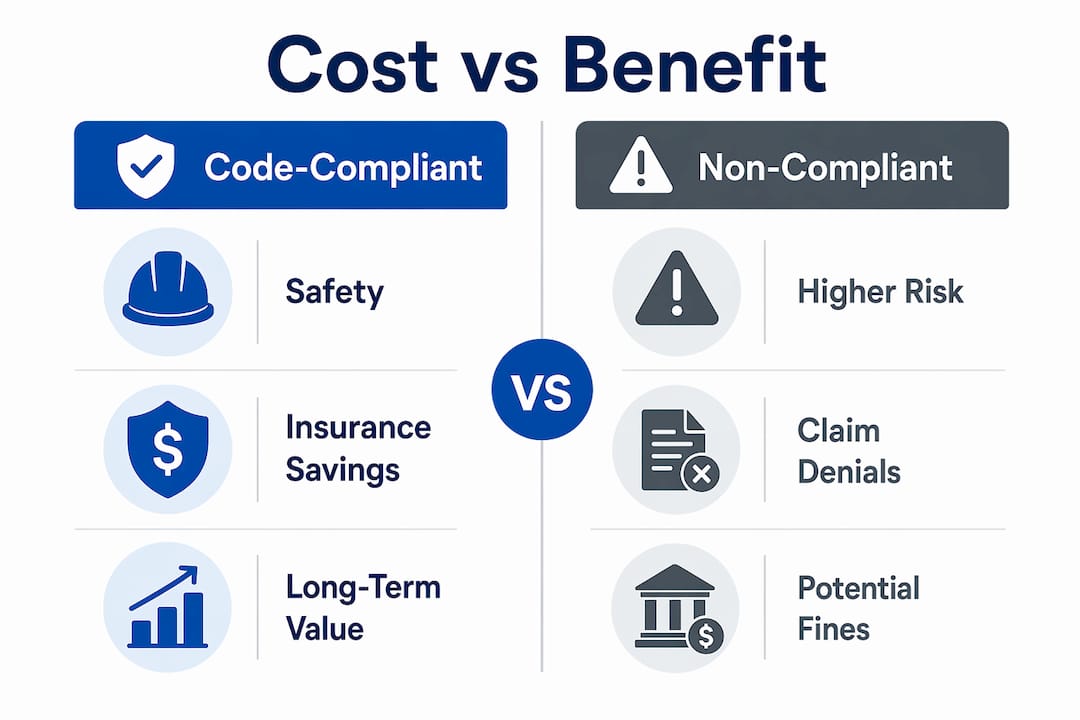
The table below compares the financial profile of code-compliant versus non-compliant construction across the building lifecycle.
| Financial Factor | Code-Compliant Construction | Non-Compliant Construction |
|---|---|---|
| Upfront construction cost | Marginally higher in some cases | Lower initially |
| Insurance premiums | Reduced due to verified risk controls | Higher or coverage denied |
| Maintenance and repair costs | Lower due to durable materials and systems | Higher due to premature failures |
| Disaster recovery costs | Significantly reduced | Potentially catastrophic |
| Resale and financing value | Full market value, easier financing | Discounted or unfinanceable |
| Legal liability exposure | Minimal when documented | Substantial and ongoing |
NFPA-compliant fire protection is a direct predictor of insurance claim severity. Insurers with code-compliant portfolios consistently outperform on loss ratios, and that performance translates into pricing advantages for building owners who can demonstrate compliance. The financial case for code adherence is not theoretical. It shows up in premium invoices and claims histories.
Modern building codes increasingly incorporate performance-based standards that encourage design innovation while maintaining safety outcomes. These standards give developers flexibility to use new materials and systems, provided they demonstrate equivalent performance to prescriptive requirements. That flexibility reduces the cost premium associated with compliance while maintaining the safety floor that protects occupants and investors alike.
Key Takeaways
Building code compliance is the most cost-effective risk management tool available to construction professionals, developers, and building owners across the entire project lifecycle.
| Point | Details |
|---|---|
| Life safety impact | Code-compliant sprinkler systems reduce fire deaths by 97% and property damage by 88%. |
| National financial savings | Modern code adoption is projected to save the U.S. more than $132 billion by 2040. |
| Legal enforcement severity | Noncompliance escalates from fines to Stop Work Orders to criminal charges rapidly. |
| Cost myth debunked | Code-compliant buildings have lower insurance and maintenance costs that offset upfront expenses. |
| Early PE involvement | Engaging Professional Engineers early improves underwriting outcomes and reduces rework costs. |
Compliance as a risk management discipline, not a regulatory hurdle
After working across multiple construction and infrastructure projects, the pattern I see most often is this: teams that treat compliance as a final inspection checklist pay for it twice. They pay once when the inspector fails the work, and again when the contractor mobilizes to fix it. The cost of that second mobilization is rarely budgeted.
The more productive framing is to treat code compliance as a risk management discipline embedded in the project workflow from day one. That means involving a licensed Professional Engineer at design development, not at permit submission. It means reviewing the Singapore construction regulations that apply to your specific building type and use before the architect finalizes the floor plan. It means building a compliance log that documents every decision, not just the ones that required a correction.
I have also observed that insurance underwriters are becoming more sophisticated about compliance documentation. A building owner who can present PE-stamped verification reports, completed inspection records, and an NFPA-compliant fire protection certificate will receive materially better terms than one who cannot. That pricing difference compounds over the life of a policy.
The final point is one that rarely appears in compliance guides: codes evolve. The ICC updates its model codes on a three-year cycle. NFPA standards are revised continuously. A building that was fully compliant at completion may require upgrades when it changes use or undergoes major renovation. Developers and building owners who track code cycles avoid expensive surprises during permitting for future work.
Compliance is not a box to check. It is a continuous practice that protects lives, preserves asset value, and keeps projects moving.
— Aman
How Aectechnicalsg supports compliance across complex projects
Aectechnicalsg provides engineering consultancy and authority submission services for construction and infrastructure projects in Singapore, covering structural, geotechnical, and M&E engineering disciplines.

For developers managing complex regulatory environments, Aectechnicalsg handles PE endorsement and authority submissions to bodies including BCA, SCDF, URA, LTA, PUB, and NEA. Integrated engineering services reduce compliance risk by aligning all disciplines to the same regulatory framework from design through approval. Developers who need a clear picture of available service types can review the full range of engineering consultancy options for Singapore projects. Early engagement with Aectechnicalsg’s team reduces rework, accelerates permit approvals, and produces the documented compliance record that insurers and lenders require.
FAQ
What is building code compliance?
Building code compliance is the practice of designing and constructing buildings in accordance with legally adopted regulations that govern structural integrity, fire safety, and occupant health. These regulations are enforced through permits, inspections, and legal penalties for violations.
Why do building codes carry legal force?
Building codes derive authority from state police powers delegated to local governments, which enforce them through permit systems, field inspections, Stop Work Orders, and fines. Ignoring enforcement actions can escalate to criminal charges and contractor license revocation.
How much can code compliance save on disaster losses?
Adopting and enforcing modern building codes is projected to save the U.S. more than $132 billion by 2040 through reduced repair costs and avoided business interruptions from disasters.
Does code compliance increase construction costs?
Research shows that code-compliant buildings do not necessarily cost more to build, and they consistently produce lower insurance premiums, reduced maintenance expenses, and higher resale values over the building lifecycle.
What happens if construction work fails a code inspection?
A failed inspection halts work until corrections are made and re-inspected. Repeated or willful violations can trigger Stop Work Orders, daily fines, license suspension, and in serious cases, criminal prosecution.