
Technical advisory is defined as strategic expert guidance delivered by senior practitioners to improve project decisions, manage risk, and ensure regulatory compliance without taking on direct execution responsibilities. For construction professionals and project managers operating in Singapore’s tightly regulated environment, the reasons to hire technical advisors go well beyond convenience. Projects that engage qualified advisory support before contracts are finalized consistently avoid the costly design revisions, authority rejection cycles, and scope creep that derail timelines and budgets. Understanding why choose technical advisory starts with recognizing that advisors provide judgment, not just information.
Why choose technical advisory in construction projects?
Technical advisory, also called technical consultancy in formal engineering contexts, fills the gap between project management and specialized engineering judgment. A project manager controls schedules and resources. A technical advisor evaluates whether the engineering decisions behind those schedules are sound. That distinction matters enormously on complex builds where structural, geotechnical, mechanical, and electrical systems interact.
Construction projects in Singapore must satisfy submissions to authorities including the Building and Construction Authority (BCA), Urban Redevelopment Authority (URA), Singapore Civil Defence Force (SCDF), Jurong Town Corporation (JTC), Land Transport Authority (LTA), Public Utilities Board (PUB), and National Environment Agency (NEA). Each authority applies its own technical standards. An advisor with direct experience across these bodies can identify compliance gaps before they become rejection notices.

The advantages of integrated engineering for construction projects are well documented. Technical advisory amplifies those advantages by adding an independent layer of review that neither the design team nor the contractor can objectively provide.
What does a technical advisor do in construction projects?
A technical advisor provides strategic guidance rather than hands-on delivery. The role involves reviewing designs, evaluating vendors, assessing risk, and validating technical decisions against project objectives. Advisors do not manage day-to-day site operations or produce construction drawings.
Typical advisory activities in construction include:
- Reviewing architectural and structural design submissions for technical soundness
- Assessing vendor proposals and comparing specifications against project requirements
- Evaluating risk exposure at key project milestones
- Advising on compliance requirements for authority submissions
- Providing input on material selection, construction methodology, and engineering standards
Technical advisors typically engage 2–4 hours monthly, charging $2,000–$5,000 or taking equity in the engagement. That commitment level suits projects that need senior judgment at decision points rather than continuous on-site presence. Engagement structures commonly include monthly retainers, fixed-scope reviews, or milestone-based arrangements.
The role is comparable to a fractional Chief Technical Officer in the technology sector. The advisor brings principal-level executive experience without the full-time cost. Effective advisors have hands-on executive experience and prevent issues by thinking through problems before they materialize on site.
Pro Tip: Before hiring, confirm whether you need advisory input on decisions or execution support for delivery. Confusing the two roles is the most common and most expensive mistake project managers make.
What are the key benefits of choosing technical advisory for your project?
The benefits of technical advisory extend across cost control, risk reduction, decision quality, and regulatory compliance. Each benefit compounds the others when advisory engagement starts early.
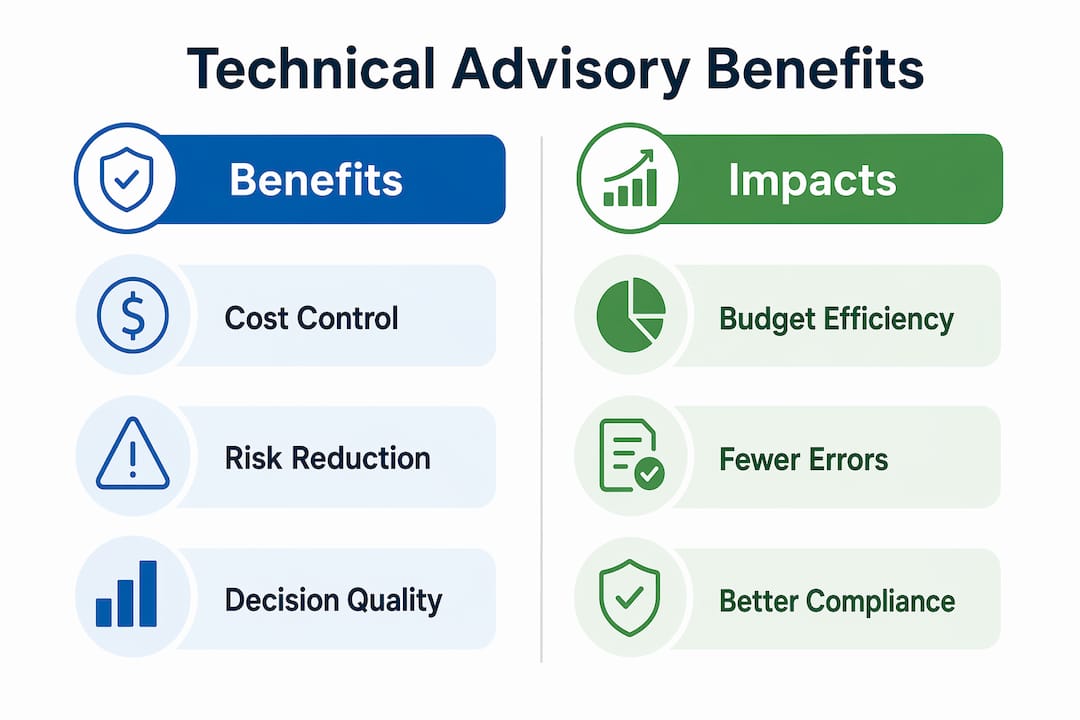
Sound vendor and architecture selection through independent advisory reduces operational costs by up to 60%. In construction terms, this translates directly to avoiding overspecified systems, unnecessary procurement, and redesign costs triggered by poor initial vendor selection.
Independent, vendor-neutral advisors reduce executive stress by about 30% by validating business cases and aligning investments with project goals. Project directors who carry sole responsibility for major technical decisions face significant pressure. An advisor provides the independent validation that converts a judgment call into a defensible, evidence-based decision.
“Advisors act as the client’s advocate to prevent unnecessary spend and ensure alignment with business goals.” — Hudson Professional Services
The table below summarizes the primary benefits and their direct impact on construction project delivery:
| Benefit | Impact on Construction Projects |
|---|---|
| Vendor-neutral procurement advice | Prevents overspecification and reduces material and system costs |
| Independent risk assessment | Identifies structural, geotechnical, and compliance risks before they escalate |
| Regulatory compliance guidance | Reduces authority rejection cycles for BCA, URA, SCDF, and PUB submissions |
| Decision validation | Gives project directors defensible, evidence-based technical positions |
| Early design review | Catches coordination errors between structural, M&E, and architectural disciplines |
Understanding why risk assessment in construction matters reinforces why advisory input at the planning stage is not optional on complex projects. Risk caught early costs a fraction of risk caught during construction.
How does technical advisory compare to similar roles?
Choosing the wrong form of technical support causes delays and overspending. Selecting the wrong role between advisor, fractional CTO, and embedded leadership is a documented source of project cost overruns. The table below clarifies the key distinctions.
| Role | Primary Focus | Time Commitment | Best Suited For |
|---|---|---|---|
| Technical advisor | Strategic guidance and decision review | 2–4 hours per month | Complex decisions, compliance reviews, vendor evaluation |
| Fractional CTO / Technical Director | Execution leadership and team management | Part-time, ongoing | Projects without internal technical leadership |
| Project manager | Schedule, budget, and resource control | Full-time or near full-time | Day-to-day delivery management |
| Embedded engineer / specialist | Hands-on technical delivery | Full-time | Specific discipline execution |
A technical advisor is not a substitute for internal technical leadership. Without internal technical leadership, advisor feedback alone cannot prevent accumulating technical debt or execution failures. The advisor strengthens decisions made by the project team. The advisor does not replace the team.
Mixing these roles creates a specific problem in construction: project managers begin treating advisors as on-call engineers, which exhausts the advisory relationship and leaves strategic oversight gaps. The scope of each role must be defined in writing before engagement begins.
Pro Tip: If your project lacks a qualified internal technical lead, hire a fractional technical director first. Bring in an advisor once you have someone internally who can act on the advisory input.
How to select and work with a technical advisor effectively
Selecting the right advisor requires evaluating experience, independence, and scope clarity. The following steps apply directly to construction and infrastructure projects.
-
Verify hands-on industry experience. Advisors must have principal-level executive experience in the relevant discipline, whether structural, geotechnical, M&E, or architectural. Theoretical knowledge without delivery experience produces advice that does not survive contact with site conditions.
-
Confirm vendor neutrality. An advisor with commercial ties to specific suppliers cannot provide objective procurement guidance. Require a written declaration of independence before engagement.
-
Define scope in writing. Specify which decisions the advisor will review, which deliverables they will assess, and which authority submissions they will support. Vague scope leads to scope creep and billing disputes.
-
Integrate advisory input into project governance. Schedule advisory reviews at defined project milestones: concept design, detailed design, pre-submission, and post-award. Ad hoc advisory input is less effective than structured review cycles.
-
Establish clear communication channels. Advisors should communicate directly with the project director or technical lead, not through intermediaries. Filtered communication delays decisions and dilutes advice.
-
Set realistic expectations on availability. Advisory engagements at 2–4 hours per month require project teams to prepare concise briefings. Advisors are not available for daily queries.
A common pitfall is engaging an advisor after contracts are signed. Engaging a technical advisor early prevents costly mistakes by enabling architecture reviews and design validation before commitments are locked in. Early engagement is the single most effective way to maximize advisory value.
What advisory work directly supports regulatory compliance and approvals?
Technical advisory contributes directly to the authority submission process in Singapore. Advisors with experience across BCA, URA, SCDF, PUB, NEA, LTA, and JTC submissions understand the technical standards each authority applies and the documentation each requires.
Specific advisory contributions to regulatory compliance include:
- Reviewing structural and geotechnical reports before BCA submission to identify deficiencies that would trigger rejection
- Advising on fire protection system designs to meet SCDF and FSSD requirements
- Assessing drainage and stormwater management plans against PUB standards
- Reviewing M&E specifications for NEA air and water quality compliance
- Providing independent technical opinions to support Professional Engineer (PE) endorsements
- Evaluating environmental impact assessments and advising on NEA QECP submissions
Technical advisory boards improve investor confidence and provide oversight credibility, particularly on large-scale infrastructure projects where multiple authorities review the same submission package. An advisor who has navigated these processes previously can identify coordination gaps between disciplines that individual consultants miss.
Understanding submission consultancy for construction projects provides the procedural context within which technical advisory operates. Advisory input and submission consultancy work together: the advisor validates the technical position, and the submission consultant manages the authority process.
The real value of consultancy firms in Singapore construction lies precisely in this combination of strategic oversight and procedural expertise. Projects that separate the two functions often find that submissions are technically sound but procedurally incomplete, or procedurally correct but technically deficient.
Key takeaways
Technical advisory is the most cost-effective way to prevent design errors, reduce authority rejections, and validate major project decisions before they become contractual commitments.
| Point | Details |
|---|---|
| Define the role clearly | Technical advisors provide strategic guidance, not execution; confusing roles causes delays and overspending. |
| Engage early | Advisory input before contracts are signed prevents the most costly design and compliance errors. |
| Require vendor neutrality | Independent advisors protect project budgets by preventing biased procurement recommendations. |
| Integrate with submissions | Advisors who understand BCA, URA, SCDF, and PUB standards reduce authority rejection cycles directly. |
| Match role to need | Use a fractional technical director for execution gaps; use an advisor for decision validation and compliance oversight. |
The case for early advisory involvement: a perspective
The most consistent mistake I see on construction projects is treating technical advisory as a late-stage quality check. By the time an advisor is brought in to review a design that is already at detailed stage, the cost of acting on their findings has multiplied several times over. Structural coordination issues that take two hours to resolve at concept stage can require weeks of redesign at detailed design stage.
Advisory is a strategic investment, not a cost center. The fee for 2–4 hours of senior advisory time per month is negligible against the cost of a single authority rejection or a contractor variation claim triggered by a design error. Project directors who understand this use advisors to stress-test their assumptions before committing, not to confirm decisions already made.
The other lesson worth stating plainly: advisory input only works when the project team has the internal capability to act on it. An advisor who identifies a geotechnical risk needs a technical lead on the project side who can translate that finding into revised specifications. Without that internal capacity, advisory feedback sits in a report and changes nothing.
Construction professionals who build advisory engagement into their project governance from the outset consistently deliver better outcomes. The projects that struggle are the ones that treat expert guidance as optional until something goes wrong.
— Aman
Technical advisory services for Singapore construction projects
Construction projects in Singapore operate under one of the most demanding regulatory frameworks in the region. Aectechnicalsg provides engineering consultancy and technical advisory services covering structural and geotechnical engineering, M&E systems, architectural planning, and authority submissions to BCA, URA, SCDF, PUB, NEA, LTA, and JTC.
Project developers, construction firms, and architectural practices working on complex builds can access engineering consultancy services tailored to Singapore’s submission requirements and technical standards. Aectechnicalsg’s advisory team brings direct experience with PE endorsement and authority submissions, providing the independent technical validation that reduces rejection risk and accelerates project approvals. Contact Aectechnicalsg to discuss advisory engagement for your next project.
FAQ
What is technical advisory in construction?
Technical advisory is strategic expert guidance provided by senior practitioners to improve engineering decisions, manage project risk, and support regulatory compliance. It is distinct from project management and hands-on engineering delivery.
How does technical advisory differ from a project manager’s role?
A project manager controls schedules, budgets, and resources. A technical advisor evaluates the engineering soundness of decisions and validates compliance positions, operating independently of day-to-day delivery.
When should a construction project engage a technical advisor?
Advisory engagement is most effective before contracts are signed and during concept and detailed design stages. Early engagement prevents costly mistakes by catching design and compliance issues before they become contractual commitments.
How much does a technical advisor cost for construction projects?
Technical advisors typically charge $2,000–$5,000 per month for 2–4 hours of engagement, though fee structures vary by project scope and advisor experience. Some advisors work on fixed-scope or milestone-based arrangements.
Can a technical advisor help with Singapore authority submissions?
Yes. Advisors with experience across BCA, URA, SCDF, PUB, and NEA understand the technical standards each authority applies. They review submissions for deficiencies before lodgment, reducing rejection cycles and accelerating approvals.