
Project developers and construction firms in Singapore frequently assume that routing consultancy budgets toward lower-cost or contractor-led solutions saves money. In practice, that assumption collapses under the weight of authority rejections, remedial structural work, and project stoppages that follow non-compliant submissions. This article clarifies what design consultants actually do, how they protect project timelines and budgets, why Singapore’s regulatory framework mandates their involvement in many project types, and how quality-led consultant selection produces measurably better long-term outcomes than chasing the lowest fee.
Table of Contents
- Understanding the role of design consultants in Singapore
- Ensuring compliance and avoiding costly delays
- Specialized expertise for complex and edge-case projects
- Consultant-driven innovation and quality: What you get for the investment
- Why short-term savings can become long-term pain: A hard-won lesson
- Connect with the right design consultancy for your project
- Frequently asked questions
Key Takeaways
| Point | Details |
|---|---|
| Compliance made easy | Design consultants navigate Singapore regulations, avoiding project stoppages and fines. |
| Specialist solutions for complex sites | Consultants provide the expertise needed for unique challenges and older or constrained projects. |
| Reduced rework saves money | Using consultants cuts costly rework by 15 to 20 percent compared to cheaper alternatives. |
| Innovation drives long-term value | Consultant-led projects unlock greater innovation, ensuring assets are future-proof and resilient. |
| Smart procurement protects investment | Choosing consultants for quality, not just low cost, maximizes returns and reduces risk. |
Understanding the role of design consultants in Singapore
Design consultants and contractors occupy fundamentally different positions in a construction project, and conflating the two is a costly mistake. A contractor executes physical works based on a defined scope. A design consultant, by contrast, provides the technical intelligence that defines that scope, ensures it meets regulatory requirements, and manages submissions to statutory authorities throughout the project lifecycle.
In Singapore’s built environment, the engineering consultancy types you engage depend on project complexity, but their core responsibilities typically include:
- Structural and geotechnical engineering: Analysis of soil conditions, foundation design, load calculations, and structural integrity assessments
- Mechanical and electrical (M&E) engineering: Design of building services systems including ACMV, fire protection, electrical distribution, and plumbing
- Architectural planning: Compliance with gross floor area (GFA) rules, setback requirements, and development control guidelines under URA
- Authority submissions: Coordinated submissions to BCA, SCDF, NEA, JTC, LTA, PUB, and other relevant authorities
- Design for Safety (DfS): Integration of hazard identification and risk mitigation into design documentation
Singapore’s regulatory framework does not treat consultancy as optional for most project categories. Regulatory compliance with BCA and WSH requirements is a primary function of design consultants, and their role in handling submissions is what prevents costly delays and penalties. The Taskforce for Architectural and Engineering Consultants has been explicit that uplifting the consultancy sector is directly linked to improving project delivery quality across Singapore’s built environment.
“The quality of built environment outcomes is inseparable from the quality of consultancy input at the design stage. Regulatory submissions prepared without adequate expertise expose developers to rejections, rework, and liability.”
The distinction matters because contractors, however competent at execution, are not licensed to certify structural calculations, prepare Professional Engineer (PE) endorsed submissions, or act as Qualified Persons (QPs) for regulatory purposes. These roles are legally reserved for registered professionals, and projects that attempt to bypass this requirement face statutory consequences.
Ensuring compliance and avoiding costly delays
Singapore’s regulatory environment for construction is one of the most structured in the region. Multiple agencies govern different aspects of a development, and failure at any single point can stall the entire project. Understanding where compliance gaps typically emerge helps developers allocate consultancy resources more effectively.
The primary regulatory bodies developers must navigate include:
- BCA (Building and Construction Authority): Structural plan approvals, building plan submissions, and quality mark certifications
- SCDF (Singapore Civil Defence Force): Fire safety plan approvals, sprinkler and alarm system compliance
- NEA (National Environment Agency): Environmental baseline studies, pollution control, and drainage impact assessments
- WSH Council: Workplace Safety and Health Act obligations during design and construction phases
- LTA, PUB, and JTC: Infrastructure interfaces, drainage proposals, and industrial land compliance
Common compliance pain points that consultants actively manage include incomplete or inconsistent drawing sets, failure to incorporate design for safety requirements into submission packages, misclassification of occupancy types, and inadequate fire compartmentation design. Each of these errors, when they reach the authority review stage, triggers a rejection cycle that can set a project back by weeks or months.
The table below illustrates the difference in project outcomes between consultant-managed compliance and contractor-managed submissions:
| Factor | Consultant-led compliance | Contractor-led submission |
|---|---|---|
| Authority rejection rate | Low (iterative pre-checks performed) | High (submissions often incomplete) |
| Timeline impact | Predictable, with buffer built in | Subject to repeated resubmissions |
| Penalty exposure | Minimal, due to proactive gap analysis | Elevated, due to reactive responses |
| PE endorsement availability | Integrated from design stage | Typically sourced late or retroactively |
| Documentation audit trail | Comprehensive and organized | Fragmented or incomplete |
Poor PE endorsements and submissions are one of the most frequently cited causes of project delays in Singapore construction. When a PE endorsement is sought late in the process, or when the PE has not been involved in the design, the certification process often requires revisiting completed design work, creating both time and cost overruns.
Pro Tip: When evaluating project procurement options, apply quality-based selection criteria to consultant appointments rather than defaulting to the lowest fee bid. A consultant whose fees are 15% higher but whose submission quality eliminates two rejection cycles will almost always represent better value.
Specialized expertise for complex and edge-case projects
The argument for consultant-led delivery becomes especially compelling when a project involves complexity that falls outside standard design parameters. Many Singapore developers assume standard residential or commercial builds are straightforward enough to manage with contractor input only. In reality, even moderate complexity introduces risks that only specialized consultants can adequately address.
Edge-case projects that demand specialist consultancy input include:
- Heritage and conservation buildings: These require alternative compliance solutions (ACS) under BCA and SCDF frameworks, since standard code requirements may be impossible to meet without altering protected architectural fabric.
- Tight or constrained urban sites: Where basement construction adjoins existing MRT tunnels, live roads, or neighboring structures, geotechnical and structural consultants must conduct detailed risk assessments and instrumentation monitoring programs.
- Major Expansion and Temporary Works (MET): Temporary structures such as shoring, formwork, and falsework require PE-endorsed designs that account for dynamic loads, sequential construction stages, and interaction with permanent works.
- Industrial and hazardous use developments: JTC-managed industrial sites with chemical storage, cleanroom facilities, or high-bay racking systems require M&E and structural consultants familiar with occupancy-specific codes.
- A&A (addition and alteration) works on older buildings: Existing structures built under earlier codes may require upgrading studies, load assessments, and structural strengthening design before any addition work can proceed.
| Project type | Contractor-led outcome | Consultant-led outcome |
|---|---|---|
| Heritage A&A works | High risk of SCDF/BCA rejection | ACS prepared, approvals secured systematically |
| Constrained basement excavation | Underpredicted settlement risk | Instrumented monitoring, risk mitigation plan |
| Industrial facility with hazardous storage | M&E gaps, fire suppression deficiencies | Code-compliant, fully integrated system design |
| Older building structural upgrade | Unforeseen capacity shortfalls discovered late | Proactive load assessment, phased strengthening |
Eurocode 3 edge case expertise is a precise example of why complex projects demand specialized knowledge. The transition to second-generation Eurocode standards in Singapore requires consultants who understand both the technical changes and their implications for existing project documentation, design assumptions, and authority submission formats.

Advanced methods such as Design for Manufacture and Assembly (DfMA) and Building Information Modeling (BIM) also require consultant-level expertise to deploy effectively. BIM modeling expertise for clash detection specifically reduces rework by 15 to 20 percent on complex projects, a figure that reflects the tangible cost savings consultants generate before a single bolt is tightened on site.
Pro Tip: During tender and project inception, always commission a legacy compliance review for sites with existing structures. This review should examine original approval documentation, identify any non-conformances with current codes, and determine whether alternative solution submissions will be needed before design can proceed.
Consultant-driven innovation and quality: What you get for the investment
Beyond regulatory compliance, the case for design consultants rests on the measurable value they generate over the full project lifecycle. The instinct to minimize upfront consultancy fees is understandable from a cash flow perspective, but it consistently underestimates the downstream costs of design deficiencies.
Rework is the most direct cost consequence of inadequate consultancy. Projects that proceed with under-specified designs, or where compliance gaps are identified only during construction, face cost increases of 15 to 20 percent attributable directly to remediation, redesign, and delayed completion. For a project with a construction budget of SGD 10 million, that translates to SGD 1.5 to 2 million in avoidable expenditure.
The real value of consultancy extends beyond avoiding rework. Quality consultants contribute to:
- Whole-life cost optimization: Structural and M&E designs that account for maintainability, energy efficiency, and future flexibility reduce operational expenditure over a building’s lifespan
- Risk transfer and liability clarity: Consultant-prepared documentation establishes a clear chain of professional responsibility, reducing developer exposure in the event of disputes or insurance claims
- Innovation in construction methodology: Consultants with DfMA expertise identify opportunities to prefabricate elements off-site, shortening program duration and reducing wet trade labor dependency
- Talent and knowledge retention within the project team: Consultants provide continuity of technical knowledge across project phases, preventing the knowledge loss that occurs when contractor-led projects rely on temporary site staff
“Quality-based procurement ensures that consultants can innovate rather than cut corners. When fees are driven down through lowest-bid selection, the first casualty is the depth of design review.”
This perspective reflects the recommendation from Singapore’s consultancy taskforce that quality-based procurement models be prioritized so that firms can allocate adequate resources to design quality, talent development, and innovation. Low-bid procurement disincentivizes the depth of engagement that distinguishes a competent submission from a compliant one.
Projects that streamline delivery through integrated design and build approaches still require consultant input at critical stages, particularly for structural endorsements, authority submissions, and performance-based fire engineering where standard prescriptive codes do not apply. The design-and-build model does not eliminate the need for qualified consultants; it changes how and when they are engaged.
Why short-term savings can become long-term pain: A hard-won lesson
The blunt reality is that the decision to minimize consultancy engagement almost always looks rational at the budget stage and regrettable at the construction stage. Projects where contractors handle authority submissions, make structural decisions without PE oversight, or proceed without DfS coordination do not usually fail spectacularly at the outset. They fail incrementally, through small gaps that compound into significant problems.
The contractor-led model saves upfront costs for simple projects but carries meaningful risk for anything with compliance complexity. The challenge is that developers often cannot accurately assess complexity at the procurement stage, which is precisely when the consultant appointment decision is made. A project that appears straightforward on a site plan may involve geotechnical surprises, adjacent owner concerns, or structural upgrade obligations that only a consultant’s due diligence process would surface.
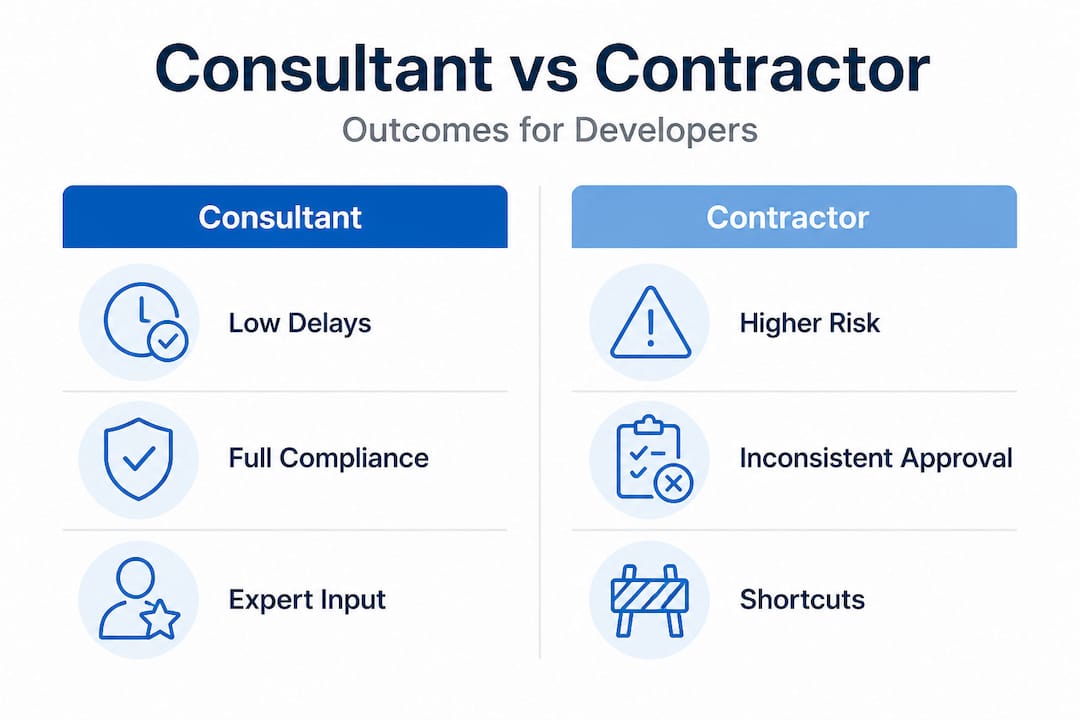
Experienced developers in Singapore’s market have consistently noted that the projects they regret most are not the ones where consultancy costs were high, but the ones where consultancy was deferred or skimped to preserve early-stage budget flexibility. The pattern is recognizable: scope gaps identified late, resubmissions consuming project float, remedial works absorbing contingency, and completion dates slipping by quarters rather than weeks.
The appropriate use of contractor-led delivery is narrow. It is defensible for minor category works that fall below BCA submission thresholds, for straightforward fit-out projects in buildings with existing compliant infrastructure, and for repetitive work types where the contractor has a demonstrable compliance track record on identical projects. Outside these parameters, consultant-led project outcomes consistently outperform contractor-managed alternatives on both quality and total cost measures.
The lesson is not that contractors cannot be trusted. It is that the professional accountabilities, technical depth, and statutory licensing that define a design consultant’s role exist for substantive reasons, and circumventing them is a risk that the project budget typically ends up absorbing.
Connect with the right design consultancy for your project
Armed with a clear picture of what design consultants deliver and where the real risks lie, the next step is securing the right technical partner for your specific project requirements.
AECTechnicalSG provides engineering and architectural consultancy services specifically structured for Singapore’s regulatory environment. Whether your project requires structural and geotechnical engineering, M&E design, or coordinated authority submissions, the team brings qualified professional expertise to every engagement. Explore consultancy types suited to your project scope, review the full scope of architectural planning services available, or connect directly for guidance on engineering authority submissions for your next development in Singapore.
Frequently asked questions
When do I need a design consultant in Singapore?
You require a design consultant for any project involving regulatory submissions to BCA, SCDF, NEA, or other authorities, as compliance with BCA and WSH requirements mandates professionally endorsed documentation and cannot be delegated to contractors.
Are consultants necessary for simple renovation projects?
For minor works that fall below statutory submission thresholds, contractors may manage execution without consultant oversight, but complex or compliance-heavy works consistently produce better outcomes with full consultant engagement covering design, documentation, and authority coordination.
How do consultants reduce project costs if their fees are higher?
Consultants eliminate the rework and resubmission cycles that typically increase project costs by 15 to 20 percent on complex sites, making their fees a cost-mitigating investment rather than an overhead.
What happens if a contractor handles submissions instead of a consultant?
Contractor-managed submissions that lack PE endorsement or fail to meet authority standards result in rejections, mandatory resubmissions, and potential financial penalties, all of which the BCA compliance framework is designed to enforce against non-compliant submissions.