
Risk Management Facilitator (RMF) for Tunnelling and Excavation Works Registers
Introduction
A Risk Management Facilitator (RMF) for tunnelling and excavation works is a competent person appointed to lead formal risk assessments and maintain risk registers on underground construction projects. In Singapore, where MRT extensions, deep basements, and sewer tunnels routinely pass beneath occupied buildings, the RMF role is anchored in the Workplace Safety and Health (Risk Management) Regulations and reinforced by client specifications from LTA, PUB, and BCA.
The RMF plans and conducts hazard identification workshops, evaluates each risk using a structured matrix, populates the risk register with hazard descriptions, control measures, trigger levels, and action owners, then tracks mitigation through construction completion. The risk register itself is a living document that records every identified hazard for a tunnelling or deep excavation project; its fields include chainage, soil type, adjacent structures, instrumentation references, and residual risk scores after controls are applied. A tunnelling risk register must span distinct project phases and separate commercial risks from geotechnical hazards.
This article focuses on the RMF role, the process of developing and maintaining excavation and tunnelling risk registers, and the supporting documentation (matrices, checklists, monitoring trigger schedules) used by the wider project organization across developers, designers, contractors, and reviewing parties. It does not cover generic project management risk frameworks or financial risk assessment. The intended audience is developers, contractors, designers, Qualified Persons (QPs), and Professional Engineers (PEs) working on Singapore infrastructure—whether they are making decisions on site or coordinating reviews from the head office—who must satisfy BCA, LTA, and MOM regulatory requirements.
The stakes are high. The Farrer Road sinkhole in November 2022 produced an 8 m × 4 m × 3.5 m ground depression on a DTSS Phase 2 sewer tunnel contract; charges filed in 2025 cited failures in continuous monitoring review and adjustment of design to observed conditions. Effective risk management identifies potential issues in project plans before they become collapses, flooding events, or settlement damage to adjacent buildings.
By the end of this article, you will understand:
- How the RMF role fits into tunnelling and deep excavation projects under Singapore’s WSH framework
- What data fields and structure a tunnelling risk register requires
- Typical hazards, evaluation criteria, and control measures for underground works
- The step-by-step process from initial workshop through close-out and lessons learned
- How monitoring and instrumentation data provide a high-level overview that supports risk register decisions
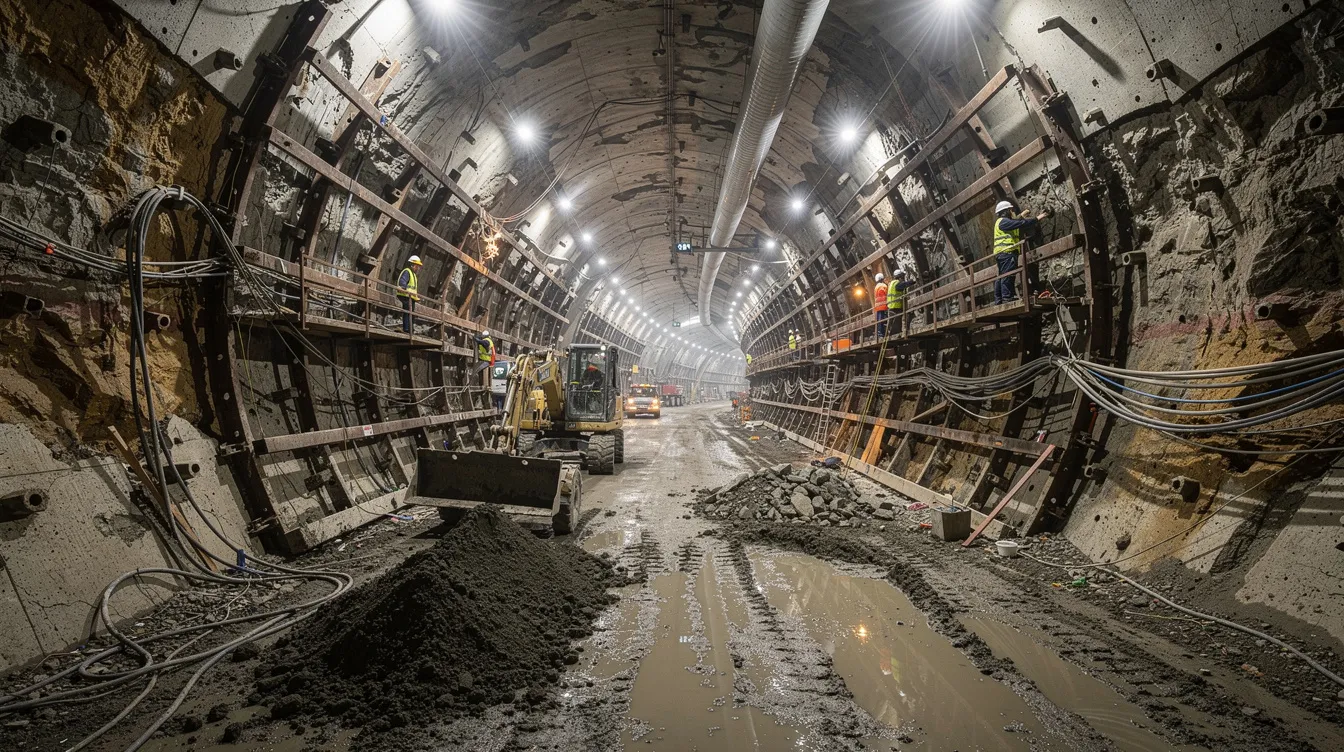
Understanding Risk Management and RMF in Tunnelling and Excavation Projects
The RMF concept originates from Singapore’s regulatory requirement that a competent person lead risk assessments on construction works. For tunnelling and excavation, this competent person must combine WSH risk management qualifications with relevant experience in geotechnical engineering, while coordinating project workflows for underground risk assessment documentation, underground construction methods, and instrumentation interpretation.
What is a Risk Management Facilitator (RMF)?
An RMF is a competent person or consultant appointed to plan, lead, and document formal risk assessments for high-risk construction works, helping the project company standardize how those assessments are documented. On tunnelling and excavation contracts, the RMF organizes multidisciplinary workshops, identifies hazards across design and construction stages, evaluates risks using standardized matrices, records findings in a structured register, and tracks whether mitigation measures are implemented and effective. Assign explicit ownership for each risk item to enhance accountability; the RMF enforces this by maintaining named action owners and target dates for every entry.
Under the WSH (Risk Management) Regulations, employers must carry out risk assessments, implement controls, record findings, and review them. The latest amendments (effective 1 January 2025 via S 1019/2024) require record retention for at least three years and review every three years or after any incident or change in conditions. LTA civil contracts and PUB tunnel contracts typically add project-specific requirements on top of these regulations, such as mandatory risk workshops at design stage and before each TBM launch.
The RMF differs from other roles on a tunnelling project in concrete ways. A QP(Design) or Professional Engineer is responsible for structural and geotechnical design, temporary works endorsement, and technical drawings. A WSH Officer conducts daily site safety inspections, manages PPE compliance, and reports incidents. A Design for Safety Professional (DfSP) works during the design stage to eliminate or reduce hazards inherent in the design itself. The RMF captures the residual risks that remain after design-stage elimination and carries them through construction in the risk register. The project manager coordinates schedule, budget, and resources; the RMF coordinates risk identification, evaluation, and mitigation tracking to support the broader business need for defensible compliance records on major infrastructure works. For a detailed breakdown of who qualifies for the RMF role on tunnel projects, see Who is Qualified to Act as a Risk Management Facilitator for a Tunnelling Project in Singapore?
Specific Risk Landscape of Tunnelling and Excavation Works
Tunnelling and deep excavation present a risk profile that generic construction risk management does not address. Work occurs in confined underground spaces where escape routes are limited. Soil and rock behaviour changes over short distances, and interaction with existing infrastructure (MRT tunnels, sewers, building foundations) creates third-party consequences that escalate severity ratings.
Typical hazards include:
- Ground loss and excessive settlement of adjacent buildings during TBM drives or diaphragm wall excavation
- Basal heave in soft clay excavations where the ratio of excavation depth to soil shear strength is unfavourable
- Groundwater inflow through diaphragm wall joints, bolt holes, or fractured rock zones
- Gas pockets encountered during boring or shaft sinking
- Instability of temporary support systems (struts, anchors, shoring)
- TBM incidents: cutterhead blockage, face collapse, over-excavation
- Working-at-height hazards in deep shafts and crane operations near shaft openings
- Compressed air work and confined space health risks
Singapore’s geology adds specific complexity. The Kallang Formation (marine clay) is soft and compressible, creating high settlement risk. Bukit Timah Granite appears as fresh rock, weathered rock, or residual soil within a single tunnel drive. Old Alluvium varies from loose sand to ceite material. Mixed soil/rock face conditions cause rapid changes in TBM face support requirements; EPB TBM face pressure must typically be maintained between 0.9 to 1.2 times overburden pressure to keep volume ground loss below approximately 2% in soft ground. Data from over 77 km of bored tunnels in Singapore shows 56 incidents of large settlements, with sinkholes concentrated near shafts and at mixed geological boundaries where face pressure dropped below natural water pressure.
Because of this risk profile, the RMF must structure risk registers to capture both design-stage and construction-stage risks with location-specific detail, not generic hazard descriptions.
Core Elements of a Risk Register for Underground Works
The risk register serves as the single source of truth for every identified hazard on a tunnelling or excavation project, and linked records plus controlled reference files support traceability across revisions and approvals. Its purpose is to quantify risk, assign control measures, define monitoring requirements, and track whether residual risk after mitigation is within acceptable limits. A comprehensive risk management system should include a dynamic register linked to real-time data from instrumentation.
Key data fields specific to tunnelling and excavation registers include:
- Unique risk ID for tracking
- Chainage or station reference and shaft/tunnel drive designation
- Soil or rock type at that location and groundwater level
- Excavation method (EPB TBM, slurry TBM, NATM, open cut, diaphragm wall)
- Adjacent structures affected (building name, foundation type, distance)
- Hazard description, cause, and consequence
- Likelihood rating and severity rating (pre-mitigation and post-mitigation risk scores help assess the effectiveness of control measures)
- Risk matrix score
- Mitigation and control measures (design-level, temporary works, monitoring, operational procedures)
- Action owner (named entity: Contractor, QP, PE, RMF, specialist subcontractor)
- Target date and current status
- Instrumentation references and trigger levels (alert, action, stop-work)
- Review frequency and documentation references (design drawings, method statements), with document control and limited file sharing access for current register references
- Emergency response plan reference
Establish clear links between the risk register and construction method statements. The register feeds directly into method statements (which describe how works will proceed given identified risks), monitoring plans (which define instruments, locations, and trigger levels), and emergency response plans (which specify reaction protocols when triggers are breached). This interconnected documentation structure enables the RMF to track whether controls exist not just on paper but in the field procedures that site teams follow daily. Regular reviews of the risk register should occur throughout the project lifecycle.
Applying RMF to Tunnelling and Deep Excavation Risk Registers
With the RMF role and risk context established, the next step is how the RMF structures and uses the register through design and construction phases. The register is not a static document produced once at project start; it evolves as ground conditions are revealed, construction methods are refined, and monitoring data accumulates.
Structuring the Risk Register for Different Excavation Phases
Categorize risks specific to underground tunnelling for better analysis by segmenting the register along project phases. Each phase introduces distinct hazards:
- Site investigation and preparation: utility diversions, trial pits, dewatering setup, mobilization of plant near existing structures
- Temporary works and support installation: diaphragm wall construction, sheet pile driving, strut installation, ground treatment (jet grouting, compensation grouting)
- Excavation and tunnelling: TBM drives, NATM headings, open-cut excavation, shaft sinking
- Structural works: tunnel lining, base slab casting, internal structures
- Backfilling and reinstatement: grouting of annular gaps, surface restoration, de-commissioning of monitoring instruments
Within each phase, the RMF aligns risks with the contractor’s activity breakdown from the construction programme and method statements. Separate sub-registers or tabs address shaft sinking (crane lifts, temporary girder installation, confined space entry), TBM drives (face pressure control, spoil handling, segment erection), cut-and-cover sections (strut removal sequencing, traffic management), and underpinning of adjacent structures.
Key structuring principles:
- One register per contract or major work package, with sub-sections by location (shaft, tunnel drive, station box)
- Risks tagged by both phase and location so that filtering by chainage or by activity is possible
- Develop a structured risk register with unique IDs for tracking each entry across reviews
- Workflow templates clarify project processes and responsibilities within the register, helping teams update it efficiently across phases and locations
Risk Identification Techniques for Underground Works
The RMF facilitates risk identification through several methods, each suited to different project stages.
Multidisciplinary HAZID workshops bring together geotechnical engineers, structural engineers, temporary works designers, the tunnelling contractor’s operations team, and safety officers. The RMF chairs these sessions, working through cross-sections and site plans systematically. Using workflow templates simplifies planning and organizes project steps for these workshops. Visual templates streamline communication and role delegation among teams, particularly when participants come from different organizations with different terminology.
Design review and constructability sessions examine the proposed alignment, diaphragm wall details, soil treatment zones, and TBM specifications. The RMF uses these to identify risks that originate in design decisions; for example, a tunnel alignment that passes through the boundary between Kallang Formation clay and Old Alluvium creates a mixed-face risk that must appear in the register.
Site walkdowns of existing conditions allow the team to inspect exposed soil, verify utility locations against drawings, and photograph areas where risk prompts arise. Templates help identify bottlenecks and dependencies in projects; checklists used during walkdowns ensure that nothing is missed.
Concrete risk prompts the RMF should pose include: sudden loss of face support during a TBM drive under an existing MRT line; leakage at diaphragm wall panel joints causing depressurization in adjacent clay layers; sewer diversion failure flooding the excavation; unexpected boulders jamming the cutterhead; failure of struts during the critical excavation stage; gas detection in a shaft or tunnel heading.
The geotechnical baseline report should inform the risk register entries. The RMF uses geotechnical investigation data (soil stratigraphy, groundwater levels, strength parameters), as-built utility surveys, nearby building foundation records, and past instrumentation readings to create location-specific risk entries rather than generic descriptions.

Risk Evaluation and Prioritisation Criteria
Utilize a 5 × 5 risk assessment matrix for evaluating likelihood and consequence. LTA’s SHE GS-A-240 risk matrix uses likelihood ratings from 1 (“Very Unlikely”) to 5 (“Almost Certain”) and consequence ratings from 1 (“Minor”) to 5 (“Catastrophic”). Pre-mitigation and post-mitigation risk scores are calculated as likelihood × consequence. Risk matrices should align scoring with industry benchmarks to escalate high-consequence risks.
The RMF defines consequence levels with concrete descriptions for tunnelling works. “Catastrophic” (5) means collapse of the excavation or adjacent building, fatality, or flooding of the tunnel. “Major” (4) covers structural damage to a third-party asset exceeding a defined repair cost threshold, including direct repair and delay costs, or injuries requiring hospitalization. “Moderate” (3) might mean settlement exceeding alert levels but within alarm limits, or equipment damage causing a schedule delay of more than two weeks.
Likelihood is influenced by measurable factors: the degree of soil variability along the alignment, adequacy of prior site investigation (number of boreholes per 100 m), design conservatism (factor of safety adopted), contractor relevant experience on similar ground, and whether real-time monitoring is in place. A contractor with no prior EPB TBM experience in mixed face conditions receives a higher likelihood rating for face instability than one with three completed drives in comparable geology.
Prioritisation focuses on risks affecting life safety, third-party assets (buildings, MRT infrastructure, utilities), public transport operations, and regulatory compliance. High-consequence events should be tracked with specialized management protocols, including escalation paths to the PE, client, and authorities. This evaluation drives the focus of mitigation and monitoring plans captured in subsequent register columns.
Implementing RMF Processes and Registers on Live Projects
Embedding an RMF-led register into day-to-day construction management requires defined procedures, clear triggers for review, and integration with the contractor’s operations. A risk management plan outlines responsibilities and timelines for stakeholders; the RMF ensures this plan is followed.
Step-by-Step RMF Process for Tunnelling and Excavation
Apply this process on projects with excavations deeper than 6 m, tunnels of any diameter, or works affecting critical infrastructure such as MRT lines or trunk sewers. The process runs from feasibility through completion.
- Pre-RMF Preparation: Collect ground investigation reports, design drawings, as-built utility records, contract specifications, and lessons learned from past projects. Inspection report templates are crucial for construction safety checks at this stage; the RMF reviews existing inspection data to identify gaps. A status report template keeps projects on track and stakeholders informed during this preparation phase.
- Initial Risk Workshop: The RMF convenes designers, geotechnical engineers, temporary works designers, construction managers, and safety professionals. The team works through the project chainage by chainage, shaft by shaft. Daily report templates help track activities and improve communication in the days following the workshop as actions are assigned.
- Register Development: The RMF populates a standardized tunnelling/excavation risk register report template, assigning ownership and target dates for each control measure. FYI offers Sample and Custom Report Templates that teams can download as controlled master templates for project-specific adaptation. Progress report templates outline accomplishments and next steps as the register takes shape. Workflow templates enable repeatable and customizable project processes, allowing the RMF to adapt the register structure to different contract types (TBM, NATM, cut-and-cover) while maintaining consistency in data fields.
- Integration with Method Statements and PTW: Every high or medium risk in the register must have a corresponding clause in the relevant method statement, an inspection and test plan reference, and monitoring requirements. The Permit-to-Work system enforces triggers; for example, stop-work when settlement exceeds the alarm level. Effective risk management ensures timely mitigation of project challenges by connecting register entries directly to field procedures.
- Ongoing Review and Update: Regular dynamic reviews of risks should be tied to key construction milestones. The RMF conducts reviews monthly at minimum, and additionally at shaft breakthrough, TBM launch, cross-passage excavation, and whenever monitoring shows deviation from predicted behaviour. Risk management includes a log for tracking changes and issues that arise between formal reviews. Risk management helps maintain project alignment with goals and objectives by ensuring that the register reflects current site conditions, not outdated assumptions.
- Close-out and Lessons Learned: At completion of each TBM drive or excavation stage, the RMF documents which risks materialized, which controls succeeded or failed, and what residual risks remain for the operational phase. These findings refine the master templates for future tunnelling and excavation projects, especially where residual underground risks still affect maintenance or other operational interfaces. The ITA guidelines provide a framework for managing risks throughout the tunnel project lifecycle, including this close-out phase.
Comparison of RMF-Managed vs Ad-Hoc Risk Registers and Report Template Use
The following comparison illustrates the difference between a formal RMF approach and an ad-hoc register for underground works. Maintaining a risk register requires a specialized approach due to geological uncertainty; the table below shows what that specialization looks like in practice.
| Criterion | RMF-Managed Tunnelling/Excavation Register | Ad-Hoc or Generic Construction Register |
|---|---|---|
| Completeness of hazards | Captures site-specific hazards by chainage, soil type, and adjacent structure; includes mixed-face risks, diaphragm wall joint leakage, TBM-specific failure modes | Lists generic hazards (e.g. “ground collapse”) without location or method specificity |
| Traceability of actions | Each risk has a named action owner, target date, status update, and verification record | Action owners listed as “contractor” without a named person; deadlines absent or ignored |
| Alignment with monitoring | Instrumentation mapped per hazard with alert/action/stop-work trigger levels linked to the register | Instruments listed in a separate monitoring plan with no cross-reference to risks |
| Regulatory compliance | Meets WSH Risk Management Regulations, WSH Construction Regulations Part XI, LTA CDC; ready for MOM or LTA audit | Gaps in citing applicable regulations; missing PE certifications for temporary works; incomplete documentation |
| Responsiveness to change | Updated at every milestone, after every incident, and when instrumentation shows divergence from predictions | Static document produced at project start; not updated; risks persist unmitigated |
The ITA and IMIA Code of Practice for Risk Management of Tunnel Works guides industry standards for what a structured register should contain. Projects that appoint a competent RMF and follow the process above achieve higher legal compliance and fewer uncontrolled risk events. Geotechnical risks include unforeseen ground conditions and high groundwater inflows; only a register with location-specific entries and real-time data links captures these before they cause harm.
Integrating Risk Registers with Monitoring and Instrumentation
The RMF links each high-risk item to specific instruments and trigger levels. Under LTA’s Civil Design Criteria E/GD/09/106/A3 (December 2025 revision), excavations deeper than 4.0 m require monitoring arrays Types A, B, and C along the perimeter at intervals of 25 m, 100 m, and 500 m respectively. For tunnels with excavated diameter greater than 3 m, arrays Types D, E, and F are spaced at 25 m, 200 m, and 1,000 m.
Integrate instrumentation data with risk management for real-time monitoring. Required instruments include settlement markers, inclinometers, piezometers, strain gauges, and load cells for struts or anchors. Inclinometers must reach at least 3 m below the toe of the retaining wall or below the tunnel invert level, whichever is deeper.
Example mapping for a specific risk entry:
- Risk: Excessive settlement of buildings adjacent to shaft S2 during diaphragm wall excavation
- Instruments: Building settlement markers BS-01 to BS-05; rod extensometers RE-01 to RE-03 for deeper soil layers; piezometers PZ-01, PZ-02 for groundwater monitoring
- Trigger levels: Settlement > 10 mm = alert (increase reading frequency to daily); > 15 mm = action (reduce excavation rate, activate compensation grouting); > 20 mm = stop work, escalate to PE for design review
- Register update process: When any trigger is exceeded, the RMF updates the register entry with the date, reading, action taken, and revised residual risk score
The register should feature emergency response plans for significant risks. When an alarm level is breached, the sequence is: stop works or reduce advance rate, notify the PE and client, initiate investigation, implement contingency measures (such as emergency grouting), and update the register with the event record. The geotechnical engineer and instrumentation specialist support the RMF in interpreting readings and recommending responses.
Common RMF Challenges in Underground Risk Registers and How to Solve Them
Maintaining an effective risk register during tunnelling and deep excavation is difficult. Construction moves fast, ground conditions change, and multiple organizations share responsibility for different risk controls.
Challenge 1: Underestimating Ground and Water Risks
Many projects rely solely on the initial site investigation data and do not update the register when new ground conditions appear. The DTSS groundwater leakage case at Changi illustrates this problem: groundwater leaking at a diaphragm wall joint caused pore pressure drops and approximately 6.5 mm of tunnel invert settlement in soft clay layers, a condition not captured in the original risk register.
The solution is to enforce mandatory RMF reviews when the TBM has advanced 25% to 50% along a drive, or whenever monitoring data diverges from predicted models. Daily site logs and instrumentation readings feed back into the register through a defined process: the site engineer flags anomalies, the RMF evaluates whether an existing risk entry needs re-scoring or a new entry is required, and the updated register is circulated before the next coordination meeting.
Challenge 2: Fragmented Ownership of Risk Actions Among Project Stakeholders
On a typical tunnel contract, the main contractor, specialist tunnelling subcontractor, temporary works designer, and QP(Supervision) each hold responsibility for different controls. Without explicit assignment, actions listed in the register go untracked.
The RMF addresses this by including columns for “Action Owner” with a named entity (not just “contractor”), a target completion date, and a verification method. In monthly coordination meetings, the RMF reviews all overdue items and escalates unresolved actions to the project manager and client. No risk entry is closed without documented verification that the control measure is in place and functioning.
Challenge 3: Overly Generic or Template-Only Registers
Copying a standard construction risk register into a tunnelling project produces entries like “ground collapse; likelihood: possible; mitigation: follow method statement.” This tells the site team nothing about what specific ground conditions at chainage 450 m require, which instruments to watch, or what trigger level demands action.
The RMF starts with a tunnelling/deep excavation master template but requires customization per chainage, shaft ID, neighbouring structure, and excavation depth. Each entry references the specific soil stratigraphy from the geotechnical baseline report, the foundation type of the nearest building, and the instrument array covering that zone. This customization takes time but converts the register from a compliance document into an operational tool.
Challenge 4: Poor Visualisation and Communication of Risks
A risk register stored as an excel spreadsheet with 200+ rows and 15 columns is rarely consulted by site supervisors or senior management, even though supervisors need a concise view of active risks to do their jobs effectively. Project stakeholders need to be on the same page about current risk status, but a dense spreadsheet does not achieve this.
The solution combines three elements. First, the RMF produces site plans marking high-risk zones with colour-coded overlays, cross-sections of critical areas, and photographs of observed conditions. Second, a “top 10 risks” dashboard is generated for monthly reports, showing risk score trends and open actions. Third, one-page risk summaries are prepared for site briefings before high-risk activities (e.g. TBM launch, strut removal at deepest excavation level). These visual aids enhance the ability of site teams to identify and respond to the risks that affect their daily tasks.
Conclusion and Next Steps
A dedicated RMF, supported by structured tunnelling and excavation risk registers linked to monitoring instrumentation and method statements, is the mechanism through which Singapore’s WSH regulatory requirements translate into safe underground construction. The Farrer Road sinkhole, DTSS groundwater leakage, and Downtown Line settlement cases all demonstrate what happens when risk registers are generic, static, or disconnected from site conditions.
Immediate next steps for project teams:
- Review current registers against the data fields and structure described above; check whether each entry has a unique ID, named action owner, and instrumentation cross-reference
- Confirm RMF appointment in writing, verifying that the appointed person holds WSQ Risk Management certification and has relevant experience in tunnelling or deep excavation
- Map monitoring arrays to hazards so that every high-risk register entry links to specific instruments and defined alert/action/stop-work trigger levels
- Schedule the first facilitated risk workshop with all project stakeholders before construction activities begin
AEC Technical Advisory supports tunnelling and excavation projects as external RMF: facilitating HAZID workshops, developing project-specific risk registers, aligning documentation with Singapore WSH regulations and LTA/PUB/BCA client requirements, and mapping trigger levels to instrumentation arrays.
Related topics to explore next include temporary works design for deep excavations, geotechnical monitoring strategies and instrumentation, and authority submissions for underground structures under BCA and LTA requirements.
Additional Resources for RMF and Underground Risk Management
The following resources provide deeper technical and regulatory detail for teams implementing RMF on tunnelling and excavation projects:
- WSH (Risk Management) Regulations (amended effective 1 January 2025 via S 1019/2024): defines duties for risk assessment, record-keeping (minimum 3 years), and review frequency
- WSH (Construction) Regulations 2007, Part XI: specific requirements for excavation shoring (PE-designed for depths > 4 m), tunnelling works, and Permit-to-Work systems
- LTA Civil Design Criteria E/GD/09/106/A3 (December 2025 revision): monitoring array specifications, instrumentation accuracy requirements, and trigger level frameworks
- ITA/IMIA Code of Practice for Risk Management of Tunnel Works: international framework for risk registers covering the full tunnel project lifecycle, from planning through operation
- Case histories: Goh, Ng & Wong (2016), Case Histories of Bored Tunnelling Below Buildings in Singapore, published in the International Journal of Geo-Engineering Case Histories
Typical RMF templates that teams should have in place include: a tunnelling risk register template with the data fields described in this article, an excavation risk assessment matrix with 5 × 5 scoring aligned to LTA/project-specific consequence definitions, and a monitoring trigger level schedule linking each instrument to its alert/action/stop-work thresholds and the corresponding risk register entry. Readers can contact AEC Technical Advisory for sample structures or customised RMF frameworks tailored to specific MRT, road tunnel, or deep basement projects.