
Introduction
A design for safety professional (DfSP) for infrastructure projects brings measurable value by identifying and eliminating foreseeable design risks before a single excavator reaches the construction site. Practical lessons from Singapore sites over the past decade confirm that embedding safety into concept and detailed design – rather than leaving it to construction-phase controls – directly reduces incidents, costly rework, and regulatory friction on MRT corridors, expressway viaducts, drainage networks, and utility tunnels.
This article focuses on heavy civil and infrastructure works, not standalone buildings. The risk profiles, stakeholder landscapes, and design decisions on linear and deep civil assets differ fundamentally from those on a typical building project. One-third of workplace fatalities stem from design-related issues, a statistic that underscores why upstream risk reduction during the design phase matters so much on complex infrastructure. AEC Technical Advisory is a Singapore-based consultancy that actively performs DfS advisory and PE design on road, rail, drainage, and utility projects – the insights shared here draw on that direct project experience as well as publicly documented cases and regulatory guidance.
The scope covers four areas: (a) the regulatory framework governing DfSP appointment and duties, (b) how the DfSP role is applied specifically in infrastructure, (c) concrete site lessons from Singapore projects between 2016 and 2026, and (d) practical takeaways developers, contractors, and designers can implement immediately. Singapore’s DfS framework integrates safety into infrastructure development through legislative guidelines, and this article translates those guidelines into field-tested practice.
What you will learn:
-
How DfSP duties differ between building and infrastructure projects in Singapore
-
Specific DfS strategies that reduced risk on MRT, road, and drainage sites
-
Typical pitfalls on live transport and utility corridors, and how to avoid them
-
How AEC Technical Advisory structures DfS reviews and documentation for complex civil works
-
When and why early DfSP engagement yields the biggest safety and cost benefits
Understanding Design for Safety for Infrastructure Projects
Design for safety is a proactive safety process that shifts hazard control upstream – to the drawing board – so that potential hazards are eliminated or reduced before they materialise on site. While the principle applies across the construction industry, infrastructure projects such as MRT stations, expressways, flyovers, sewers, and substations present distinctly higher-consequence risk profiles: deep excavations in challenging ground, interfaces with live traffic and rail operations, confined-space utility works, and decades-long maintenance obligations. The DfS concept is part of the global “Prevention through Design” movement, and Singapore has codified it into law with particular rigour.
What Is a Design for Safety Professional (DfSP) in Singapore?
A design for safety professional is the appointed facilitator under the WSH (Design for Safety) Regulations 2015, which took effect on August 1, 2016. Projects over $10 million must appoint a Design for Safety Professional. The DfSP’s key duties include convening DfS review meetings at key project milestones, maintaining the Design for Safety Register, and ensuring that safety information flows between developers, designers, and contractors throughout the entire project lifecycle.
The DfSP is typically a senior registered professional engineer (Civil, Structural, or Geotechnical) or a registered architect holding a valid practicing certificate, with relevant experience on infrastructure construction projects. Crucially, the DFSP does not replace the responsibilities of designers, contractors, or project owners – nor does the DfSP manage day-to-day site safety operations like a regular safety officer. Instead, the role emphasises upstream risk reduction: working at the design phase to identify, assess, and mitigate risks that would otherwise emerge as safety issues during construction or operations. DFSPs serve as a bridge between designers and construction teams, translating safety considerations into design deliverables that the entire project team can act on.
For infrastructure works, a DfSP must hold a solid understanding of multiple regulatory layers: the WSH Act (which mandates reducing risks at their source), the WSH (DfS) Regulations 2015, LTA’s Transport Infrastructure Design Criteria, BCA/SCDF fire safety codes, PUB drainage requirements, and NParks or URA planning constraints where relevant. This regulatory expertise distinguishes infrastructure DfSPs from those working predominantly on buildings.
Why DfS Matters More on Linear and Deep Civil Works
Linear assets – roads, tunnels, drains, utility corridors – and deep excavations such as cut-and-cover boxes, shafts, and underpasses represent some of the highest-risk contexts in Singapore’s construction industry. Traffic interface, third-party buried services, ground movement adjacent to live MRT tunnels, and confined-space entry create hazards that compound along corridor lengths and across multiple work zones.
Consider Thomson-East Coast Line works where tunnelling passed as close as 1.8 m below the existing East-West Line, or downtown MRT interchange construction in dense areas like Outram and Marina Bay between 2017 and 2024. These projects share common constraints: narrow worksites hemmed by buildings and roads, live traffic overhead, adjacent operational rail tunnels, and complex ground conditions in marine clay. Early hazard identification on such projects is not optional – it is the primary mechanism by which the project team avoids catastrophic outcomes.
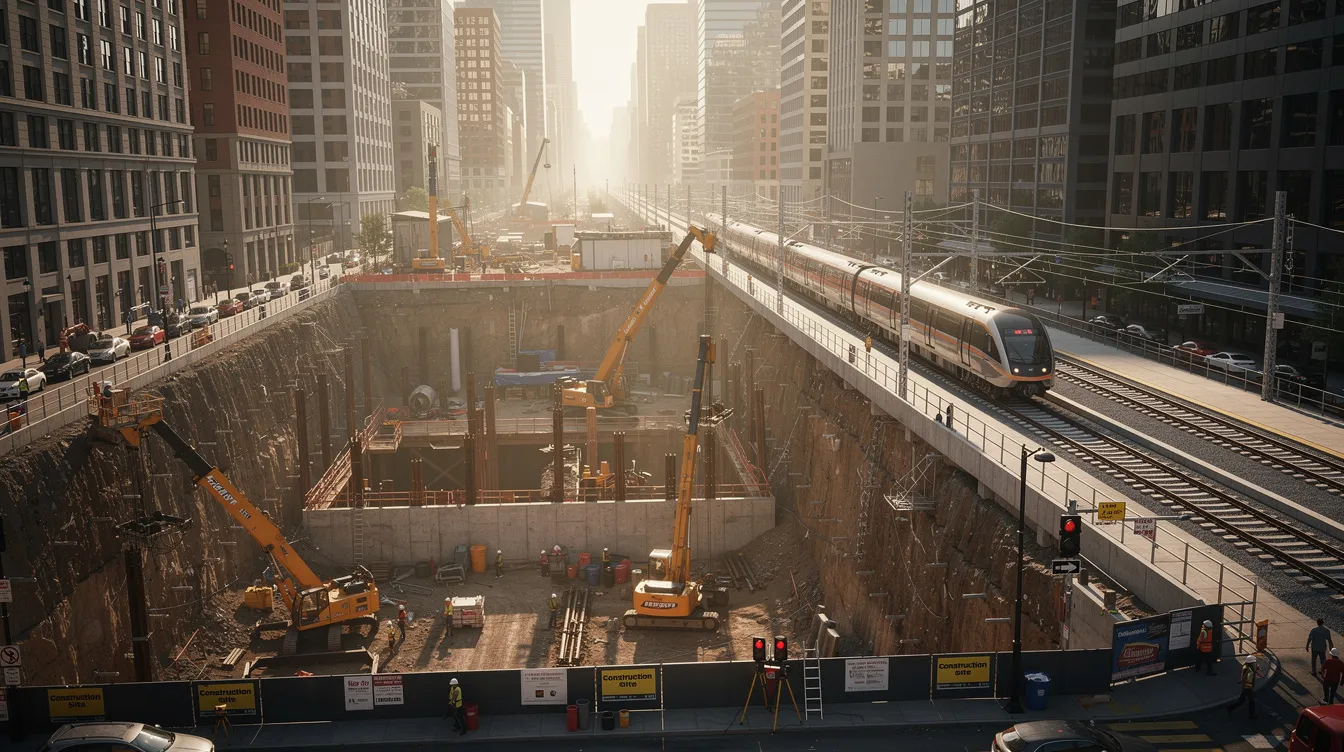
More interfaces mean more design-stage opportunities to remove or reduce hazards through alignment selection, construction method choice, staging sequence, and prefabrication. To unlock these benefits, DfSPs must work differently on infrastructure than on standalone buildings – a distinction the next section explores in detail.
How DfSPs Operate on Singapore Infrastructure Projects
Moving from regulatory compliance to day-to-day DfS practice on large civil and infrastructure jobs requires a shift in mindset. The DfSP on an infrastructure project is not simply reviewing structural drawings for fall hazards; they are analysing temporary works design, traffic staging sequences, ground movement predictions, and operational maintenance access strategies across kilometres of corridor and multiple contract packages.
Key Points of Difference from Building Projects
The differences are substantial across several dimensions:
-
Stakeholders: Infrastructure projects involve LTA, PUB, SP Group, NParks, JTC, adjacent building owners, public commuters, and often multiple main contractors and sub-consultants. A building project typically has fewer external interfaces. The DFSP facilitates structured risk reviews involving these multiple stakeholders.
-
Risk profile: Buried utilities with inaccurate records, traffic diversion conflicts, live rail operations within metres of active works, monsoon flooding exposure, and slope stability on embankments all feature prominently. Building projects more commonly centre on falls from height and façade risks.
-
Design horizon: Infrastructure DfS must cover entire corridors and address long-term maintenance access, emergency response for tunnels and viaducts, and the entire life of assets measured in decades. A DFSP fosters a positive safety culture among project teams by making these long-horizon concerns visible from the very beginning.
DfS reviews on infrastructure must consider construction staging – for example, multiple traffic diversions phased between 2023 and 2026 on a major expressway widening – and interfaces with live systems, not just permanent structure safety. Safety risks should be managed throughout the entire lifecycle of a construction project, from concept through operations and eventual decommissioning.
Typical DfSP Touchpoints Across the Infrastructure Lifecycle
On well-managed Singapore infrastructure projects, the DfSP is engaged at the following stages:
-
Pre-feasibility and alignment studies – participating in early LTA or PUB concept design phases to flag high-risk alignments or methods before they become entrenched.
-
Preliminary and detailed design – conducting safety reviews for road, rail, drainage, and utility diversion designs, with risk assessments for each major structure.
-
Tender documentation – ensuring DfS requirements, safety measures, and residual risks are communicated clearly to bidding contractors through writing specifications and tender conditions.
-
Construction planning – reviewing traffic staging, temporary excavation support, and contractor method statements at critical points.
-
Handover to asset owners – delivering the updated DfS Register with maintenance access strategy and safety information to LTA, PUB, or JTC as the building owner for ongoing operations.
AEC Technical Advisory often embeds DfS workshops into major design milestones and authority submission checkpoints, treating DfS not as a standalone exercise but as an integral part of the infrastructure project workflow.
The DfS Register for Linear and Complex Assets
The Design for Safety Register documents all identified design risks and mitigation measures. It is a living document throughout a project’s lifecycle, maintained by the Design for Safety Professional. But for infrastructure, the register looks fundamentally different from its building equivalent.
On a 3 km viaduct or a multi-station MRT corridor, risk entries are organised by chainage, segment, or structure type rather than by floor level. Construction-stage and operation-stage hazards are separated – for instance, fall hazards during segment launching are distinct from future inspection access requirements under the completed viaduct. The DfS Register must be handed over to future building owners, and it serves as legal evidence of safety compliance during incidents.
Common register content includes: identified hazards, risk ratings, design decisions (such as choice of bored piles versus cut-and-cover), control measures agreed with QPs and contractors, and residual risks where elimination was not reasonably practicable. For infrastructure, the register must track evolving temporary works design – struts, decking, traffic diversions – more closely than in typical building jobs. It documents all identified design risks and mitigation measures throughout the project lifecycle, making clear accountability for safety measures essential.
The rest of this article draws on actual Singapore site experience to show how these concepts translate into practical risk management decisions.
Practical Lessons from Singapore Infrastructure Sites
The following subsections present concise case-style insights drawn from common infrastructure scenarios encountered in Singapore between approximately 2015 and 2026. Each follows a consistent pattern: context, design challenge, DfSP intervention, outcome, and transferable lessons. DFSPs help identify risks before construction starts – these examples show what that looks like in practice.
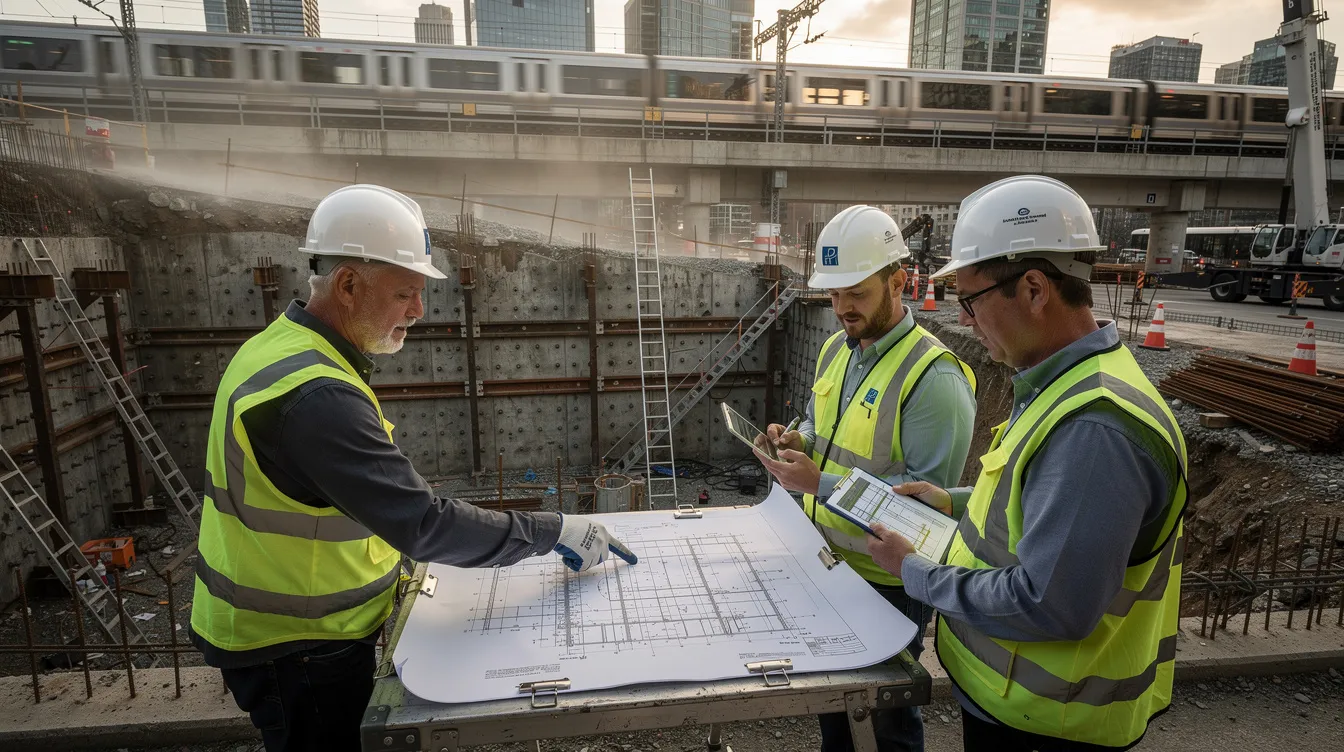
Lesson 1: Designing Excavation and Temporary Works for Deep Shafts Near Existing MRT Lines
Context: A new station box and ventilation shaft adjacent to operating MRT tunnels in a dense area – a scenario repeated across Orchard, Outram, and Marina Bay between 2017 and 2024. Excavation depths reached 30 m or more in marine clay, with live rail tunnels sometimes within two metres of the proposed works.
Key risks: Ground movement affecting existing tunnels, deep excavation collapse (the catastrophic potential demonstrated by the 2004 Nicoll Highway collapse, where a roughly 33 m deep braced excavation in marine clay failed, killing four workers), complex strutting sequences, and tight worksites with overhead traffic diversions.
DfSP-led design decisions:
-
Preference for diaphragm walls over sheet piles to provide greater stiffness and control of ground movement near live tunnels – a decision made at concept stage during the first DfS review meeting rather than left to contractors.
-
Reduced excavation stages by evaluating top-down construction and pre-stressed struts, eliminating several high-risk open-excavation phases.
-
Specifying comprehensive geotechnical instrumentation regimes – inclinometers, settlement markers, strain gauges – integrated directly into design drawings with pre-agreed action thresholds and emergency response triggers.
Outcomes: Fewer unplanned stoppages, stronger assurance to LTA/SMRT of tunnel protection compliance, and safer working platforms for contractors. On one project in the Marina Bay area, adoption of dual-function secant bored piles (serving as both temporary earth retaining and permanent foundation) saved approximately 10,000 m³ of concrete and 1,000 tonnes of steel reinforcement while maintaining safety margins – demonstrating that safety and efficiency are not opposites.
Transferable tips:
-
Start DfS before ground investigation is finalised; use preliminary SI data to scope the safety analysis and commission additional boreholes where uncertainties are highest.
-
Include the deep excavation monitoring strategy as a formal item in the DfS Register from the outset.
-
Involve the DfSP early in design to substantially reduce future construction risks by selecting appropriate ERSS systems at concept stage.
Lesson 2: Managing Traffic Safety in Elevated Road and Viaduct Widening Projects
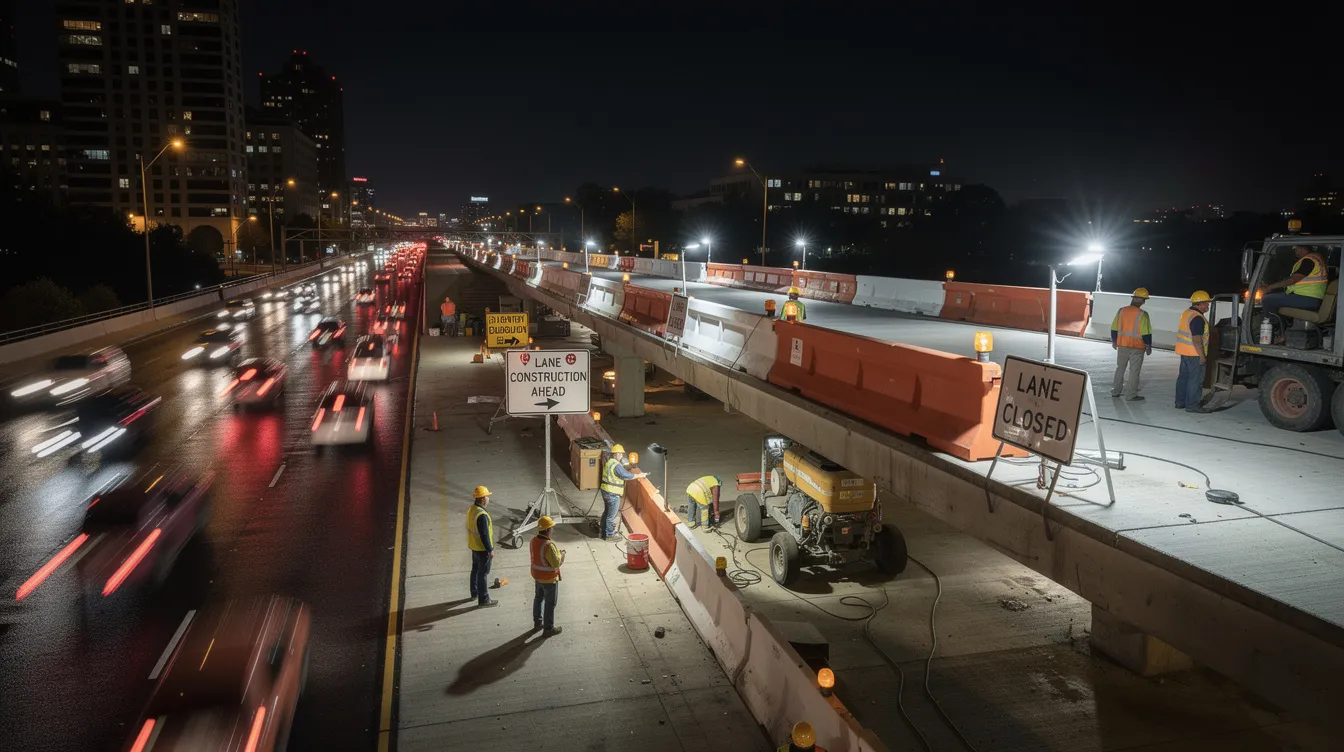
Context: Widening of existing expressways or flyovers – scenarios encountered on PIE, CTE, and TPE corridors between 2018 and 2025 – with live traffic running adjacent to active work zones throughout construction.
Primary hazards: Interface between public traffic and work zones, lifting operations adjacent to live lanes, complex traffic diversions during night shifts, and falling objects from deck works onto vehicles below.
DfSP influence on design:
-
Encouraging use of precast segments and full-depth precast parapets to reduce in-situ concrete work above traffic, thereby limiting worker exposure at height and reducing the duration of lane closures.
-
Designing permanent edge protection anchorages and access walkways that serve double duty as safe platforms during construction – embedding safety into the permanent structure rather than relying solely on temporary measures.
-
Recommending barrier selection, crash cushions, and staging sequences included directly in design drawings and writing specifications rather than left to ad-hoc construction site decisions.
Results: Shorter traffic closure windows, lower risk of vehicle strikes on workers, fewer design variations mid-construction, and fewer accidents related to working-at-height on falsework and shoring systems.
Transferable tips:
-
Treat traffic staging as a design deliverable, not a contractor afterthought – the DfSP should review traffic management plans alongside structural drawings.
-
Specify permanent maintenance access during design so that future inspection of bearings, expansion joints, and drainage does not require lane closures.
Lesson 3: Coordinating Utility Diversions and Confined Space Works for Major Drainage Upgrades
Context: Upgrading major drains, canals, and large-diameter sewers under roads or HDB estates, with multiple utility owners (PUB, SP Power, telcos) involved – a recurring scenario between 2019 and 2026.
Hazards: Accidental service strikes on incorrectly charted utilities, working in manholes and culverts (confined spaces), temporary flooding risk during monsoon periods, and limited rescue access in deep culverts.
DfSP contributions:
-
Pushing for early consolidated utility survey – trial trenches, ground-penetrating radar – and including a “no-go” envelope around critical services in design models to prevent accidental strikes.
-
Recommending larger, straight access manholes with integrated ladders and fall-arrest anchor points designed into the permanent structure, supporting safer entry and rescue for both initial construction and long-term operations.
-
Ensuring the design provides bypass pumping provisions and temporary storage volume to allow safe diversion works during high rainfall – a lesson reinforced after the 2017 tunnel flooding incident between Bishan and Braddell MRT stations, where floodwaters rose to almost one metre deep and prompted LTA and PUB to increase flood protection standards significantly.
Learning: DfS must address both initial construction diversions and long-term O&M confined-space entries, not just permanent hydraulic performance. Proactive risk management reduces hazards during the design phase – and these hazards often span the entire life of the drainage asset. Effective DfS processes rely on multidisciplinary collaboration among engineers, designers, and contractors, particularly when monsoon readiness intersects with utility protection requirements.
Lesson 4: Safe Access and Maintenance Design for Long-Span Pedestrian Bridges and Linkways
Context: Pedestrian overhead bridges, linkways connected to MRT stations, and park connectors built over busy roads or waterways between 2016 and 2024.
Key risks: Working at height during erection and later maintenance, limited inspection access once operational, risk to the public below during lifting works, fire and egress where covered linkways connect into malls or stations.
DfSP-driven design changes:
-
Incorporating permanent maintenance walkways, anchor points for fall protection, and integrated lighting maintenance access – making safety a built-in feature rather than a retrofit.
-
Designing segment sizes and splice locations to allow ground assembly and lifting in fewer, heavier but safer lifts versus many high-risk small lifts, reducing the number of crane operations over live traffic.
-
Coordinating with fire safety engineers and SCDF requirements for safe evacuation routes along covered linkways, ensuring safety concerns about smoke management and egress were resolved during detailed design rather than at authority submission stage.
Practical lesson: Even “simple” link bridges require systematic DfS thinking for long-term maintenance of finishes, lighting, drainage, and expansion joints. DfS emphasises designing out risks to improve long-term safety and maintenance – the safety professional must look beyond construction to the decades of inspection and repair that follow.
Lesson 5: Integrating Digital Tools (BIM and 4D) with DfS Reviews on Complex Corridor Projects
Context: A multi-structure corridor – combined road widening, bus priority lane, cycling path, and utility diversions – using BIM and 4D sequencing between 2020 and 2026.
How DfSPs used digital tools during DfS workshops:
-
Visualising clashes between temporary decking systems, crane envelopes, existing utilities, and proposed structures – turning abstract safety registers into tangible visual evidence.
-
Simulating safe lifting paths and material delivery routes through constricted urban streets, identifying pinch points where workers and equipment would conflict.
-
Verifying future inspection and emergency access routes along the corridor length, confirming that maintenance teams could reach every bearing pad and expansion joint without traffic closures.
Benefits: Clearer stakeholder understanding for developers, LTA officers, and contractors; faster consensus on safer methods during DfS review meetings; and stronger documentation of design decisions. The collaborative process becomes more effective when project stakeholders can see rather than merely read about potential risks.
Implementing an Effective DfS Process on Infrastructure Projects
The case lessons above share a common thread: the DfSP’s impact is greatest when integrated into a structured, repeatable process aligned with the project lifecycle. Here is how AEC Technical Advisory and similar teams can implement that process on complex civil works.
Step-by-Step DfS Workflow Tailored to Infrastructure
-
Early scoping workshop: Define project extent (chainages, structures), key construction operations (traffic staging, rail possessions, flooding exposure), and all project stakeholders including authorities and utility owners.
-
Hazard brainstorming at concept stage: Compare alternative alignments, construction methods (e.g. bored tunnel vs cut-and-cover), and staging sequences through a safety lens. This is where early hazard identification yields the biggest returns.
-
Discipline-specific reviews during detailed design: Structural, geotechnical, M&E, traffic, and architectural/landscaping teams each address safety considerations relevant to their scope, with the DfSP coordinating across disciplines.
-
Consolidated multi-stakeholder DfS meeting: Authorities (LTA, PUB, SCDF) and contractors (where appointed) participate to freeze safety-critical design decisions and document residual risks.
-
Integration into deliverables: DfS outcomes flow into drawings, specifications, method statements, and tender documents – not as a separate safety annex but embedded within design deliverables.
-
Periodic DfS reviews during construction: Triggered by design changes, unforeseen ground conditions, or newly identified hazards (e.g. unmarked utilities discovered during excavation).
-
Final DfS handover: Updated DfS Register, as-built safety notes, and maintenance access guidance delivered to asset owners – completing the safety management chain. The DfS Register must be handed over to future building owners.
Comparing Typical DfS Approaches: Building vs Infrastructure
|
Criterion |
Building Projects |
Infrastructure Projects |
|---|---|---|
|
Project geometry |
Single site, vertical |
Linear corridor, multiple segments |
|
Key interfaces |
Adjacent buildings, public sidewalks |
Live traffic, operating rail, buried utilities |
|
Temporary works complexity |
Moderate (scaffolding, formwork) |
High (ERSS, temporary decking, traffic diversions) |
|
Dominant hazards |
Falls from height, façade works |
Excavation collapse, traffic strikes, ground movement |
|
Maintenance access strategy |
Internal access within building |
External walkways, catwalks, confined-space entry |
|
Stakeholder count |
Typically 3–5 parties |
Often 8–15+ agencies and contractors |
|
DfS Register structure |
Floor-by-floor |
Chainage-based, structure-by-structure |
This table is not “either/or” – many projects blend both characteristics. The key insight is that infrastructure demands stronger early DfS focus on staging, temporary works, and multi-agency coordination. AEC Technical Advisory’s capability spans both building-style and infrastructure-specific DfS approaches, drawing on combined civil, structural, geotechnical, and M&E expertise through an integrated engineering consultancy model.
Common Challenges and How Experienced DfSPs Address Them
Even with a strong safety process, infrastructure construction projects in Singapore face recurring problems that DfSPs must actively manage. Recognising these challenges early helps the entire project team prepare practical solutions rather than reactive fixes.
Challenge 1: Late Appointment of the DfSP on Civil Projects
DfSPs are sometimes only brought in at detailed design or after tender award, when key alignment and excavation method decisions are already locked in. Research by NUS’s Department of the Built Environment confirmed that designers felt constrained in making safety-enhancing changes at that point. Involving the DFSP early in design can substantially reduce future construction risks.
Solutions:
-
Developers and public agencies should include DfSP scope in EOI/RFP documents at concept design stage, treating it as a legal requirement rather than an afterthought.
-
On several 2020s projects, early AEC Technical Advisory involvement allowed safer method selection and fewer re-design cycles – saving time and cost while making safety outcomes stronger.
Challenge 2: Incomplete Site Information and Underground Utility Records
Inaccurate utility plans and insufficient ground investigation data undermine DfS decisions for excavation and piling. Without reliable data, even the most thorough safety analysis rests on flawed assumptions.
Solutions:
-
Make early trial trenching, GPR survey, and soil investigation a formal action item out of the first DfS workshop – not something deferred to the contractor.
-
Record all assumptions and verification requirements clearly in the DfS Register and design notes. When reality differs from assumptions, the register provides a clear basis for design change control. Risk assessment in construction depends on data quality.
Challenge 3: Balancing Construction Staging with Public and Operational Constraints
Conflicts frequently arise between safety-optimal staging and requirements like minimal lane closures, limited night work, or maintaining bus corridors and rail operations. Cost and schedule pressures can override safety efforts if trade-offs are not rigorously documented.
Solutions:
-
Use 4D simulations and quantified risk comparisons to justify safer staging options to authorities and clients, moving discussions from opinion to evidence.
-
Document trade-offs clearly with “reasonably practicable” justification in the DfS Register when residual risks cannot be completely eliminated. This protects all parties and demonstrates compliance with legal and statutory requirements.
Challenge 4: Fragmented Communication Among Multiple Contractors and Sub-consultants
Mega-corridor projects often involve several main contracts and numerous sub-consultants, risking DfS “gaps” at contract boundaries. One package’s drainage diversion can create safety issues for the adjacent package’s excavation if communication skills are lacking.
Solutions:
-
Establish corridor-wide DfS coordination meetings with representation from all packages – a collaborative effort led by the DfSP.
-
Maintain a consolidated DfS Register that references, but does not replace, package-specific registers. This ensures no identified hazards fall through interface gaps.

Conclusion and Next Steps
DfSPs transform how infrastructure projects in Singapore manage risks, and practical site lessons confirm that the design for safety process is both achievable and valuable when implemented with discipline, technical knowledge, and genuine early engagement. DFSPs enhance project efficiency by preventing costly rework – and the case experiences above demonstrate that safety and efficiency reinforce each other rather than competing.
Key takeaways:
-
Early DfSP engagement on alignment, excavation, and staging decisions yields the biggest risk reductions – past projects consistently show this pattern.
-
DfS for infrastructure must explicitly address temporary works, traffic and rail interfaces, and long-term maintenance access, not just permanent structural safety.
-
Proactive DfS reduces incidents, rework, and regulatory friction – making safety a value proposition, not merely a compliance burden.
-
The collaborative approach involving the entire project team, from designers to contractors to authorities, produces better outcomes than siloed safety efforts.
Concrete next steps for different audiences:
-
Developers and public agencies: Ensure DfSP engagement from concept design on all infrastructure projects over S$10 million – and consider applying DfS principles even on smaller works where the safety and health risks warrant it.
-
Contractors: Invite DfSPs into method statement development and value engineering discussions, not just compliance meetings. DFSPs help identify and mitigate risks during the design phase that directly affect constructability.
-
Designers and QPs: Integrate safety into project design from the outset – embed DfS actions into design deliverables, BIM models, and specifications as standard practice.
-
Potential clients of AEC Technical Advisory: The firm provides integrated DfS advisory, PE services, and design consultancy for upcoming infrastructure works. Engaging early in concept design maximises the value of DfS input.
For related topics, explore our guides on temporary works design, geotechnical risk management in deep excavations, and LTA impact assessments for works near MRT tunnels.
Additional Resources and FAQs on DfSPs for Infrastructure in Singapore
This section provides quick-reference answers and useful documents for teams planning or currently executing infrastructure DfS in Singapore.
Useful Local References and Guidance Documents
-
WSH (Design for Safety) Regulations 2015 – Core legal framework for DfSP appointment, safety professional duties, and DfS Register requirements. Design for Safety Regulations 2015 took effect on August 1, 2016.
-
Guidelines on Design for Safety (MOM/WSHC) – Practical implementation guidance covering concept design reviews, DfS review meetings procedures, and reasonably practicable safety measures for infrastructure and civil works.
-
LTA Transport Infrastructure Design Criteria and Specifications – Including the Civil Design Criteria (revised December 2025) and Rail Infrastructure Design Criteria (revised August 2026), which intersect directly with DfS considerations for bridges, viaducts, road structures, and rail assets.
-
PUB Code of Practice on Surface Water Drainage and Sewerage – Key reference for DfS on drainage and sewer upgrade projects, particularly regarding bypass pumping, confined-space access, and flood resilience design.
FAQ: Do All Infrastructure Projects in Singapore Need a DfSP?
The WSH (DfS) Regulations apply to all construction projects with a contract sum of $10 million or more – this includes large road, MRT, drainage, and utility projects. The DFSP role is mandated for projects over $10 million. Smaller infrastructure jobs are not legally required to appoint a DfSP, but applying design for safety principles remains strongly advisable wherever significant safety and health risks exist.
FAQ: When Should a DfSP Be Brought Into an Infrastructure Project?
The optimal time is during feasibility or concept design – before alignments, excavation strategies, and major staging decisions are fixed. Early engagement of the DFSP is critical for effective risk elimination. On successful Singapore projects, DfSPs have joined from early LTA or PUB design phases, participating in alignment studies and method comparisons well before detailed design begins. This is the stage where problem solving skills and safety analysis deliver the greatest impact.
FAQ: What Should Clients Look for When Appointing a DfSP for Civil and Infrastructure Works?
Key selection criteria include:
-
Proven infrastructure experience: Track record on Singapore MRT, expressways, or major drainage projects from the 2010s–2020s, demonstrating practical skills across multiple infrastructure types.
-
Professional registration: DFSPs are typically registered professionals in engineering or architecture – a registered professional engineer (Civil/Structural/Geotechnical) or QP Architect – with completion of the mandatory course “Perform Design for Safety Professional Duties.”
-
Digital capability: Ability to use BIM/4D tools and coordinate across multiple agencies and package contractors, helping explain complex safety issues through visual models.
-
Integrated DfS and design track record: Experience integrating DfS with authority submissions and temporary works design – ensuring safety decisions are reflected in actual design output, not just meeting minutes.
FAQ: How Does AEC Technical Advisory Support DfS on Infrastructure Projects?
-
Provides integrated civil, structural, geotechnical, and M&E design with built-in DfS reviews at every major design stage.
-
Offers certified DfSP services for Singapore projects, including preparation and maintenance of DfS Registers as living documents throughout the project lifecycle.
-
Coordinates authority submissions (LTA, BCA, PUB, SCDF) with DfS outcomes to avoid late-stage redesign for safety – reducing costly rework and regulatory delays.
-
Conducts site walkdowns and lessons-learned sessions to feed real-world insights from past projects into future designs, building safety culture across the project team.