
Introduction
Any construction or geotechnical works near MRT tunnels in Singapore requires a formal impact assessment governed by the Land Transport Authority’s Code of Practice for Railway Protection. This step-by-step process for an LTA impact assessment for works near MRT tunnels in Singapore is not optional – it is a legal and technical obligation that protects critical rail infrastructure from settlement, structural damage, and operational disruption during nearby construction.
This article focuses specifically on underground and near-tunnel works: deep basement excavations, ERSS installations, bored and driven piles, utility diversions, underpinning, and foundation deepening within LTA’s Railway Protection Zone. It does not cover general traffic impact assessment for road developments or surface-level traffic management, and it is different from a transport impact assessment in Singapore, which addresses broader network effects for development proposals.
Target readers: contractors, developers, and consultants in Singapore planning infrastructure or building projects close to MRT tunnels – including A&A works involving foundation deepening, new basements adjacent to station boxes, or utility tunnelling within rail corridors.
Direct answer: The process follows nine stages – feasibility screening and tunnel proximity check, data collection from LTA, pre-consultation with LTA Railway Protection, detailed geotechnical and ERSS design, structural impact evaluation on MRT assets, monitoring and trigger level planning, compilation and submission of the impact assessment package, LTA technical review and approval, and construction-phase monitoring through to close-out. Nearly all projects within the Railway Protection Zone must complete this full sequence before any site works can begin.
What you will learn from this article:
-
How to confirm whether your site sits within LTA’s Railway Protection Zone and what that triggers
-
What geotechnical, structural, and monitoring data LTA expects in a complete impact assessment
-
How ERSS and geotechnical design integrates directly into the tunnel impact assessment – not as a separate exercise
-
Realistic approval timelines and common reasons for delays or resubmission
-
How AEC Technical Advisory supports teams to carry out end-to-end coordination from feasibility screening to construction monitoring
Understanding LTA Impact Assessment for Works Near MRT Tunnels
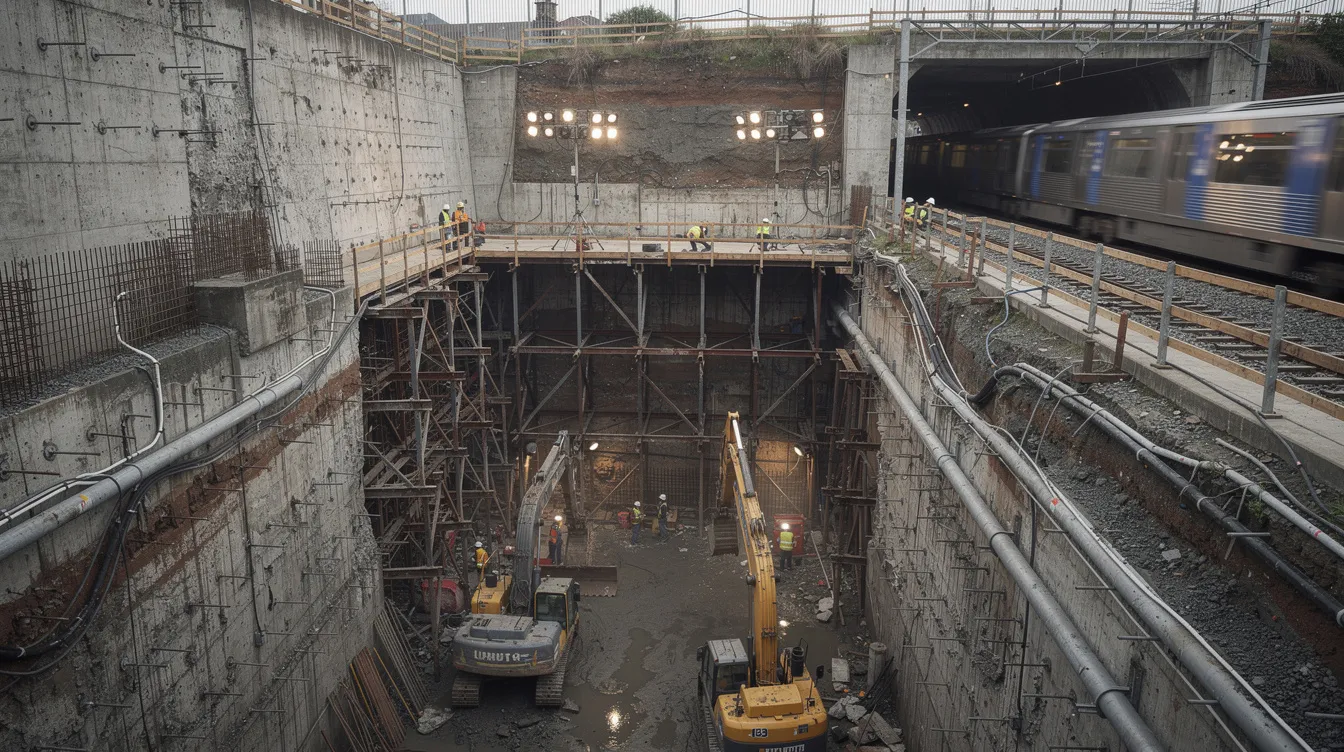
An LTA rail tunnel impact assessment is a structured technical evaluation that demonstrates proposed construction works will not compromise the structural integrity, water-tightness, track geometry, or operational safety of existing MRT tunnels and stations. Impact assessments near MRT tunnels in Singapore are governed by the Code of Practice for Railway Protection. LTA’s Railway Protection and Civil Design divisions require this assessment for any engineering works – temporary or permanent – that may induce ground movements, loading changes, or vibrations affecting MRT structures.
What Counts as “Works Near Cross Island Line MRT Tunnels”?
The Railway Protection Zone extends up to 40 meters from MRT structures, measured from the outermost edge of the railway infrastructure. Within this zone, LTA applies distance and depth criteria to classify risk: horizontal offset from tunnel extrados, depth relative to tunnel crown, and the nature of proposed activities all determine whether a full impact assessment is triggered.
Concrete examples of works requiring assessment include deep basements, ERSS for station-linked developments, bored and driven piles, micro-piling, jet grouting, underpinning, utility tunnels, sewer diversions, and road underpasses. Even seemingly minor works – void deck strengthening, lift shaft construction for lift upgrading programmes, or minor slope stabilisation – may trigger the assessment if the site sits close to cut-and-cover tunnels or MRT station boxes.
Both permanent structures (foundations, basement walls) and temporary works (sheet piles, struts, ground improvement, dewatering systems) fall within scope. Dewatering during excavation can cause soil settlement and affect tunnel integrity, making it a particularly scrutinised activity in any submission.
Regulatory Context and LTA’s Protection Objectives
The legal backbone is the Rapid Transit Systems (Development and Building Works in Railway Corridor and Railway Protection Zone) Regulations 2021, which define engineering works requiring permits, mandate supervision by Qualified Persons, and establish compliance requirements. These regulations are complemented by LTA’s Code of Practice for Railway Protection (2024 Edition), the Civil Design Criteria, and the Infrastructure Design Criteria – the latter two updated as recently as December 2025 and August 2026, respectively.
LTA’s core protection objectives are clear: no adverse impact on tunnel structural safety, track geometry, water-tightness, or operational performance. Total movement must not exceed 15 mm in the critical zone around MRT tunnels, with differential settlement generally limited to 1:1000. Track distortion limits (vertical dip, cant change, twist) vary by MRT line – for instance, East-West Line vertical dip limits are approximately 1.5 mm over specified chord lengths. Peak Particle Velocity during construction must not exceed 15 mm/s at the MRT boundary, and heavy machinery usage is restricted near MRT tunnels to prevent operational hazards.
The September 2026 Addendum to the Code of Practice introduced enhanced requirements for works near compressible soils affecting RTS tunnels, reflecting LTA’s evolving emphasis on ground risk. LTA assessments must address risks associated with compressible soils near tunnels as part of any submission. These stringent performance criteria drive the structured, step-by-step process that follows.
Key Components of an MRT Tunnel Impact Assessment
Before walking through the chronological steps, it helps to understand the three main technical components LTA expects in a complete impact assessment. These components recur throughout every stage of the process.
Geotechnical and Ground Condition Assessment
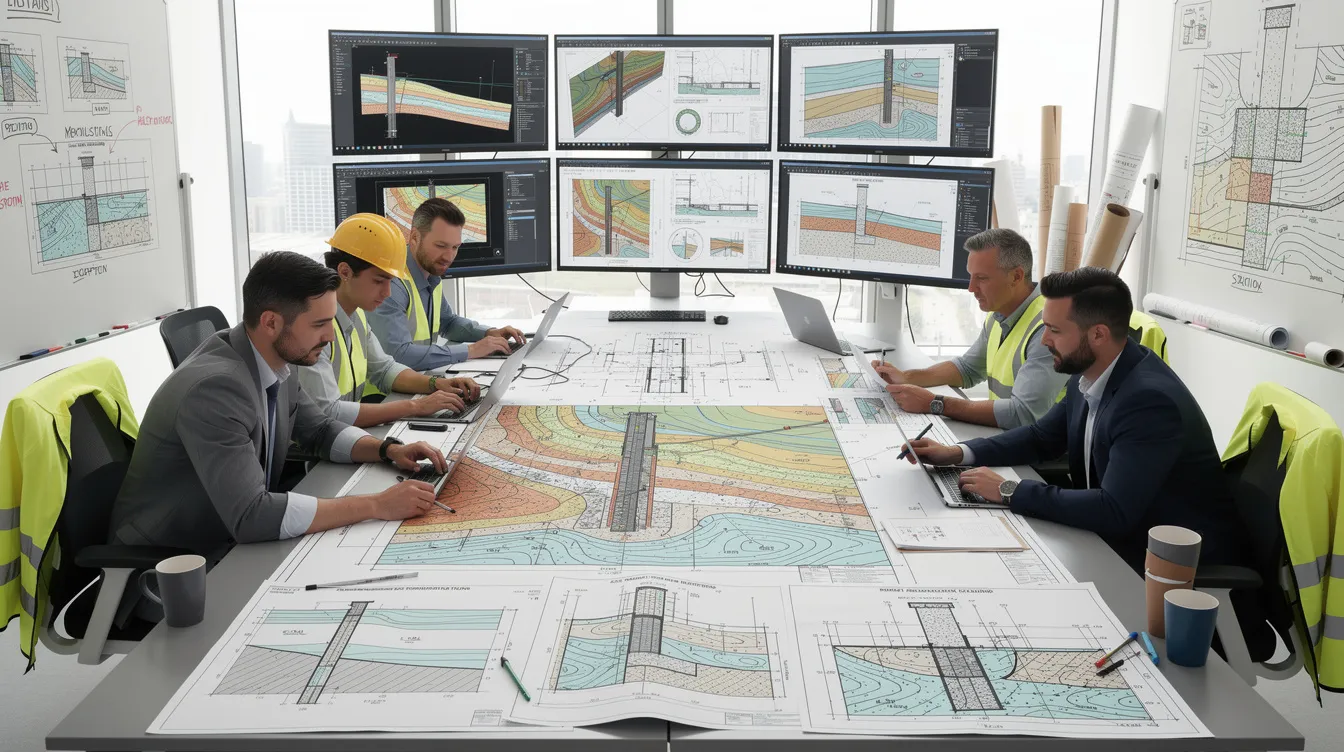
Geotechnical investigations must assess local soil profiles and groundwater conditions comprehensively. This means collecting and interpreting site investigation data – boreholes, Cone Penetration Tests (CPTs), Standard Penetration Tests (SPTs), laboratory tests for soil stiffness, strength, compressibility, and permeability, plus piezometer readings for groundwater levels. Where available, existing SI data from LTA’s archives should be retrieved to supplement new investigations and avoid gaps. Understanding why geotechnical investigations are needed is foundational to this entire process.
Soil and rock parameters derived from these investigations directly govern predicted ground movements towards the MRT tunnel. Zones of weaker soil – marine clay, mixed ground faces, or deep compressible layers – require particular attention because they amplify settlement risk. A detailed impact analysis includes excavation effects, groundwater drawdown, and vibration hazards, all of which must be quantified.
Common analysis methods include 2D and 3D numerical modelling (using tools such as PLAXIS or FLAC), empirical methods for tunnelling-induced settlement, and specific checks for basal heave, piping, and slope stability. LTA requires calibrated models for Type 2 and Type 3 studies, and calibration of models against real-world counts is mandatory – meaning model predictions must be validated against observed conditions from comparable projects or baseline monitoring data.
Structural and ERSS Design Interface
Earth Retaining and Stabilising Structures (ERSS) for works near tunnels encompass diaphragm walls, secant piles, sheet piles, soldier piles with lagging, ground anchors, struts, and walers. The ERSS design directly controls ground deformation and therefore tunnel movement – it must be fully integrated into the impact assessment, not treated as an isolated structural exercise.
Structural checks on MRT assets translate predicted ground movements and load changes into forces on tunnel lining segments, cross-passages, station box walls, and slabs. Independent checks are required for high-risk excavations or structural designs, ensuring that a second qualified engineer verifies the analysis assumptions, model outputs, and design adequacy. Construction methods must minimize vibrations and structural disruptions to meet LTA’s stringent operational criteria.
Instrumentation, Monitoring, and Trigger Levels
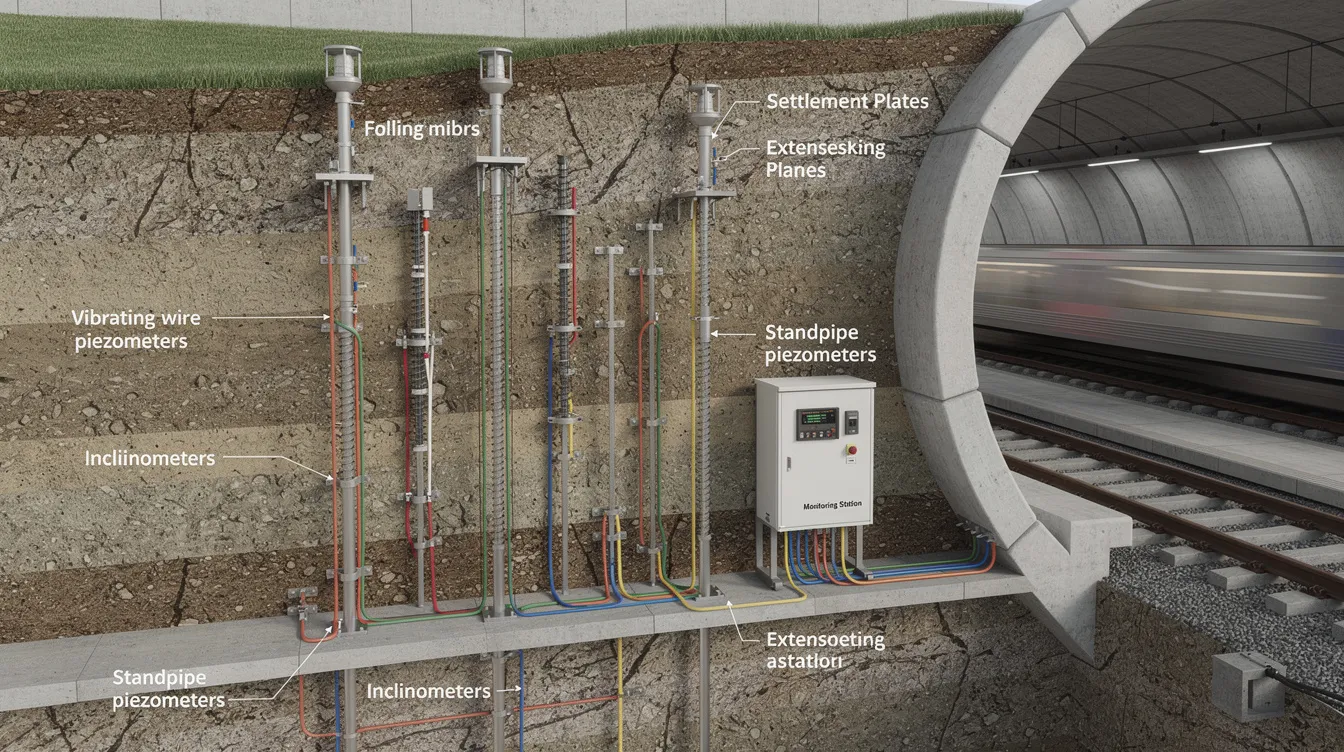
Monitoring instruments must be deployed at specified intervals based on project proximity to MRT structures. Typical systems include tunnel crown settlement points, track geometry monitoring devices, inclinometers, piezometers, building settlement markers, and strain gauges. Instrumentation must be installed to monitor structural movements in real-time, especially during critical construction phases.
A three-tier trigger system is mandatory for monitoring impacts during construction. Green, amber, and red trigger levels correspond to escalating response actions agreed with LTA and rail operators – from continued monitoring through slowed excavation to full work stoppage and design review. The monitoring and contingency plan forms a core part of the impact assessment submission and cannot be an afterthought.
These three components are woven into each stage of the step-by-step process described next.
Step-by-Step Process for an LTA Impact Assessment Near MRT Tunnels
This section presents the chronological, practical workflow commonly adopted in Singapore, aligned with LTA requirements and typical industry practice. While parallels exist with traffic impact assessment or environmental impact assessment processes (such as the phased approach used for developments along the cross island MRT line near the central catchment nature reserve), the tunnel protection assessment has its own distinct technical and regulatory pathway.
Step 1 – Early Tunnel Proximity and Feasibility Screening
The developer or consultant first identifies MRT lines, tunnels, and stations near the project site using LTA’s published railway protection plans, street directory maps, and as-built drawings where accessible. For major projects such as developments near the cross island line alignment, this screening begins during concept design.
Preliminary offsets – horizontal distance from tunnel extrados, depth to tunnel crown – are used to classify risk level and confirm whether the site sits within the Railway Protection Zone. A Certified Survey Plan must map the exact alignment of MRT structures relative to proposed works, providing the geometric basis for all subsequent analysis. If the project falls within the 40 m protection zone or involves restricted activities (deep piling, excavations beyond specified depths, dewatering), a full impact assessment is triggered.
AEC Technical Advisory typically performs this screening during the first phase of project planning to flag implications on cost, programme, and feasible foundation systems – avoiding surprises that lead to delays and redesign later.
Step 2 – Data Collection and Information Request from LTA
Key data to obtain includes MRT tunnel alignment and chainage, invert and crown levels, structural details (lining type, segment joints, waterproofing), nearby cross-passages, ventilation shafts, and any special structures such as crossover tunnels or crossing points between lines. For projects near an MRT station or MRT interchange, additional structural information about station boxes and platform slabs may be required. Developments near MRT interchanges face stricter public transport criteria and correspondingly more detailed data requirements.
Formal information requests to LTA are typically needed, and non-disclosure obligations apply to as-built structural drawings and soil investigation records. Retrieving existing SI data and as-built records is critical – it avoids over-design based on conservative assumptions and reduces the likelihood of repeated submissions due to data gaps.
Step 3 – Pre-Consultation with LTA Railway Protection
A pre consultation meeting with LTA’s Development & Building Control (DBC) department is strongly recommended before full submission. LTA’s scoping meeting is the first stakeholder consultation for tunnel protection works, similar in objective to the scoping meeting used in TIA submissions for road developments. Bring a site plan and proposed land use to the meeting, along with preliminary layout plans, cross-sections showing the relative position of proposed works and tunnels, indicative ERSS schemes, and initial SI findings.
The purpose is to confirm whether a full impact assessment is required, agree on assessment extent, and understand project-specific constraints – such as allowable working hours, track possession windows, or particular sensitivities on lines with a history of settlement issues. Confirm study area boundaries during the scoping meeting to avoid wasted analytical effort.
Typical outcomes include confirmation of the required calculation scope, whether 2D or 3D analysis is needed, specific monitoring instruments LTA expects, and whether Accredited Checkers or QP(ST) sign-off will be required. Request a scoping meeting to confirm classification early – this single step can prevent months of rework.
Step 4 – Detailed Geotechnical and ERSS Design for Impact Assessment
After scoping is agreed, the design team refines ERSS and foundation schemes to minimise environmental impact on the MRT tunnel. This is where the geotechnical considerations for deep excavation become most intensive.
Analyses carried out include staged construction modelling, sensitivity checks on soil parameters (stiffness, strength, permeability variations), assessment of short-term and long-term settlements (typically 15–25 mm total for deep foundation elements, with differential settlement limited to 1:1000), and evaluation of alternative ERSS layouts or construction sequences. Integrating construction staging – excavation levels, strut installation timing, dewatering phases – into the model is essential to reflect realistic ground movements rather than idealised conditions.
AEC Technical Advisory’s ERSS & Geotechnical Design team iterates schemes to keep tunnel movement within LTA’s performance criteria while balancing cost and constructability. One thing that distinguishes experienced consultants is the ability to run multiple ERSS options through the model quickly, presenting developers with clear cost-risk trade-offs rather than a single conservative solution.
Step 5 – Structural Impact Evaluation on MRT Tunnels and Assets
Predicted displacements and stresses from geotechnical models are translated into structural effects on tunnel lining segments, joint movements, cross-passage connections, and station box walls and slabs. Checks cover axial forces, bending moments, shear, joint shear capacity, and waterproofing integrity, all benchmarked against LTA civil works specifications and original design assumptions for the MRT structure.
Projects must ensure structural integrity and operational safety of MRT tunnels throughout construction – not just at the final state. This means evaluating intermediate construction stages where temporary load imbalances or partial excavation may produce worse conditions than the completed works. Where predicted stresses or movements approach allowable limits, local strengthening or protective mitigation measures are proposed: buffer piles, ground improvement zones, or modified construction sequences.
Step 6 – Development of Monitoring, Trigger Levels, and Contingency Measures
A detailed Instrumentation & Monitoring Plan is prepared specifying instrument types, locations relative to tunnel and proposed works, reading frequency (daily during critical phases, weekly otherwise), baseline requirements, and reporting lines to LTA and rail operators. Deep excavation monitoring expertise is essential here.
Green, amber, and red trigger values are derived from analysis results and LTA limits. For example, green might be set at 60% of the 15 mm total movement limit, amber at 80%, and red at 100% – with specific response actions at each level. Contingency measures must be clearly defined: slowing excavation rate, adding emergency struts, revising dewatering strategy, imposing temporary load restrictions, or suspending specific activities. These measures and decision trees must be pre-agreed with all parties, including the rail operator.
Step 7 – Compilation and Submission of the LTA Impact Assessment Package
All work is compiled into a structured Impact Assessment report: project description, proximity to MRT infrastructure, ground conditions and geotechnical model, design assumptions, ERSS and foundation details, analysis results with model files, monitoring and contingency plan, method statements, and conclusions on acceptability against LTA criteria.
Submission typically includes calculation reports, model input/output files, GA drawings, cross-sections, instrumentation layouts, and PE/QP endorsements. The installer of construction works must submit applications through the CORENET digital portal for LTA clearance, ensuring all documentation is properly lodged. LTA requires evidence-backed claims in all narratives – vague assertions about “minimal impact” without supporting analysis will be rejected.
Clarity, traceability of assumptions, and alignment between drawings, models, and method statements are critical to minimise LTA queries. The report should include an executive summary that allows LTA reviewers to quickly assess the project’s risk profile and adequacy of proposed mitigation measures.
Step 8 – LTA Review, Clarifications, and Approval
Realistic timeframes for LTA technical review vary significantly. Type 1 studies typically last a few months for simpler cases, while complex projects – deep excavations in close proximity to tunnels, compressible soil zones, or multiple tunnel alignments – may require several rounds of clarification over months. Common reasons for extended review include insufficient justification of soil parameters, inadequate model boundary conditions, inconsistencies between construction staging assumptions and method statements, and unclear contingency actions.
LTA reviewers examine technical completeness, compliance with the Code of Practice, and consistency across all submitted documents. Iterative resubmissions are common; engaging an experienced consultant with a strong track record in MRT tunnel protection – such as AEC Technical Advisory – can significantly reduce review cycles by anticipating queries and addressing them proactively in the first submission.
Formal approval typically includes conditions that must be complied with during construction, particularly regarding monitoring frequency, reporting protocols, and specific construction restrictions. A Post Implementation Review may be required after TIA approval for certain developments, and similar post-construction review obligations apply to tunnel impact assessments.
Step 9 – Construction Phase Monitoring, Reporting, and Close-Out
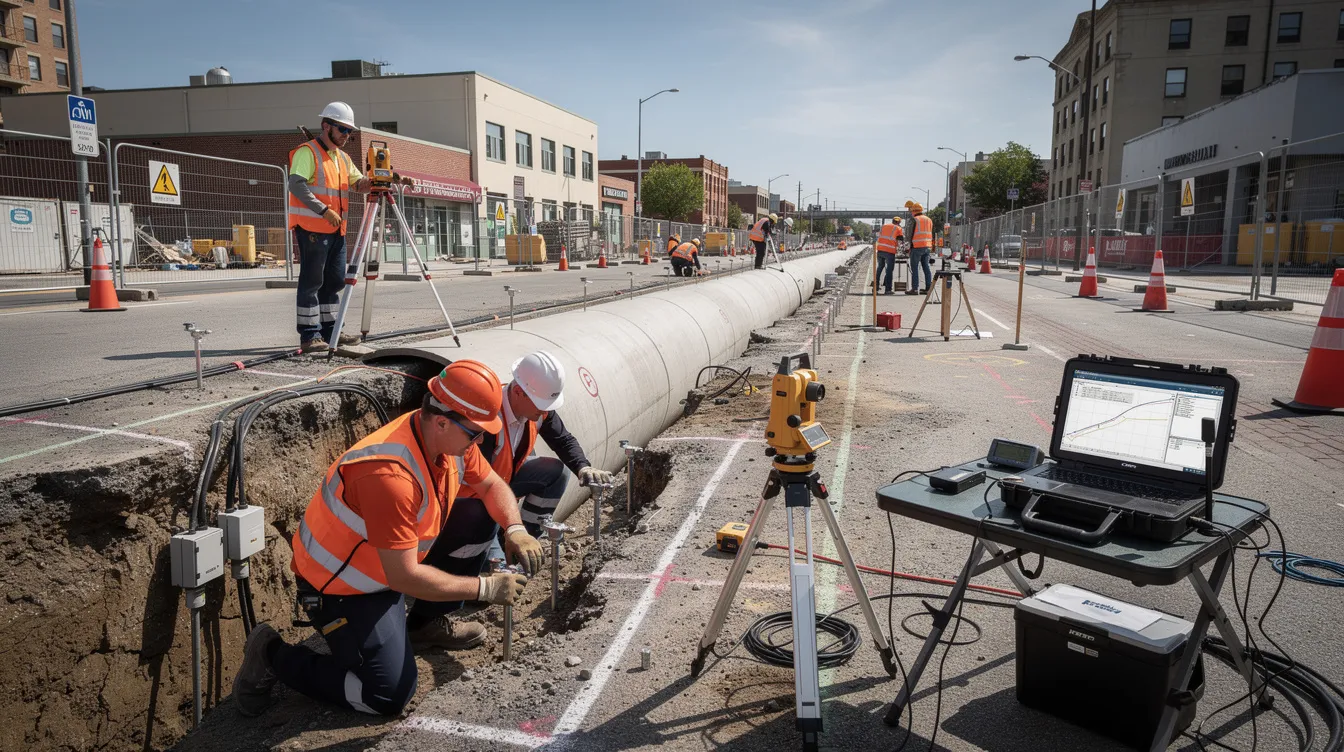
Monitoring is implemented with baseline readings before works commence, increased frequency during critical stages, and real-time or near-real-time alerts for tunnel-related instruments. Settlement monitoring methods must be robust enough to capture rapid changes during excavation and dewatering phases.
Periodic reporting to LTA and rail operators includes trend charts, comparisons against predicted values, and commentary from the QP or geotechnical engineer. If trigger levels are exceeded, immediate response actions are activated per the pre-agreed contingency plan – ranging from excavation rate reduction to full work stoppage and emergency design review.
End-of-project close-out involves a final report summarising monitored versus predicted performance, demonstrating that all LTA conditions were met, and providing formal confirmation of compliance. LTA requires a Post Implementation Review for certain developments, particularly where construction involved significant dewatering, deep excavation, or where monitored movements approached trigger thresholds.
Common Challenges in MRT Tunnel Impact Assessments and How to Address Them
Even well-prepared project teams encounter recurring issues during tunnel impact assessments, and their core job is still to identify likely effects early and reduce them before construction proceeds. This section addresses the most common reasons for delays, rework, and cost overruns based on Singapore practice.
Underestimating Ground Movements Due to Simplified Modelling
Relying solely on 2D models or empirical charts without sensitivity checks is a frequent source of problems. Overly simplified boundary conditions may not capture real 3D effects, ground heterogeneity, or the interaction between multiple excavation stages. Type 2 and Type 3 studies require micro simulation modeling or equivalent numerical sophistication. A TIA report must include calibrated micro-simulation modeling – and while this terminology is more commonly associated with traffic impact assessment, the principle of calibrated, evidence-based modelling applies equally to tunnel impact work. Solutions include robust sensitivity studies, 3D analysis where site geometry is complex, and independent peer review of soil parameters and staging assumptions.
Incomplete or Misaligned Construction Sequences
Differences between the actual site construction sequence and the modelled sequence can invalidate predictions and trigger LTA queries during the second phase of review. This is one of the most common reasons for trigger exceedances during construction – the contractor changes strutting sequences, delays dewatering, or alters excavation staging without updating the impact assessment. Closer coordination between the contractor’s method statements and the designer is essential, with regular model updates when sequences evolve.
Late Engagement with LTA and Fragmented Authority Submissions
Engaging LTA only after designs are finalised – or handling BCA, LTA, PUB, and other agencies in silos – creates cascading problems. Changes requested by one agency (for instance, a deeper basement to accommodate increased gross floor area or altered land use intensity, or revised emergency vehicle routes that affect the final design near MRT tunnels) must be evaluated for their tunnel impact before resubmission to LTA. Coordination across agencies prevents conflicting messages and wasted design iterations. Stakeholder engagement avoids costly changes after submission.
AEC Technical Advisory’s ability to manage multi-agency TIA submissions alongside tunnel impact assessments ensures that structural submissions to BCA, fire safety requirements to SCDF, and drainage constraints from PUB are all coordinated with LTA’s tunnel protection requirements, including site-access and nearby junction effects where those agency requirements influence the road interface.
Inadequate Monitoring and Slow Response to Trigger Exceedance
Sparse instrumentation layouts, delayed data processing, or unclear escalation protocols undermine the entire monitoring framework. Traffic surveys must avoid atypical survey days for accuracy – and similarly, monitoring readings taken during atypical construction phases or with poorly calibrated instruments produce unreliable data. Solutions include automated data acquisition where justified, clearly documented response plans, and pre-agreed decision trees with all parties. Engaging residents early helps adjust access design before submission – and while this is primarily a traffic impact assessment principle, early engagement with affected stakeholders (building owners, rail operators) is equally valuable in tunnel protection contexts.
Conclusion and Practical Next Steps
A structured, step-by-step LTA impact assessment process protects MRT tunnels from construction-induced damage, avoids costly mid-project redesign, and safeguards development timelines. Developers must comply with LTA requirements for construction near MRT tunnels – this is not discretionary and carries significant legal and safety obligations. The benefit of early, thorough assessment far outweighs the upfront cost of professional fees and site investigation.
Immediate next steps for project teams considering works near MRT tunnels:
-
Confirm proximity to MRT tunnels using available alignment information and verify whether your site sits within the Railway Protection Zone.
-
Engage a qualified ERSS & geotechnical design consultant early – during concept design, not after planning approval – to scope the impact assessment strategy, with experienced engineers and planners working together from the outset.
-
Prepare preliminary layouts and SI data for an LTA pre-consultation meeting; this single step can prevent months of rework.
-
Plan for monitoring and contingency measures at the same time as design, not after approval – LTA expects these as integrated components of the submission.
-
Coordinate authority submissions across LTA, BCA, PUB, and SCDF from the outset to avoid conflicting requirements.
AEC Technical Advisory supports this process end-to-end: from feasibility screening and SI planning, through ERSS design and tunnel impact modelling, to construction monitoring coordination and multi-agency submissions. Engage a registered consultant with demonstrated MRT tunnel protection experience to reduce submission risk and approval timelines.
Frequently Asked Questions About LTA Impact Assessments Near MRT Tunnels
Below are specific, common questions from Singapore developers and contractors undertaking works near MRT infrastructure.
Do All Projects Near an MRT Tunnel Need a Full Impact Assessment?
Not necessarily. Requirements depend on horizontal distance, depth relative to tunnel crown, type of work, and scale of the project. Some minor shallow works outside the most restrictive reserve lines may require only a simplified assessment or written confirmation from LTA rather than a full submission. However, TIA classification depends on trip generation thresholds – and similarly, tunnel impact classification depends on proximity and risk thresholds. Perform an initial proximity check and then seek formal scoping advice from LTA or through your consultant. Phase 1 includes scoping and survey stages that help determine the required level of assessment.
How Long Does the LTA Impact Assessment and Approval Process Typically Take?
Preparation of analysis and documentation takes weeks to several months depending on site complexity. LTA review ranges from several weeks for straightforward cases to several months for complex projects requiring multiple clarification rounds. Phase 1 of TIA involves scoping and traffic surveys – and the tunnel impact equivalent (Steps 1–3) follows a similar timeline. Factors affecting overall duration include the number of review cycles, whether 3D modelling is required, concurrent BCA submissions, and contractor appointment timing. LTA classifies TIAs into three tiers based on complexity, and tunnel impact assessments follow an analogous risk-based approach.
Can I Start Construction Before LTA Approves the Impact Assessment?
No. Any works affecting MRT tunnels or within the Railway Protection Zone must not commence before LTA’s formal approval. This is both a safety requirement and a legal obligation under the RTS Development and Building Works Regulations. Non-compliance can result in stop-work orders, financial penalties, and serious reputational risk. Inspection and baseline monitoring must also be completed before works begin.
What Qualifications Should My Impact Assessment Consultant Have?
Your consultant should be a Professional Engineer (Civil/Structural or Geotechnical) registered in Singapore, with specific MRT and rail protection experience. Familiarity with LTA’s codes, numerical modelling tools, and the CORENET submission process is essential. Engage a registered TIA consultant, and screen TIA consultancy firms for relevant submission experience and track record, for reduced submission risk – and the same principle applies to tunnel impact work. Multidisciplinary capability – covering structural, geotechnical, ERSS design, and authority submission experience – is especially valuable. A specialist PE Geo alongside PE Civil may be required depending on project complexity.
How Is Tunnel Impact Assessment and Traffic Impact Assessment Coordinated with BCA and Other Authority Submissions?
Structural submissions to BCA, fire safety requirements (SCDF), and drainage and utilities constraints (PUB, SP Group) all influence the final design near MRT tunnels. Changes requested by one government agency – such as increased basement depth to achieve higher gross floor area – must be evaluated for their tunnel impact before resubmission to LTA. Informal engagement with local organizations and surrounding network stakeholders can also flag access or construction constraints early. For mixed-use or larger developments, a separate transport impact assessment may also review surrounding access patterns, public transport operations, and issues such as bus dwell times that sit outside the tunnel-protection scope. Integrated submission planning ensures that modifications driven by one agency’s requirements do not trigger non-compliance with another’s, avoiding the costly cycle of sequential redesign across multiple authorities.