
Risk Management Facilitator (RMF) for Confined Space Work Registers in Industrial Facilities
Introduction
A Risk Management Facilitator (RMF) for confined space work is a competent person who leads the risk assessment, documentation, and ongoing management of confined space operations across industrial facilities. In Singapore’s industrial segment-factories, process plants, warehouses, and manufacturing environments-confined space work registers form the backbone of safe, legally compliant entry operations. These registers systematically document every confined space, every permit issued, every person trained, and every piece of rescue equipment maintained on site.
An RMF helps industrial operators set up, maintain, and audit confined space work registers so that every entry event meets the requirements of the Workplace Safety and Health (WSH) Act, the WSH (Confined Spaces) Regulations 2009 (as amended in June 2024), and MOM’s Risk Management Regulations. The scope of this article covers the RMF role, register design, workflow templates, and practical implementation for industrial buildings, plants, and warehouses in Singapore. It excludes detailed training course syllabi and generic safety theory unrelated to confined space registers.
This article is written for EHS managers, project managers, contractors, MCSTs, and plant owners in the industrial segment who must manage confined space entries and want a structured, compliant system backed by engineering and safety documentation, particularly those with an occupational safety background or related compliance responsibilities.
Why does this matter? Confined spaces can carry high-consequence hazards like oxygen deficiency and toxic gases-legal compliance under the WSH Act and Confined Spaces Regulations is non-negotiable, and well-managed registers directly prevent fatalities while ensuring smoother MOM inspections and insurance audits.
To implement an RMF-led confined space register in an industrial facility: appoint competent authorised managers and safety assessors, develop a complete inventory of all confined spaces, create linked registers for entry permits, training and competency, equipment and rescue readiness, ensure regulatory atmospheric testing and monitoring, digitise or standardise templates, and conduct audits and updates at triggered intervals.
What you’ll learn from this article:
- How to define the RMF role within Singapore’s confined space regulatory framework
- How to design and structure each type of confined space work register (inventory, permits, competency, equipment)
- How to integrate permits, atmospheric testing, and training certification into a consistent structure
- How to choose between digital and paper-based register systems for industrial settings, including when print use cases still suit paper-based control
- How to address common challenges and prepare for MOM audits using structured safety documentation
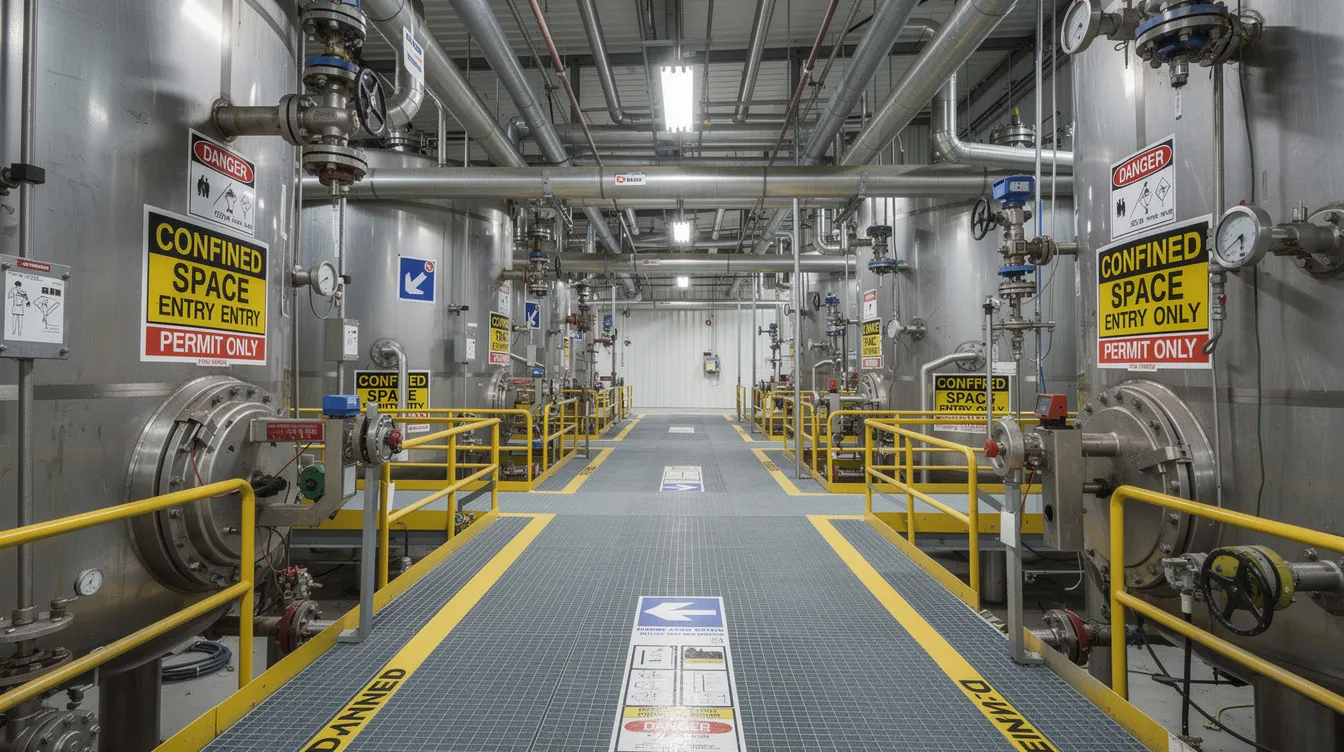
Understanding RMF and Confined Space Work Registers
Before designing any register system, it is essential to understand the foundational roles and regulatory context that shape confined space management in Singapore’s industrial facilities. This section outlines what an RMF does, what confined space work registers contain, and the legal framework that governs both.
What Is a Risk Management Facilitator (RMF) in the Context of Confined Space Work and Risk Assessment?
In the Singapore context, the RMF for confined space work is a competent person appointed to lead risk assessments under the WSH (Risk Management) Regulations, with specific emphasis on confined space operations. The RMF acts as an integrator across multiple statutory roles defined in the Confined Spaces Regulations: the authorised manager (appointed under Regulation 9), the confined space safety assessor, the responsible person (typically the employer or principal), and competent persons performing entry, monitoring, or rescue tasks.
Minimum expected competencies for an RMF include thorough knowledge of confined space hazards-atmospheric hazards in confined spaces include oxygen levels outside 19.5% to 23.5% and toxic gases-as well as familiarity with engulfment risks, mechanical and electrical hazards, and ingress of dangerous substances. The RMF must understand ISO 45001:2018, which is a standard for occupational health and safety management, and be well-versed in the WSH (Confined Spaces) Regulations, MOM/WSHC Codes of Practice, and Singapore Standard CP 84:2000. Hazard identification for confined spaces includes atmospheric, physical, mechanical, and environmental hazards, and the RMF must be able to identify all of these categories during risk assessment and explain how confined space hazards and controls affect entry decisions.
On industrial sites, the RMF interacts closely with the Workplace Safety and Health Officer (WSHO)-who must comply with the Workplace Safety and Health Act-Fire Safety Managers (who must follow the Fire Safety Act regulations), entry supervisors, contractors, and maintenance or process engineers. Safety officers manage permit-to-work for confined spaces, conduct EHS trainings and emergency drills, and must be registered with the Ministry of Manpower. The collaboration between FSMs and Professional Engineers is particularly relevant where confined spaces are adjacent to fire-rated compartments or hazardous storage areas.
AEC Technical Advisory typically fills the RMF role on industrial projects-factories, logistics hubs, process plants-by structuring registers, conducting risk assessments, and coordinating with structural, M&E, and fire safety engineering teams to ensure compliant operation, including support for business reporting and register governance in industrial operations.
What Are Confined Space Work Registers?
A confined space work register is a systematic record of all confined spaces within a facility, their risk profile, and every entry or permit-to-work event carried out in those spaces. A confined space risk register must be updated regularly and should bridge hazard identification and compliance. There are several distinct register types:
- Confined space inventory register: A master list of all fixed and stationary confined spaces in the facility. Confined spaces include tanks, vaults, silos, and pipelines. Each entry includes a unique identifier, location, hazard profile, and access details. Confined spaces must have unique identifiers and detailed descriptions to meet safety standards.
- Entry/permit register: A log of all work activities, including dates, personnel, atmospheric test results, control measures, close-out status, and, where relevant to the work scope, supporting documents such as a safety data sheet. Confined space entry permits are mandatory before performing work in such areas.
- Training/competency register: A record of personnel qualified for roles such as entrant, standby man, gas tester, entry supervisor, and rescue team member, including course titles, validity dates, and medical fitness.
- Equipment and rescue preparedness register: A catalogue of gas detectors, breathing apparatus, retrieval systems, and rescue equipment, including calibration dates and inspection results.
These registers support traceability for audits, incident investigations, continuous improvement, and management oversight. EHS compliance includes mandated report submissions to local authorities, and a complete register system provides the data needed to generate those reports.
Regulatory and Workplace Safety Standards Context in Singapore
Several statutes and standards govern confined space work registers in Singapore:
- WSH Act 2006 – overarching duties on employers, principals, and responsible persons for workplace safety and occupational health.
- WSH (Confined Spaces) Regulations 2009 (amended 1 June 2024 via S 434/2024) – specific duties for record-keeping, permit systems, atmospheric testing, competency, rescue, and training. Under Regulation 4, factory occupiers must make a record of the description and location of all fixed and stationary confined spaces and inform persons who may be exposed of their existence and hazards.
- WSH (Risk Management) Regulations – requirement for workplaces to conduct risk assessments before work begins. Risk management regulations guide workplace safety practices, and risk assessments must include method statements and safe work procedures.
- Singapore Standard CP 84:2000 and MOM/WSHC Approved Code of Practice on Confined Spaces – practical guidance on definitions, permits, controls, and register formats.
MOM expects documented risk assessments, permits-to-work, and retention of records. Under Regulation 16, atmospheric test records must be kept for at least two years from the date they were made. Permits must be retained by the authorised manager. Periodic audits of the risk register are required following changes in process or workspace.
Structured confined space registers demonstrate due diligence during MOM inspections, insurance audits, and enforcement reviews. Ensuring regulatory compliance across all operational domains-including confined space management-is a core responsibility for industrial facility operators.
Understanding these definitions and the legal context sets the stage for designing practical RMF-led registers that hold up under scrutiny.
Core Components of an RMF-Led Confined Space Register System
Once the foundational concepts and regulatory requirements are clear, the next step is to break down what a well-structured register system looks like in an industrial facility. Each register type serves a distinct purpose, and the RMF must ensure they work together as an integrated system.
Confined Space Inventory Register Consistent Structure
The inventory register is the foundation. Hazard profiles should document intrinsic and task-generated hazards for confined spaces, and this register captures that data systematically. Key data fields include:
- Unique ID/code for each confined space
- Location within facility: plant area, tank farm, basement, building level, with drawing or map reference
- Type of space: manhole, tank, silo, culvert, mixer pit, wash-out sump, service tunnel
- Dimensions: volume, depth, internal layout, access points and hatches
- Known hazards: atmospheric (oxygen deficiency, flammable vapours, toxic gases), mechanical, thermal, biological, chemical, engulfment
- Normal contents or services: liquid, sludge, powder, installed equipment
- Access/egress means: size, restrictions, vertical/horizontal entry, ladder, manway
- Ventilation capability
- Photos and annotated sketches or floor plan excerpts
Confined spaces should be categorized as Permit Required or Non-Permit Required based on hazards present. The RMF works with structural, M&E, and process engineers-such as those from AEC Technical Advisory’s engineering consultancy-to cross-check as-built drawings, Piping & Instrumentation Diagrams (P&ID), and plant layouts. A facility walk-through is essential to discover non-obvious spaces like dry sumps, overflow trenches, and vertical shafts behind walls. Including images, thumbnails linked to full drawings, and annotated plans in the register makes identification faster and reduces ambiguity.
A confined space risk register should be built by a competent person or a multidisciplinary team, ensuring every space is captured from both a design and operations perspective.
Confined Space Entry and Permit-to-Work (PTW) Register
Permit-to-work is required for confined space operations, and permit-to-work systems are essential for confined space operations. The PTW register must capture the following fields for every entry event:
- Permit number, date/time of issue and expiry
- Description of work and purpose of entry
- Location and description of the confined space (linked to inventory register ID)
- Name(s) of entrant(s), entry supervisor, and standby attendant(s)
- Name of authorised manager who issued the permit
- Gas test/atmospheric test results: oxygen level, flammable gas/vapour (as % LEL), toxic substances, date/time of test, instrument ID and calibration status
- Control measures: ventilation, isolation/LOTO confirmation, PPE requirements, standby personnel, rescue plan reference
- Monitoring data during entry (continuous monitoring if more than two persons inside)
- Close-out status: confirmation of exit, hazard controls removed or safe, permit returned or digitally closed
- Signatures of safety assessor and authorised manager
- Any incidents during entry
Singapore regulations require pre-entry atmospheric testing and continuous monitoring in confined spaces. Under Regulation 12, the safety assessor must test the atmosphere in a specific sequence: oxygen first, then flammable gas/vapour, then toxic gases if applicable. Under Regulation 13, the authorised manager must confirm that oxygen is within 19.5–23.5%, flammables are below 10% LEL, and toxic substances are below permissible exposure limits before issuing a permit. The permit must be posted at the entrance to the confined space along with a sketch if reasonably practicable.
The RMF’s role is to standardise permit templates, ensure every mandatory field is complete, and maintain the linkage between PTW events and the central register. For example, in a sludge pit cleaning operation, the safety assessor might record oxygen at 19.8%, flammables at 5% LEL, and toxicity below PEL-all documented in the permit and filed in the register. Risk assessments in confined spaces use standard scoring matrices based on probability and severity, and these should be referenced in the permit documentation.
Regarding format, digital systems offer version control, mobile access via device (tablets or phones), automated alerts on permit expiry, easier data extraction for audit, and web-shareable links as a controlled option for viewing permits or reports online instead of relying only on static PDF exports. Paper-based permits remain common for field use but carry risks of loss, illegibility, and poor searchability.
Competency and Training Register for Confined Space Roles
The training register must track every person qualified for a confined space role. Typical roles include:
- Entrant
- Standby person (attendant)
- Entry supervisor
- Authorised gas tester
- Confined space safety assessor
- Rescue team members
- RMF
For each individual, the register should capture: name, role(s) qualified for, course title (e.g. “Perform Work in Confined Space Operation,” “Assess Confined Space Entry and Work”), training provider, credential or certificate number, validity dates, refresher training due date, medical fitness status where applicable, and equipment-specific training (gas detectors, SCBA, retrieval systems). The WSQ competency unit “Assess Confined Space Entry and Work” recommends 40 directed learning hours for safety assessors.
Under Regulation 21, every person entering or working in a confined space must have received adequate safety and health training familiarising them with hazards and precautions. Safety officers develop and maintain EHS documentation and procedures, and safety officers advise on occupational health and fire safety.
The RMF uses this register to verify that only competent persons are listed on permits. A 2026 Singapore District Court case (SGDC 357) emphasised that persons working in confined spaces must hold valid and genuine training certificates (such as PWCSO cards)-a forged card led to legal liability for the employer. Cross-checking the competency register against every permit application is a critical control step. Similar to how RMF for work at height tracks competency, confined space competency verification must be systematic and documented.
Equipment, Monitoring, and Rescue Preparedness Register
This register catalogues all equipment used in confined space operations. Equipment to track includes gas detectors (portable and fixed), breathing apparatus/SCBA, harnesses and retrieval lines, tripods and winch systems, ventilation equipment, communication devices, rescue stretchers, and first aid or reviving equipment. PPE for confined space entry may include harnesses, retrieval lines, and respiratory protection.
Fields for each item: equipment name and type, serial number, model, calibration and test dates, inspection results (pass/fail), maintenance history, storage location, responsible department or person, readiness status, and next calibration due date.
Engineering controls may include mechanical ventilation and continuous gas monitoring in confined spaces. Under Regulation 22, rescue equipment must be thoroughly examined at least once monthly or at prescribed intervals, and inspection records must be kept for at least two years.
Emergency protocols for confined spaces should include non-entry rescue plans and trained personnel. The RMF must confirm that rescue equipment and gas detectors are ready and calibrated before approving any entry. The register should also reference rescue procedures specific to each space, rescue team contact information, and the location of rescue equipment relative to the confined space.
Summary of all four register types:
- Confined space inventory register – identifies and describes every space
- Entry/PTW register – documents every permitted entry event
- Competency and training register – tracks qualified personnel
- Equipment and rescue register – catalogues and monitors safety equipment readiness
With these components defined, the next step is to design the process for creating, rolling out, and maintaining these registers in practice.
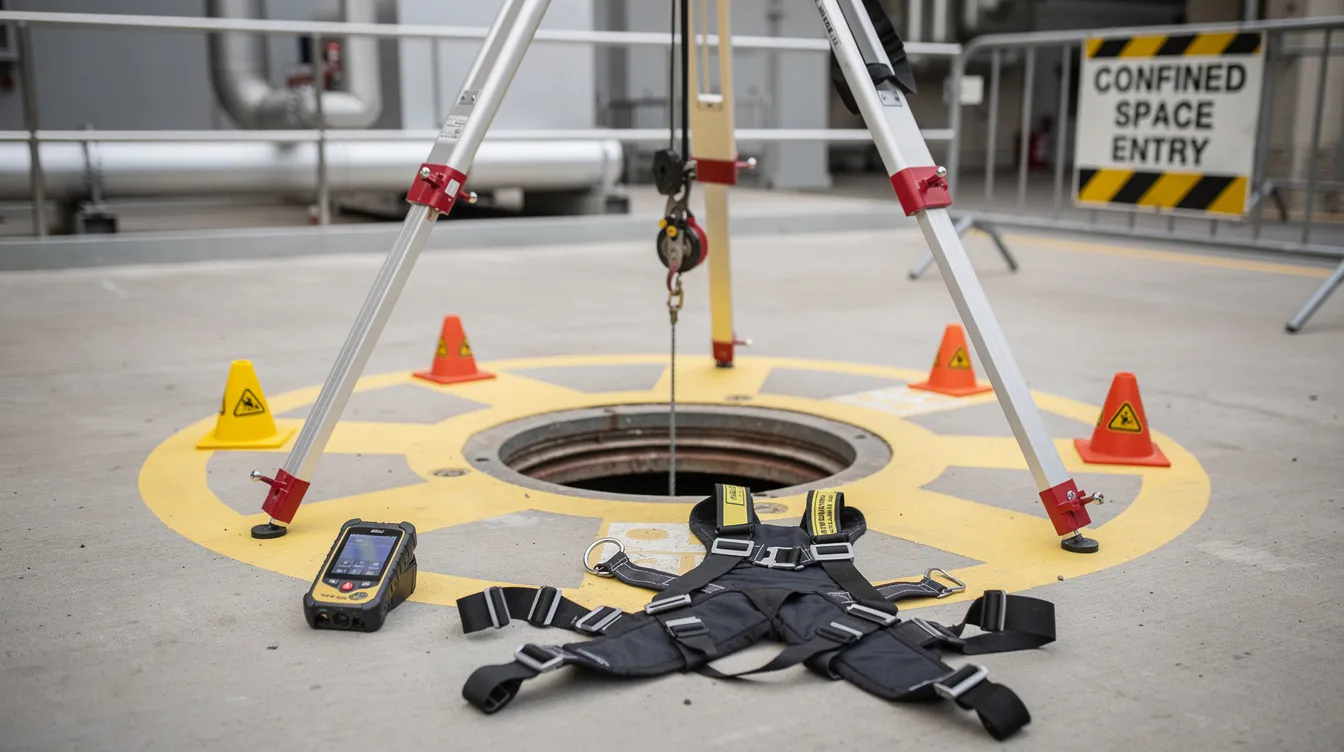
Designing and Implementing Confined Space Work Registers: RMF-Led Process
An RMF should use a structured procedure to create, roll out, and manage these registers in an industrial facility. The process below applies whether commissioning a new plant, executing a major retrofit, or overhauling an existing system that has gaps.
Step-by-Step RMF Implementation Workflow
This workflow applies when establishing registers for a new facility, after a significant layout or process change, or as a retrofit where existing risk documentation is incomplete.
- Gather drawings and process information: Collect architectural, structural, M&E, P&ID, and layout plans. Review as-built drawings against original design documents and scan for deviations.
- Conduct facility walk-through: Verify confined spaces on drawings and discover spaces not obvious from plans-sumps, trenches, mixer pits, service tunnels, vertical shafts. Consult maintenance and operations team members who are familiar with the site.
- Draft initial inventory register: Assign unique IDs, photograph each space, create annotated plans, complete hazard identification per space. The hierarchy of controls must be applied when evaluating risks in confined spaces.
- Develop standardised PTW and entry register templates: Tailor workflow templates to site conditions, ensuring all fields required by WSH regulations are included (gas test results, validity period, isolation confirmation, rescue plan reference).
- Map existing training and competency records: Identify gaps for key roles (entrants, standby persons, safety assessors, rescue teams). Schedule missing training with accredited providers.
- Set up equipment and rescue preparedness register: Include gas testing protocols, calibration schedules, and rescue equipment readiness checks. Confirm all devices are functional and current.
- Pilot the system on a limited scope: Select one process line, tank farm, or building. Run actual permit issuance, record-keeping, and close-out. Collect feedback from users-maintenance, operations, contractors, and ask pilot users to Comment on form usability, missing fields, and workflow issues during the trial.
- Roll out across the facility: Conduct toolbox talks, training sessions, and induction for all supervisors and contractors. Place signage at confined space entry points.
- Establish a review cycle: Set quarterly reviews for the RMF to update registers, review statistics, and confirm consistency. Trigger additional reviews after plant upgrades, process modifications, incidents, or new confined spaces discovered. Periodic reviews of confined space risks should account for incidents or near-misses to update practices.
Digital vs Paper-Based Register Systems in Industrial Settings
Industrial facilities must choose between paper-based forms, spreadsheet-based systems (such as Excel or shared cloud files), and integrated EHS or CMMS software platforms. Here is a comparison:
| Criterion | Paper-Based Forms | Digital Systems (Excel / Cloud / EHS Software) |
|---|---|---|
| Ease of use | Simple, no IT training needed; familiar to all users | Requires initial training; more consistent once adopted |
| Audit traceability | Difficult to search; risk of loss or damage; poor version control | Full version history; easy search and data retrieval; audit-ready PDF or report export |
| Field access (mobile) | Portable but can be damaged in wet/dirty settings | Accessible via mobile device (tablet/phone); may need offline capabilities in plants with limited connectivity |
| Cost and IT support | Low upfront cost; no IT infrastructure needed | Higher initial investment; requires IT support, cybersecurity controls, and backup |
AEC Technical Advisory typically recommends scalable digital templates-starting with Excel or cloud-based tools for small and medium industrial sites-and full EHS software or CMMS integration for large plants with many projects and entry points. Digital systems enforce data validation (mandatory fields cannot be left blank), generate automated reminders for training expiry and permit validity, and support easier collaboration among multiple users. Including screenshots or images of sample digital forms in training materials helps guide users visually toward correct execution.
Integration with Existing Safety Management Systems
Confined space registers should not exist in isolation. They must align with the company’s broader Workplace Safety and Health Management System (WSHMS) or ISO 45001:2018 framework, which is a standard for occupational health and safety management. Confined space risk management should link with health and safety regulations and standards, and the registers serve as documented information under ISO 45001’s clauses on operational planning, control, and evaluation.
Key linkages include:
- Incident and near-miss reporting: PTW events flagged with incidents feed directly into the incident management system. EHS documentation should be developed and maintained for compliance.
- Maintenance shutdown planning: Confined space entries often coincide with planned shutdowns. The PTW register must coordinate with maintenance schedules.
- Lock-Out/Tag-Out (LOTO) procedures: Isolation confirmation on the PTW must reference and confirm LOTO execution.
- Emergency response plans: Rescue protocols in the equipment register should align with SCDF requirements and internal emergency plans. They conduct EHS trainings and emergency drills.
- Management review dashboards: The RMF should define key performance indicators (KPIs)-number of permitted entries, near-misses, permit violations, overdue training, overdue equipment calibrations-and present these in management review meetings. Compliance audits assess whether risk findings translate into actionable safeguards in confined spaces.
Diagrams or flowcharts illustrating the information flow-from PTW initiation through safety assessor evaluation, permit issuance, entry monitoring, close-out, record storage, and periodic review-help users understand the complete process. This integration ensures a repeatable structure that supports both day-to-day operation and long-term continuous improvement.
Common Challenges in Managing Confined Space Work Registers and How RMF Addresses Them
Many industrial sites struggle with accurate confined space records. Appointing a competent RMF and implementing structured analysis of register data mitigates these issues. Below are the most common challenges and practical solutions.
Incomplete Identification of Confined Spaces
Industrial facilities frequently omit non-obvious confined spaces-culverts, vertical shafts behind walls, underground pits, dry sumps, overflow trenches, and mixer pits. One industrial facility that retrofitted a tank farm discovered 15 additional confined spaces (mixers, wash-out sumps) that were not on any drawings.
RMF techniques to solve this:
- Systematic review of all drawings-architectural, structural, M&E, services-combined with physical site surveys
- Consultation with maintenance and operations teams who are familiar with hidden or rarely accessed spaces
- Use of photos, mark-ups, and annotated layout drawings to eliminate ambiguity. In very large plants, laser scanning or 3D mapping may be justified
- Cross-referencing with additions and alterations (A&A) documentation to capture spaces created during past renovations
Inconsistent or Poor-Quality Register Entries
Common problems include missing gas test readings, incomplete close-out records, illegible handwriting on paper forms, inconsistent abbreviations, and permits lacking a specified purpose or work description.
RMF-driven solutions:
- Standardised forms with mandatory fields-digital systems can enforce this through data validation (users cannot submit unless all required fields are complete)
- Short training sessions for supervisors and contractors on correct form completion
- Periodic RMF audits and feedback loops-rejecting incomplete permit applications and providing example completed forms as a library reference
- Maintaining a consistent format across all registers so that any reviewer or auditor can search and interpret records quickly
Difficulty Linking Registers to Real-Time Site Conditions
Plants are dynamic: layouts are adjusted, new equipment is installed, hatches are modified, and unauthorised changes occur. Without updates, the inventory register becomes stale and the data unreliable.
RMF strategies:
- Include confined space registers in the facility’s Management of Change (MOC) workflow-any change to layout, process, or equipment triggers a review of the inventory and associated hazard assessments
- Schedule quarterly register updates tied to facility maintenance cycles
- Use updated photos and sketches to reflect modifications
- Trigger reviews after plant upgrades, A&A works, or process changes-similar to how temporary works approvals require documentation updates after scope changes
Limited Awareness Among Contractors and Short-Term Project Teams
Contractors arriving for short-duration tasks are often unfamiliar with a facility’s confined space registers, PTW process, and site-specific hazards. This is a significant risk factor in manufacturing and industrial settings.
RMF solutions:
- Mandatory site induction covering the confined space register, PTW process, and emergency response plan-this must be carried out and documented before any contractor begins work
- Simple visual guides or posters with images showing typical confined spaces and hazards at the facility
- On-site briefings before high-risk shutdowns or tank entries, led by the RMF or assigned safety officer
- Verification that contractor competency registers are checked and that contractor personnel hold valid certifications before being listed on any permit
- Assign contractor supervisor responsibilities explicitly and document them in the PTW
Addressing these challenges proactively ensures that registers remain accurate, complete, and genuinely useful-not just a compliance exercise on paper.
Conclusion and Practical Next Steps for Industrial Operators
A competent Risk Management Facilitator, supported by well-designed confined space work registers, is central to safe and compliant work in industrial confined spaces. These registers are not administrative overhead-they are the operational tools that connect hazard identification, risk assessment, training verification, equipment readiness, and permit control into one traceable system. For factories, warehouses, process plants, and manufacturing facilities, this structured approach directly reduces the risk of serious injury or fatality, satisfies MOM and SCDF requirements, and supports smoother audits and insurance reviews.
Practical next steps for industrial operators:
- Audit current confined space documentation and identify gaps in your inventory, permits, competency records, and equipment registers.
- Appoint or engage a qualified RMF with confined space expertise. AEC Technical Advisory provides RMF services for industrial clients, including risk assessment, register design, and cross-disciplinary coordination.
- Standardise and digitise key registers with clear field definitions, mandatory data fields, and visual aids (photos, annotated plans, screenshots of sample forms).
- Integrate registers with permit-to-work, MOC, LOTO, and emergency response systems to create a complete, linked workflow.
- Schedule regular reviews and refresher training for supervisors and contractors-quarterly at minimum, and after any process, layout, or personnel change.
Related topics readers may explore next include temporary works design around confined spaces, structural integrity checks of tanks and pits, fire safety integration for industrial premises, and design for safety in construction projects.
Additional Resources and RMF Support from AEC Technical Advisory
This section provides useful references and support options for industrial facility operators who need to go deeper or engage professional help.
Useful Singapore references:
- WSH (Confined Spaces) Regulations 2009 (as amended June 2024)
- MOM Risk Management guidance
- MOM/WSHC Approved Code of Practice on Confined Spaces
- Singapore Standard CP 84:2000 – Code of Practice for Entry into and Safe Working in Confined Spaces
- SCDF guidelines for industrial emergency response and Company Emergency Response Teams (CERT)
How AEC Technical Advisory supports industrial clients:
- Providing RMF services for confined space risk assessments, register design, and safety documentation
- Developing site-specific confined space PTW templates and digital log systems tailored to each facility’s layout and process
- Coordinating with structural, M&E, and fire safety engineers to ensure safe design, emergency access, and compliance across all disciplines
- Supporting regulatory compliance for construction and industrial projects
For complex industrial sites, engaging an external consultant ensures that registers are built with engineering rigour and regulatory precision. Contact AEC Technical Advisory to discuss your facility’s confined space management needs.
Frequently Asked Questions on RMF and Confined Space Registers
Below are answers to the most common practical questions from industrial facility owners and contractors in Singapore.
Who can be appointed as a Risk Management Facilitator for confined space work?
An RMF must be a competent person with sufficient experience and training in confined space hazards, risk assessment methodology, and the WSH regulatory framework. Typical backgrounds include WSHO-qualified professionals, senior EHS engineers, or safety professionals with WSQ-accredited confined space training (such as the “Assess Confined Space Entry and Work” competency unit requiring 40 directed learning hours). The person must be familiar with ISO 45001:2018, MOM Codes of Practice, and site-specific hazards. For larger or more complex facilities, engaging a professional engineer or an external RMF specialist with industrial confined space experience is advisable.
How long must we keep confined space work registers and permits?
Under the WSH (Confined Spaces) Regulations, atmospheric test records must be retained for at least two years from the date they were made. Copies of entry permits must be retained by the authorised manager. Equipment inspection records also carry a two-year minimum retention period. As a practical best practice, many industrial operators retain all confined space records-including permits, training files, and equipment logs-for a minimum of five years or longer, particularly where insurance or contractual obligations require extended archival. Storing records in searchable digital format (PDF or structured data files) significantly improves retrieval during audits.
Can we use one generic register template across multiple industrial sites?
Using a single generic template across multiple sites is possible but carries significant risk. Each industrial facility has different confined spaces, process hazards, atmospheric risks, and layout characteristics. The RMF should establish core templates that meet all regulatory requirements-ensuring a repeatable structure with mandatory fields-then adapt those templates site by site. Over-generic templates can miss critical site-specific hazards. AEC Technical Advisory recommends creating a master template library that is customised during the initial site assessment for each facility.
How often should the RMF review and update confined space registers?
At a minimum, registers should be reviewed quarterly for active industrial environments. Additional reviews should be triggered after major facility changes (additions, A&A works, process upgrades), after incidents or near-misses, after planned shutdowns or major maintenance, or whenever new confined spaces are discovered. Periodic audits of the risk register are required following changes in process or workspace. Tying register updates to the facility’s Management of Change workflow ensures that no modification goes undocumented.
When should we engage an external consultant like AEC Technical Advisory?
External RMF and engineering support is most valuable in these situations:
- New industrial facility commissioning: When confined space registers need to be built from scratch alongside design and construction
- Complex plants with many interconnected confined spaces, multiple process lines, or hazardous materials
- Post-incident reviews or in response to MOM enforcement actions where existing documentation has been found inadequate
- When in-house capacity is lacking: Facilities without dedicated EHS staff or with limited confined space expertise benefit from external specialists who can design the system, train the team, and hand over a complete, operational register
- Cross-disciplinary coordination: When confined space work involves structural, M&E, fire safety, or geotechnical considerations, an integrated engineering consultancy ensures nothing falls between the gaps