
Introduction
External site hoarding decorative fencing must be structurally designed against wind forces before installation on any Singapore construction or A&A project-and in most cases, that design requires Professional Engineer (PE) endorsement. Failing to account for wind loads on temporary hoarding systems has caused documented collapses, injuries, and regulatory penalties across the industry.
This guide covers the classification of construction hoarding and protective fencing under Singapore’s Building Control framework, the wind load calculation methodology contractors need to follow, and the PE endorsement process that ensures compliance. It is written for contractors, developers, and project managers responsible for erecting temporary barriers around construction sites, renovations, and public-facing A&A works.
The direct answer: External site hoarding decorative fencing requires PE-endorsed wind load calculations when structures exceed approximately 2.4 m in height, are positioned in high-wind exposure areas, or are adjacent to public rights-of-way. Singapore’s basic design wind speed of 33 m/s (3-second gust) must be applied per BCA guidelines and AS 1170.2 standards.
By the end of this article, you will understand:
-
How temporary hoarding is classified under BCA regulations and why that classification matters
-
The specific wind load calculation parameters and safety factors required for site hoarding
-
When PE endorsement is mandatory versus recommended for your project
-
How to select materials and hoarding systems that balance wind resistance, decorative impact, and cost
-
A step-by-step compliance workflow from concept through installation and removal
Understanding External Construction Site Hoarding Classification
External site hoarding is a robust, opaque, temporary barrier around building sites that serves two simultaneous purposes: it protects the public from construction hazards, and it provides a visual barrier that can be enhanced with branding, graphics, and decorative elements. Construction hoarding secures the boundary of a construction site while also blocking visibility to deter opportunistic theft and reducing noise and dust from construction activities.
For A&A works in Singapore, classification determines which regulatory pathway applies-affecting everything from permit requirements to whether a PE must endorse the structural design. Getting the classification right at the outset prevents costly delays and rework.
Temporary Fencing vs Permanent Classification
Under the Building Control (Temporary Buildings) Regulations 2018, a temporary building includes hoardings, site boards, shelters, and fencing structures made of short-lived construction materials, used for prescribed periods (commonly up to 36 months), and generally not more than two storeys high. This is distinct from permanent structures, which fall under more stringent plan submission and approval regimes.
The classification as a temporary works structure carries specific regulatory implications. Temporary hoarding is essential for securing construction sites, but the fact that it is temporary does not exempt it from structural safety requirements. Protective structures-including hoardings, fencing, safety netting, and catch platforms-must be of solid and robust construction and are required whenever works are likely to cause obstruction, inconvenience, or danger to the public near streets, footways, or adjacent properties.
Certain minor structures may qualify as “insignificant building works” exempt from permit requirements: specifically, structures with every part less than 4 m from ground level and a surface area of 10 m² or less. However, even exempt structures must still comply with protective structure regulations for safety, and the connection to PE endorsement requirements remains-any hoarding that could pose wind-related risk to public safety will commonly require professional structural verification.
Decorative Elements and Structural Impact
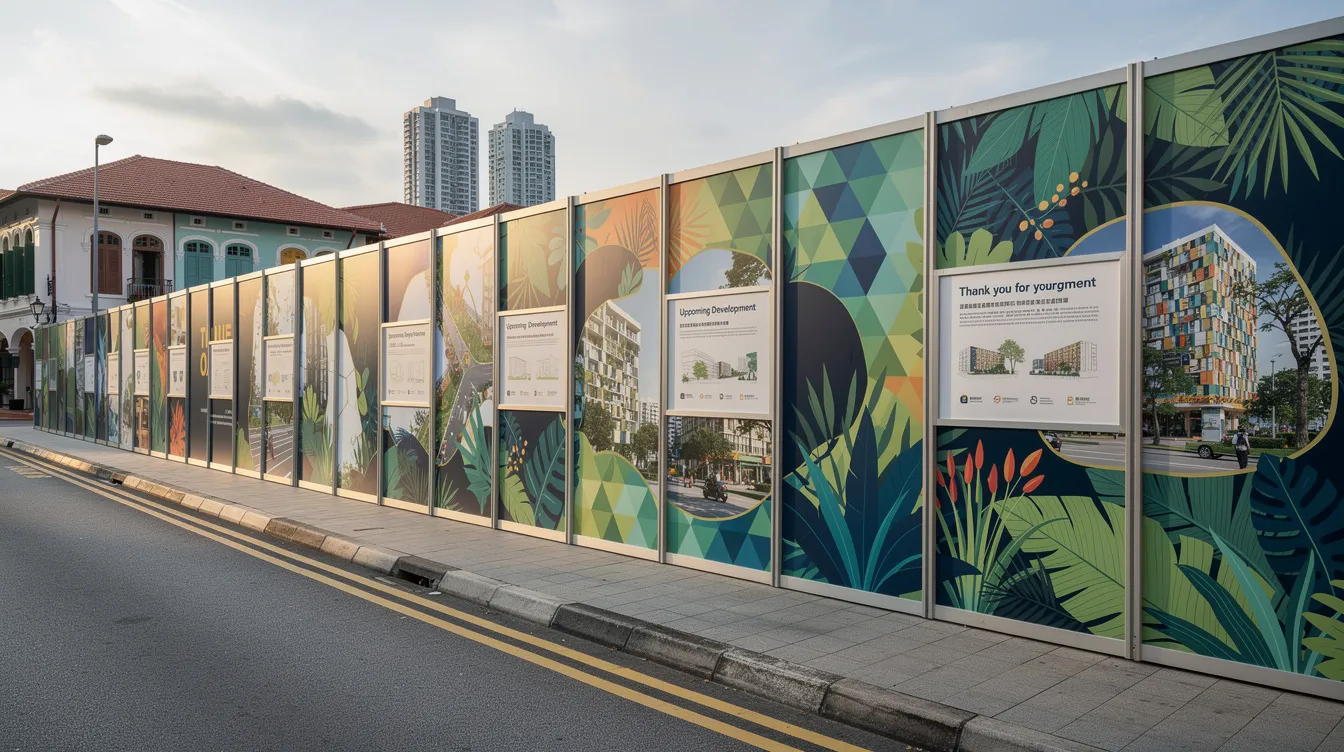
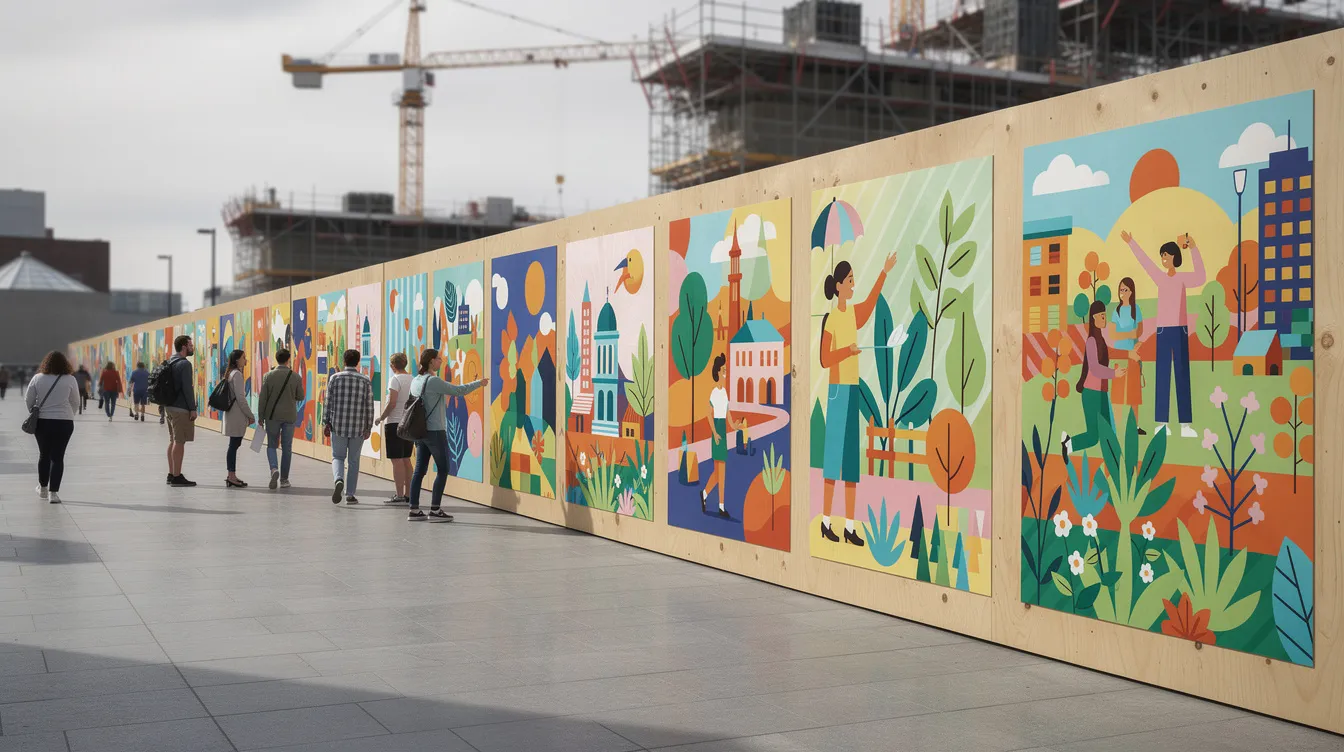
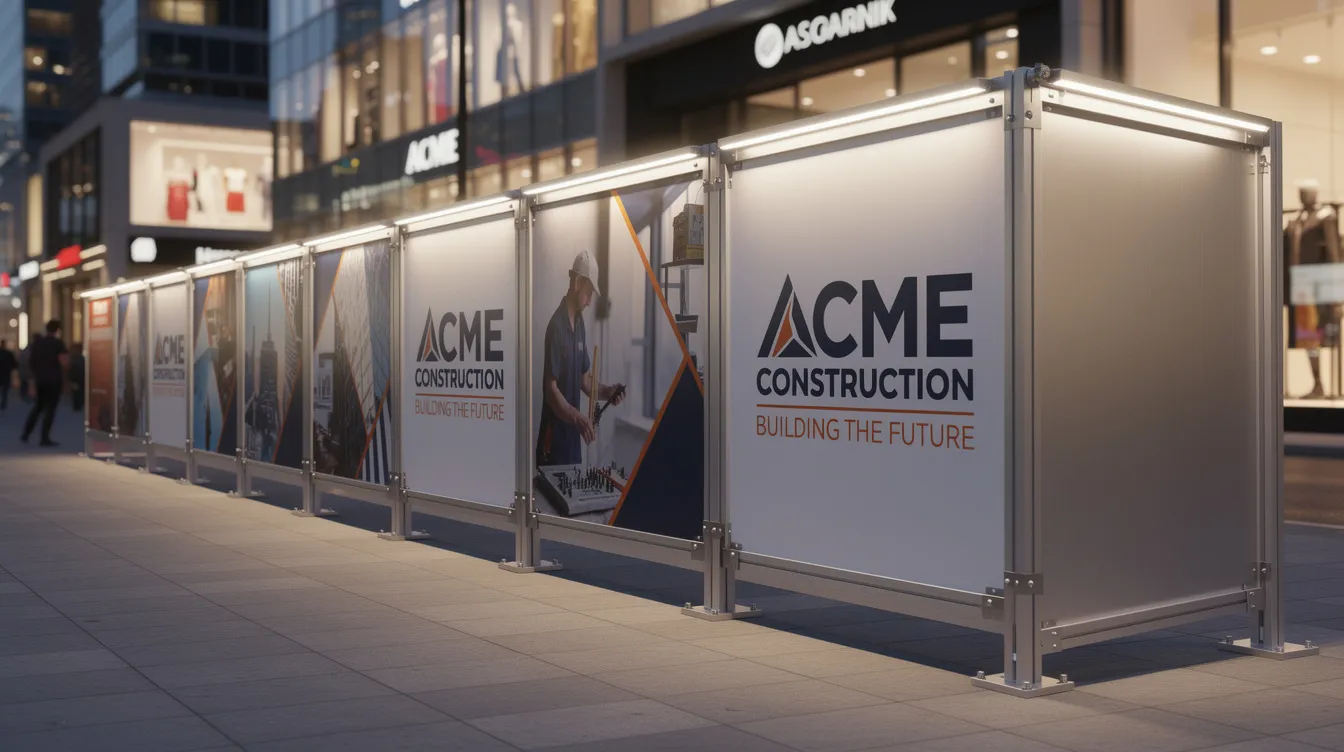
Decorative fencing components-including a range of panels, mesh fence panels, vinyl banners, branded screens, LED-lit features, and graphic wraps-transform basic construction hoarding into a marketing and community engagement tool. Hoarding can block visibility while providing advertising space for project graphics and branding, and decorative fencing can contain artworks or historical content to engage the public. Custom branding on hoarding increases project visibility. Well-designed hoardings also strengthen project branding. Meanwhile, community goodwill can be improved with aesthetic hoardings that reflect local culture or identity.
However, every decorative element has a structural consequence. Solid panels, vinyl banners, and graphic wraps increase the effective surface area exposed to wind. Decorative screens and cut-outs can act as flapping surfaces under gusts, potentially doubling wind pressure in extreme conditions compared to plain hoarding. Even perforated panels, while reducing net wind pressure somewhat, must be designed for worst-case full exposure scenarios.
This is precisely why wind load analysis becomes critical once decorative elements are added. A hoarding that might have been structurally adequate as a simple timber hoarding or traditional plywood hoarding can become dangerously undersized once large-format graphics, branding panels, or lighting systems are installed on its face.
Wind Load Calculations for Site Hoarding
With classification defined and the structural impact of decorative elements established, contractors must address the technical core of hoarding design: calculating the wind forces that the structure must resist. Hoarding must be wind resistant to ensure public safety-this is not optional, and the calculation methodology is well-defined under Singapore’s adopted standards.
BCA Code Requirements
Singapore’s basic design wind speed is 33 m/s (3-second gust speed), as specified in the BCA Approved Document and applicable to both permanent buildings and temporary structures including site hoarding. This wind speed serves as the starting point for all wind pressure calculations.
Height is the primary trigger for mandatory PE involvement. While no single regulation states an exact threshold in those terms, industry practice and BCA procedural guidelines commonly treat hoardings taller than 2.4 m to 3 m-especially when solid and exposed-as high risk requiring PE endorsement. For structures where the uppermost part reaches 4 m or more from ground level, or where signage area exceeds 10 m², a permit and PE certification become explicitly required. A Class hoarding systems are engineer certified for safety, reflecting this regulatory expectation.
Exposure categories further affect design requirements. A hoarding on an open, unshielded site-such as a waterfront location or open ground-experiences significantly higher effective wind pressure than one sheltered between buildings in a dense urban area. The terrain roughness, shielding from adjacent structures, and turbulence characteristics at the specific location must all be factored into the calculation.
Calculation Methodology
The wind load calculation follows AS 1170.2 (Wind Actions), the standard adopted within BCA’s framework for structural design. The step-by-step process involves:
-
Establish basic wind speed (Vb): 33 m/s for Singapore conditions, adjusted for the specific exposure category, surface roughness, and shielding at the project site
-
Calculate design wind pressure (p): Using the formula p = 0.5 × ρ × V² × Cd, where ρ is air density (~1.2 kg/m³), V is the design wind speed adjusted for height and terrain, and Cd is the drag coefficient for the panel configuration
-
Determine projected area: Calculate the total height above ground multiplied by the panel width, accounting for solid versus perforated sections-decorative elements such as graphics, banners, and solid screens increase the effective area
-
Apply load combinations and safety factors: Combine wind load with dead load (self-weight) and any applicable live loads; AS 1170.2 requires specific load factors, and for temporary works the factor of safety against overturning should be ≥ 1.25 to 1.5 depending on exposure and risk level
-
Check overturning moment versus resisting moment: The wind force applied at the centre of pressure must be resisted by the foundation/anchorage system with adequate margin
-
Verify deflection and vibration limits: For decorative screens and graphic panels, movement under wind must not damage materials, loosen connections, or compromise safety
The severity of getting these calculations wrong was demonstrated in a well-documented Singapore case. In August 2016, 24 table formworks-each approximately 10.2 m tall-collapsed under sudden gusts at a high-rise construction site. Wind speeds recorded were approximately 23.9 m/s maximum (well below the 33 m/s design speed). PE analysis found the factor of safety against overturning was less than 0.7-far below the required minimum. The failure was driven by wind pressure acting on large free-standing surfaces with insufficient anchorage and inadequate resisting moment. This case remains a stark warning for anyone who considers wind load calculations for temporary structures to be a formality.
Foundation and Anchoring Requirements
Ground bearing capacity and anchoring design are where wind load calculations translate into physical safety. The foundation must resist both the overturning moment and any uplift or sliding forces generated by wind.
For hoarding systems, common foundation approaches include:
-
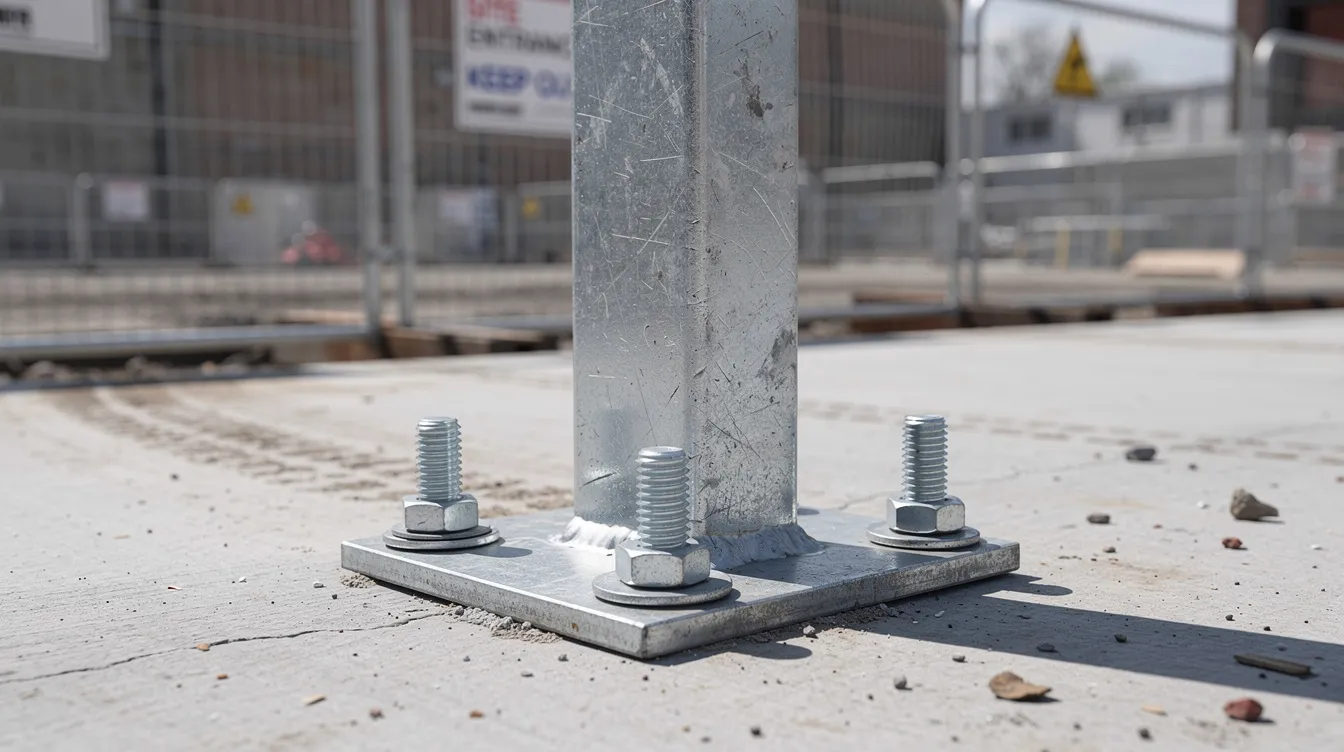
Embedded posts: Posts driven or set into the ground at a minimum depth of 300 mm (per HDB EMMP specifications), suitable for lower hoarding heights on firm ground. Fence feet or base plates provide additional stability for installations on paved surfaces.
-
Concrete pad foundations: Required for taller, solid hoarding where overturning moments are significant; the pad dimensions and reinforcement are calculated based on wind forces and soil conditions
-
Steel base plates with ballast: Used where ground penetration is not possible; the base plate area and ballast weight must be sufficient to resist the calculated overturning moment with required safety factors
-
Mechanical anchors to existing structures: Bolt connections to adjacent concrete slabs or walls, designed for the specific pull-out and shear forces involved
Connection details between hoarding panels and support structures-bolted, welded, or clamped-must be specified in the PE-endorsed drawings. Waterlogging, temporary ground cover conditions, and soil type all affect foundation performance and must be assessed during design.
The critical calculation parameters to retain: 33 m/s design wind speed, factor of safety ≥ 1.5 for exposed hoarding, 300 mm minimum embedment for posts, and worst-case full-surface-area loading for any hoarding with decorative elements.
PE Endorsement Process and Implementation
With wind load calculations and foundation requirements established, the next step is formalizing the design through PE endorsement-the regulatory mechanism that ensures structural adequacy and public safety for temporary works including hoardings.
PE Endorsement Procedure
PE endorsement is mandatory when hoarding structures interface with public spaces, expose the public or workers to risk, or exceed the height and area thresholds discussed above. Even where not strictly mandatory, PE endorsement is strongly recommended for any hoarding installation that could cause harm if it fails-the liability exposure under the Building Control Act makes professional verification a prudent investment.
The PE endorsement process follows a defined sequence:
-
Engage a registered PE early in the project-ideally during the concept or tender stage. Provide concept designs, site photographs, ground condition data, and intended decorative elements. Early engagement prevents redesign costs later.
-
Submit structural drawings with wind load calculations to the qualified PE for review. Drawings should include elevations, sections, connection details, foundation specifications, and material properties. The wind load calculations must reference the applicable code (AS 1170.2 or equivalent), show derivation of design pressures, and document all assumptions.
-
Obtain PE review and endorsement of the hoarding design and installation method. The PE will verify loads, materials, foundation adequacy, and integration with fire safety and public access requirements. Deliverables typically include endorsed structural drawings, calculation reports, material specifications, and method statements for installation and inspection.
-
Prepare installation specifications including foundation details, connection methods, panel sequencing, and safety measures for the public during erection (lighting, signage, temporary barriers).
-
Coordinate BCA submission if required for the specific project type or location. If the temporary hoarding affects or is adjacent to a public right-of-way, a Temporary Building Permit (PTU) must be applied for via CORENET. Plan drawings endorsed by the PE form part of this submission package.
An additional compliance layer applies for fire safety. According to SCDF’s Fire Code 2023, hoarding works must not obstruct means of escape, fire protection systems (sprinklers, detectors), or firefighting access (hydrants, dry/wet risers, fire lifts). If hoarding affects any of these, PE-endorsed plans must be maintained on-site and building occupants must be notified at least two weeks prior to installation.
For hoarding that incorporates signboard or advertising elements, additional permits from URA may be required when signage area exceeds 10 m² or the structure height reaches 4 m or more from ground level.
Material and Hoarding System Comparison
External site hoarding is commonly made from plywood, timber, or steel panels. The choice of hoarding systems directly affects wind resistance, decorative capability, PE requirements, and overall project cost. The following comparison covers the three primary systems suitable for decorative applications:
|
System Type |
Wind Resistance |
Decorative Options |
PE Requirements |
Cost Profile |
|---|---|---|---|---|
|
Steel Panel Systems |
High – tested for sustained wind loads; steel hoarding panels provide complete privacy and protection |
Powder coating, vinyl graphics, custom branding; hoarding can be covered with graphics for advertising |
Required above 2.4 m; always recommended for public-facing installations |
Higher material and installation cost; durable over many years; lower maintenance |
|
Timber Frame with Cladding |
Medium – suitable for sheltered locations; plywood is a lightweight and cost-effective hoarding material |
Custom panels, signage mounting, banners; traditional plywood hoarding offers flexibility |
Always required due to lower inherent wind resistance and connection variability |
Lower material price; higher maintenance; susceptible to moisture over extended periods |
|
Modular Aluminum Systems |
High – excellent option for exposed locations with lightweight structure; increase stability through engineered connections |
Integrated graphics, LED lighting, modular branding panels; suitable for branded boundaries at events |
Required above 2.4 m; pre-engineered systems may simplify PE review |
Higher upfront price; fast installation; reusable across multiple projects |
Steel hoarding panels provide durability and complete site privacy, making them suitable for projects requiring maximum security and protection from debris. Timber hoarding remains commonly used for cost-sensitive projects in sheltered locations. Modular aluminum systems are increasingly popular for projects where branding and visual impact are priorities-high-impact marketing can utilize hoarding as advertising space, and PVC hoarding elements can be extruded in various corporate colors to match brand guidelines.
PVC hoarding can create an airtight barrier without gaps, which is an excellent option for projects where dust and noise control is a priority alongside aesthetic presentation. Temporary fencing is more environmentally friendly than plywood hoarding, and PVC hoarding is often made from recycled waste materials-considerations that may matter for projects with sustainability requirements. Temporary fencing can also be modular and easily assembled, while decorative fencing can create an attractive boundary at public gatherings.
When selecting a system, contractors should match the hoarding type to the site’s wind exposure, the project’s decorative requirements, the expected installation duration, and budget constraints. A PE can advise on which systems offer the optimal balance for specific conditions.
Common Challenges and Solutions
Even with a clear regulatory framework and established calculation methods, contractors regularly encounter practical obstacles when implementing PE-endorsed hoarding systems. Addressing these proactively saves time, cost, and risk.
Inadequate Ground Conditions
Soft soil, waterlogged ground, or paved surfaces that cannot be penetrated are common on urban construction sites. When standard embedded posts are not feasible, implement ground improvement measures such as concrete pads or steel base plates with calculated ballast. Revised foundation calculations must be submitted to the PE for re-endorsement-modifying the foundation without PE review invalidates the original endorsement and creates liability exposure.
Wind Load Underestimation
The most dangerous error in hoarding design is underestimating wind forces, particularly for decorative elements with higher surface area. Vinyl banners can enhance hoarding visibility and branding but also significantly increase drag. Conduct a site-specific wind assessment considering nearby building effects, channelling between structures, and turbulence amplification. For hoarding incorporating solid decorative panels or large-format graphics, increase safety factors by at least 20% above minimum requirements. The 2016 formwork collapse-at wind speeds well below the 33 m/s design limit-demonstrates that marginal designs fail in real conditions.
Delayed PE Approval
Incomplete submissions are the primary cause of delayed PE endorsement. Missing load calculations, absent connection details, or failure to account for decorative elements that affect wind load all trigger revision cycles. Submit complete structural calculations and drawings early in the project planning phase, allowing 2–3 weeks for PE review and potential revisions. Engaging your PE during the concept stage-rather than after fabrication has begun-eliminates the most common delay scenarios.
Cost Overruns from Over-Engineering
Conversely, overly conservative designs that use heavier materials and deeper foundations than necessary inflate project costs without proportional safety benefit. Optimize the design using modular hoarding systems with proven wind load capacities and standardized connection details. Pre-engineered systems reduce calculation complexity and approval time, and their tested configurations give PEs confidence to endorse more efficiently. Stored records of previously endorsed configurations can further accelerate approvals for repeat projects.
Early planning, professional consultation, and complete documentation are the common thread across all these challenges. The cost of engaging a PE and preparing thorough submissions is a fraction of the cost of a failed hoarding, a stop-work order, or a public safety incident.
Conclusion and Next Steps
Proper classification, wind load calculations, and PE endorsement form the non-negotiable foundation of safe and compliant external site hoarding decorative fencing installations in Singapore. Construction hoarding protects public safety at construction sites while providing opportunities for project branding and community engagement-but only when the structural integrity of the hoarding system is assured through rigorous engineering.
To move forward on your project:
-
Assess project height and exposure requirements – determine whether your hoarding exceeds the 2.4 m threshold or is positioned in an exposed location requiring mandatory PE endorsement
-
Engage a qualified PE for preliminary review – provide site conditions, intended heights, decorative elements, and location details to scope the structural requirements
-
Prepare detailed drawings with wind load calculations – follow AS 1170.2 methodology with Singapore’s 33 m/s design wind speed, appropriate safety factors, and foundation details
-
Submit for PE endorsement before installation – allow adequate review time and ensure all decorative elements are included in the structural assessment
-
Coordinate authority submissions – apply for Temporary Building Permits via CORENET and any signage permits from URA where required
Regulatory requirements for hoarding may exist across multiple agencies in urban public spaces, so a coordinated approach-or engaging a temporary works design consultant experienced with BCA, SCDF, and URA requirements-ensures nothing is missed.
Related topics worth exploring include façade inspection requirements for permanent installations, temporary works design for complex geometries, and authority submission processes for projects with extended installation periods.
Additional Resources
-
BCA Approved Document – includes structural design requirements and wind load parameters for Singapore
-
AS 1170.2 Wind Actions Standard – calculation methodology for wind pressure on temporary and permanent structures
-
Building Control (Temporary Buildings) Regulations 2018 – legal definitions and compliance requirements for temporary structures including hoardings
-
SCDF Circular on Managing Fire Safety for Hoardings – fire code requirements affecting hoarding design and installation
-
PE Endorsement Singapore: The Ultimate Guide – comprehensive guide to PE endorsement requirements across project types