
Introduction
Only BCA-recognised Competent Persons (CPs), who must be either a Professional Engineer in civil or structural engineering or a Registered Architect holding the Certificate in Façade Inspection, can legally carry out periodic facade inspection for an industrial building in Singapore. They work alongside accredited Façade Inspectors (FIs) who perform hands-on checks under the CP’s direct supervision. No other professional, contractor, or vendor can sign off on a statutory PFI report.
This guide is written for building owners, facility managers, logistics and plant managers, MCSTs, and contractors responsible for factory, warehouse, or flatted factory buildings that exceed 13 metres in height and 20 years in building age. The Building and Construction Authority regulates building safety and statutory inspections in Singapore, and the periodic façade inspection PFI regime it issued on January 1, 2022 applies equally to industrial facilities as it does to commercial buildings and residential towers. This page focuses on who is legally allowed and qualified to perform PFI on industrial buildings, how to appoint and verify them, and what AEC Technical Advisory can do for owners facing their first (or next) inspection cycle. It does not cover full remedial design or defect repair methodology.
By the end of this article, you will:
-
Know exactly which professionals are legally allowed to perform periodic facade inspection for an industrial facility in Singapore.
-
Understand the difference between a competent person CP and a Façade Inspector for factory and warehouse façade elements.
-
Be able to check qualifications, registrations, and BCA/PEB/BOA listings before appointing anyone.
-
See how PFI roles interact with contractors, safety officers, drone operators, and plant operations.
-
Learn how AEC Technical Advisory can support end-to-end PFI for industrial buildings.
Understanding PFI for Industrial Buildings in Singapore
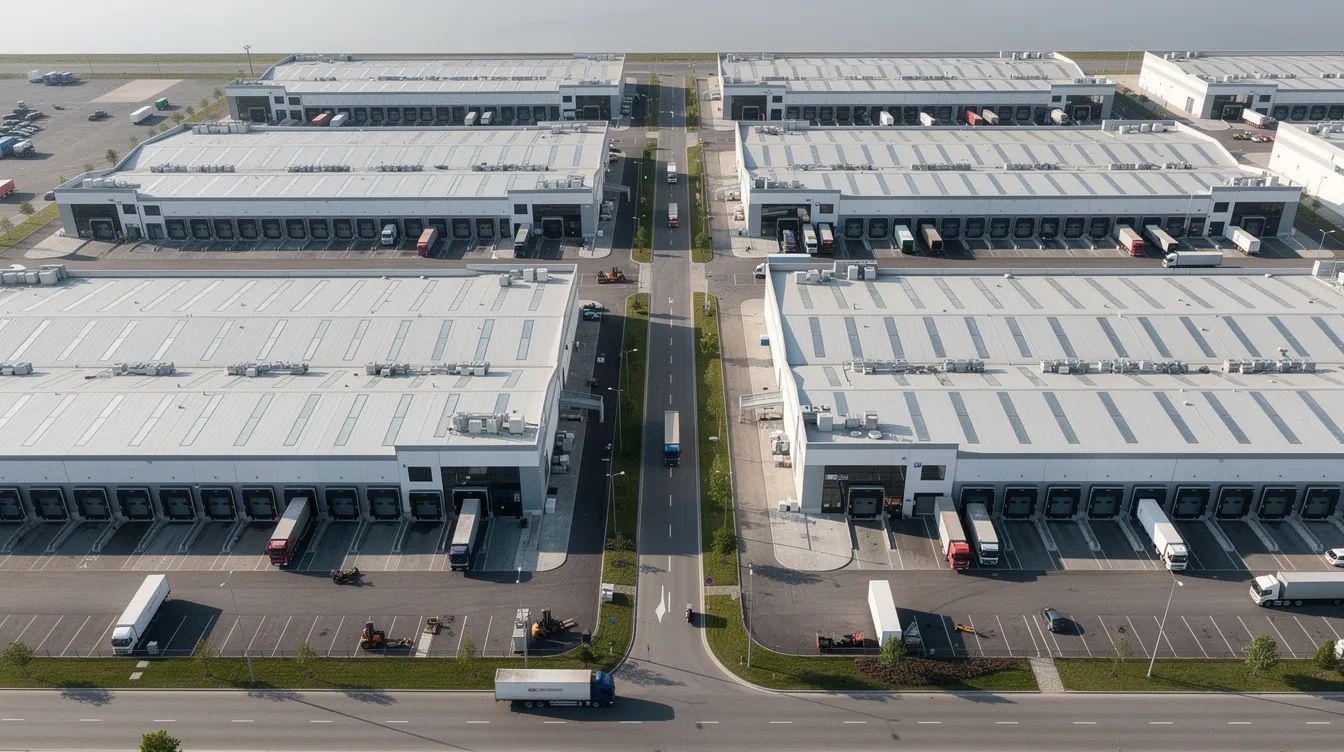
Periodic facade inspection is a mandatory safety requirement under Singapore’s building control act. The same regime that applies to office towers and condominiums applies to factories, warehouses, flatted factories, and process plants that meet height and age thresholds. Facade safety in industrial estates is not abstract: 90 cases of falling debris were reported over a three-year period, and industrial sites compound the risk because heavy goods vehicles, forklift traffic, and staff regularly circulate directly beneath building façades.
What Is PFI Under Singapore’s Building Control Regulations?
PFI is mandated by the Building Control (Periodic Inspection of Buildings and Building Façades) Regulations 2021, and the PFI regime became mandatory on January 1, 2022. It requires qualifying buildings to undergo façade inspection every seven years. The scope covers the building’s exterior: precast panels, metal cladding, concrete walls, curtain walls, canopies, signage, parapets, brackets, and any prescribed exterior features attached to the facade. This is distinct from periodic structural inspection, which addresses the building’s load-bearing frame rather than its envelope.
Buildings over 20 years old must undergo PFI every 7 years, measured from the date of the temporary occupation permit (TOP) or, if no TOP was issued, the Certificate of Statutory Completion (CSC). Inspection findings must be endorsed and submitted to BCA by the appointed competent person. BCA estimates 30,000 buildings will require inspection by 2029 across the first seven-year cycle.
Eligibility: When Does an Industrial Building Need PFI?
Two thresholds determine whether an industrial building requires periodic façade inspection PFI:
-
Height: The building must exceed 13 metres at its highest point (excluding roof-mounted antennas or similar items). Many flatted factories, process plants, and logistics warehouses with high-bay racking halls reach 15 to 20 metres and fall squarely within scope.
-
Age: The building must be 20 years or older from its TOP or CSC date. An industrial building completed in 2003 became due in 2023.
A flatted factory in Jurong built in 1999, a logistics warehouse in Tuas with 15-metre-high racking halls, or a wafer fabrication facility with extensive cladding would all qualify. Exemptions exist for detached houses, semi detached houses, terraced or linked houses used solely as residences, and temporary buildings. Low-rise sheds whose highest point is 13 metres or lower are also exempt. But most sizeable industrial buildings in mature estates will fall under PFI over time.
BCA typically sends a PFI Notice (formally called the Facade Inspection Notice) to the owner or MCST when the building becomes due. This triggers the compliance process and the need to appoint qualified PFI professionals.
Why “Who Does the PFI” Matters for Industrial Facilities
BCA will only accept facade inspection reports prepared and endorsed by recognised Competent Persons with the correct façade credentials. Using an unqualified inspector risks report rejection, re-inspection costs, and non-compliance penalties. Non-compliance can result in fines up to S$10,000 for building owners.
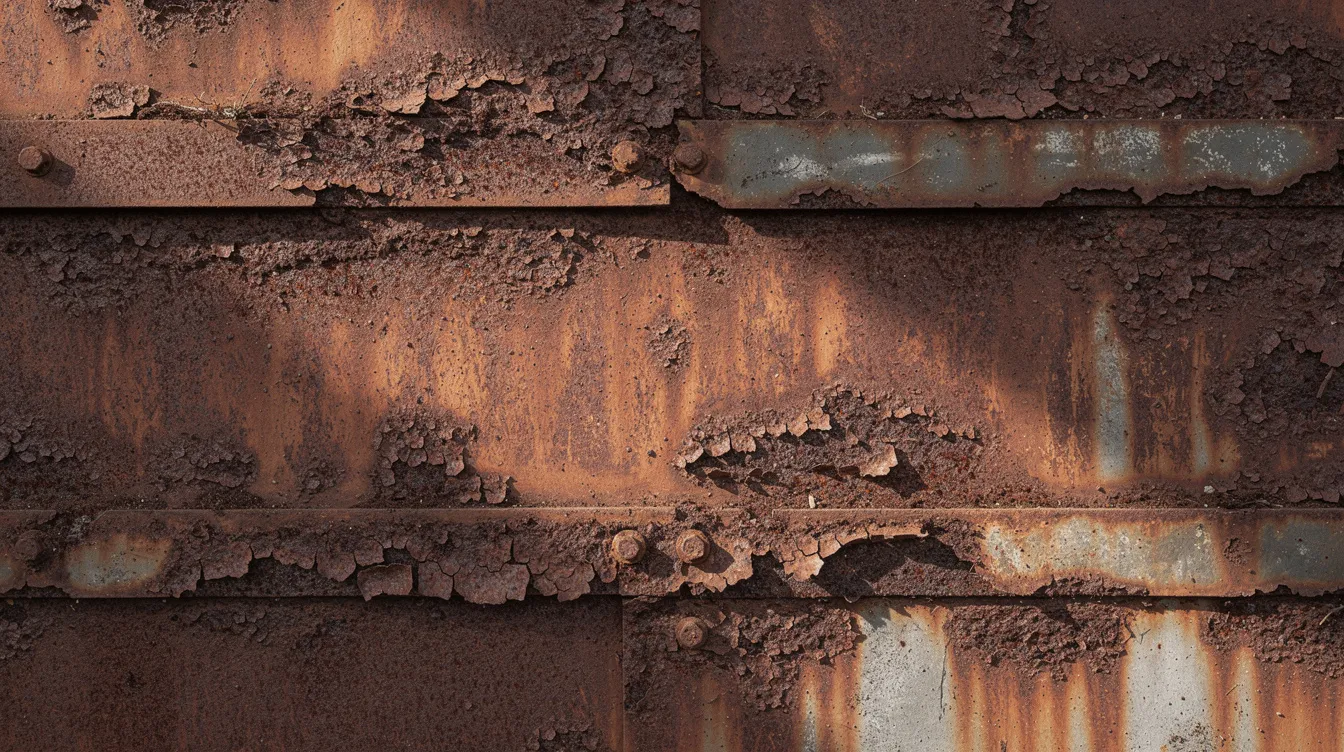
Industrial buildings carry specific safety risks that general surveyors may not scope correctly: heavy metal cladding sheets above loading bays, precast wall panels spanning truck circulation routes, gantry crane runway girders fixed to façade walls, rooftop plant screens, and oversized signage above driveways. Common defects include cracked concrete and spalling concrete, sealant failure (which leads to water ingress and material degradation), corrosion affecting metal components like window frames and anchors, and loose tiles and cladding that pose immediate safety risks. These conditions demand inspectors who understand industrial facade systems, not just residential or office towers.
This is why the next section breaks down exactly who is allowed to carry out PFI and what each role is responsible for.
Who Can Legally Carry Out PFI for an Industrial Building?
For any qualifying industrial building, PFI is not a “do-it-yourself” checklist. It must be led by an appointed competent person and supported by accredited facade inspectors and, where needed, specialist access and testing teams. Multiple actors participate, but only specific registered professionals hold the legal authority to plan, supervise, and certify the inspection.
The Competent Person (CP) for Façade Inspection
The competent person CP is the overall professional in charge of a PFI project under BCA regulations. Building owners must appoint a Competent Person for inspections, and the appointment triggers all downstream work.
CP qualification requirements are defined under Regulation 9 of the 2021 Regulations:
-
Must be either a professional engineer (PE) in the civil or structural engineering discipline, registered with the Professional Engineers Board of Singapore; or a registered architect (RA) under the Board of Architects.
-
Must hold the Certificate in Façade Inspection from BCA Academy or IES Academy (or an equivalent course recognised by BCA).
-
Must have no professional or financial interest in the building or its façade. If the person designed or constructed the building façade (unless the work was minor, localised, or unrelated to key structural elements), they are disqualified.
Competent Persons must oversee all façade inspections. For industrial buildings, CP responsibilities include: planning inspection strategy for metal sheeting, precast concrete walls, curtain wall systems, canopies, silos, external pipe racks, and similar façade elements; leading and supervising the inspection team; classifying defects as Safe, Repair, or Unsafe; prioritising areas above loading bays and pedestrian zones; recommending rectification works with timelines; notifying BCA of unsafe conditions; and preparing and endorsing the PFI report for submission. Building owners must report unsafe conditions within 24 hours.
As of September 2021, there were 149 registered Competent Persons in Singapore. The current list is maintained by BCA and can be checked before any appointment.
Façade Inspectors (FI) for Industrial Buildings
Façade inspectors carry out the detailed hands-on inspection work under the CP’s direct supervision and control. They cannot submit reports directly to BCA; the CP is the signatory and remains accountable for inspection findings.
FI qualifications are set out under Regulation 10. Each FI must hold the Certificate in Façade Inspection plus meet one of several combinations of education and experience:
-
A degree in civil/structural engineering or architecture recognised by PEB, plus at least 3 months of post-qualification experience.
-
A diploma with facade-related experience.
-
An Industrial Technician Certificate or NCCS from BCA Academy with at least one year of facade-related experience.
-
10 years of facade-related working experience within the last 12 years, combined with lower academic qualifications under certain allowances.
Facade Inspectors must be accredited through the Joint Accreditation Committee (JAC), established by IES, ACES, and BCA. Facade Inspectors cannot be directly employed by the building owner. Their statutory duties include exercising due diligence, acting under the CP’s full-time supervision, and reporting unsafe façade defects immediately to the CP.
On an industrial site, FIs use tapping rods on precast panels, borescopes for concealed fixings behind cladding, and moisture meters around wet areas. They record and tag defects on drawings and photo logs, covering conditions around dock levellers, ramp walls, and fire escape stair shafts.
Professional Engineers (PE) and Registered Architects (RA) in the PFI Team
For most industrial PFI, the CP is already either a professional engineer (civil/structural) or a registered architect. Professional engineers and architects are responsible for the design and certification of PFI projects. Additional PEs may be needed for:
-
Reviewing structural integrity of heavy façade attachments such as pipe bridges, gantry beams fixed to walls, heavy signage, or solar panel frames.
-
Designing temporary works or access platforms around high-bay racking or production equipment.
Architects can assist in understanding previous A&A works that changed openings, parapets, or canopy geometry. Only PEs or RAs who hold the façade inspection certificate can act as CP; others may contribute technical input but cannot replace this role.
Access, Drone, and Specialist Testing Providers
Rope access firms, gondola operators, MEWP vendors, and drone operators are facilitators. They are not the legally responsible party for PFI. Drones are used for high-resolution visual inspections, but drone inspection can only cover the 100% visual inspection component, not the close range inspection that requires physical contact with the facade.
Unmanned aircraft systems used for PFI must comply with CAAS regulations and TR 78-1:2020 standards. As of 12 July 2023, drone service providers must be accredited by the Singapore Accreditation Council (SAC) under the Inspection-Body Scheme. Currently, four accredited drone service providers operate in Singapore (H3 Zoom, Operva AI, Novapeak, and Singapore Inspection & Engineering). Over 50% of drone-aided façade inspections since July 2023 have been performed by accredited providers. By 2025, over 75% of high-rise building inspections incorporated drone-based methods for the visual component.
For industrial PFI near airports, shipyards, or petrochemical zones, additional airspace restrictions apply. Specialist NDT firms may be needed for half-cell potential tests, anchor pull-out tests, or ultrasonic checks on steel plates. All such work must be specified and interpreted by the CP or PE; raw data alone does not satisfy BCA submission requirements.
Who Cannot Legally Conduct PFI (Common Misconceptions)
These roles cannot act as CP or FI for statutory periodic facade inspection:
-
In-house facility engineers or EHS managers without BCA façade accreditation and PE/RA registration.
-
General building contractors who do not have a registered CP or FI on their staff.
-
Drone imaging companies offering “façade check” packages without a CP/PE façade partner.
-
Foreign consultants not registered with PEB or BOA in Singapore.
These parties can support with data collection, site access, or repairs, but they cannot sign off the official facade inspection report. The distinction matters because an unqualified appointment leads to report rejection, repeated access costs, and extended non-compliance.
How Qualified Professionals Carry Out PFI on Industrial Façades
Once a CP and FI team are appointed, they follow a BCA-aligned inspection process tailored to industrial buildings. Warehouses and factories present façade complexity that office towers do not: large roller shutters, vent blocks, metal sheeting, process ducts, stair towers, silos, and heavy external attachments.
Step-by-Step PFI Workflow for an Industrial Building
The inspection process follows a three-stage methodology. Here is how it applies to an industrial facility:
-
CP appointment. The owner or MCST appoints the CP after receiving a BCA Facade Inspection Notice (or proactively, before the notice arrives). The owner has 2 months to appoint a CP and must notify BCA within 7 days after that period ends. The formal appointment letter is submitted to BCA.
-
Desktop study. The CP reviews BCA-approved plans, façade elevations, previous A&A submissions, process layouts, maintenance history (e.g., corrosion complaints, previous inspection reports), and building documentation. Missing facade drawings require the CP to reconstruct plans via measurement surveys.
-
Site reconnaissance with the facilities team. The CP and FI walk the site to identify high-risk façade zones (loading bays, staff entrances, LPG yards, chemical storage areas, bus stops) and façade access constraints (stacked containers, racking, tanks, forklift routes).
-
Stage 1: 100% visual inspection. The team inspects every face of the building from ground level, roofs, adjacent structures, and via drones. CP and FI mark suspect areas on elevation grids. Inspections include a 100% visual and 10% close-range assessment across all elevations.
-
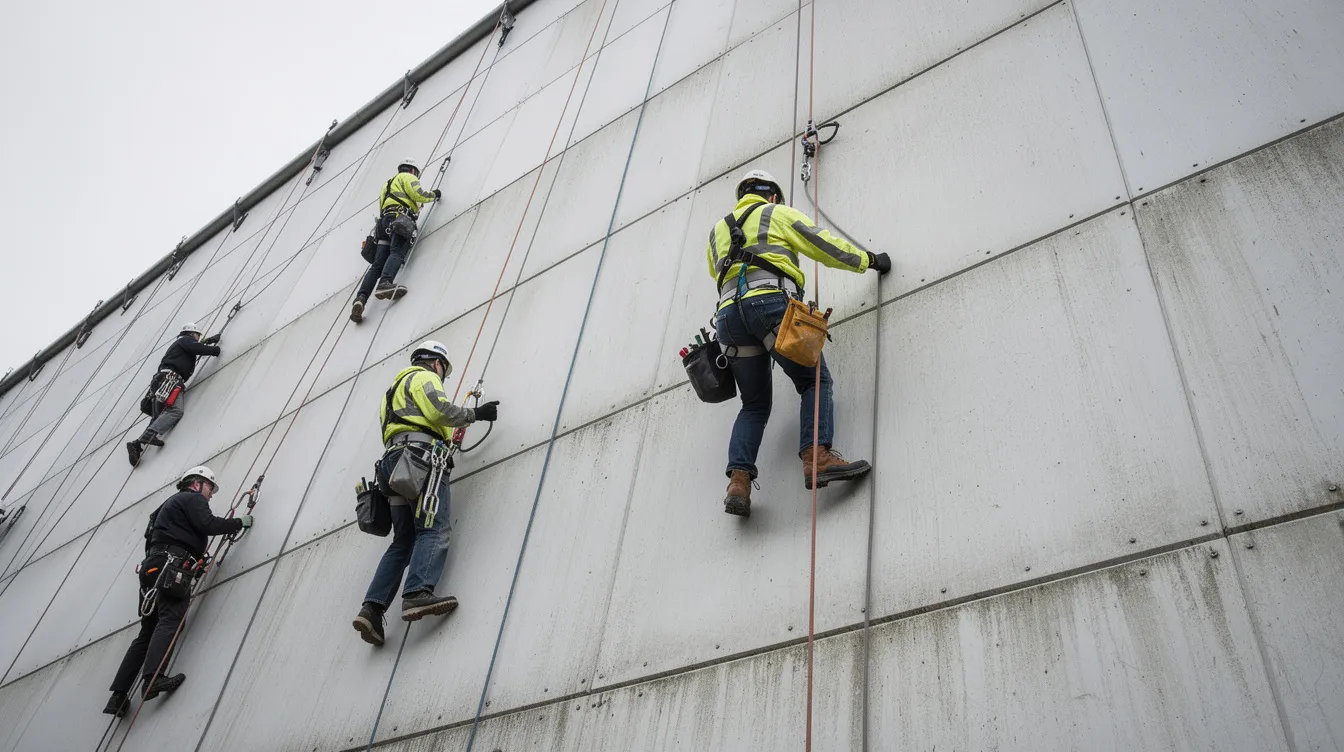
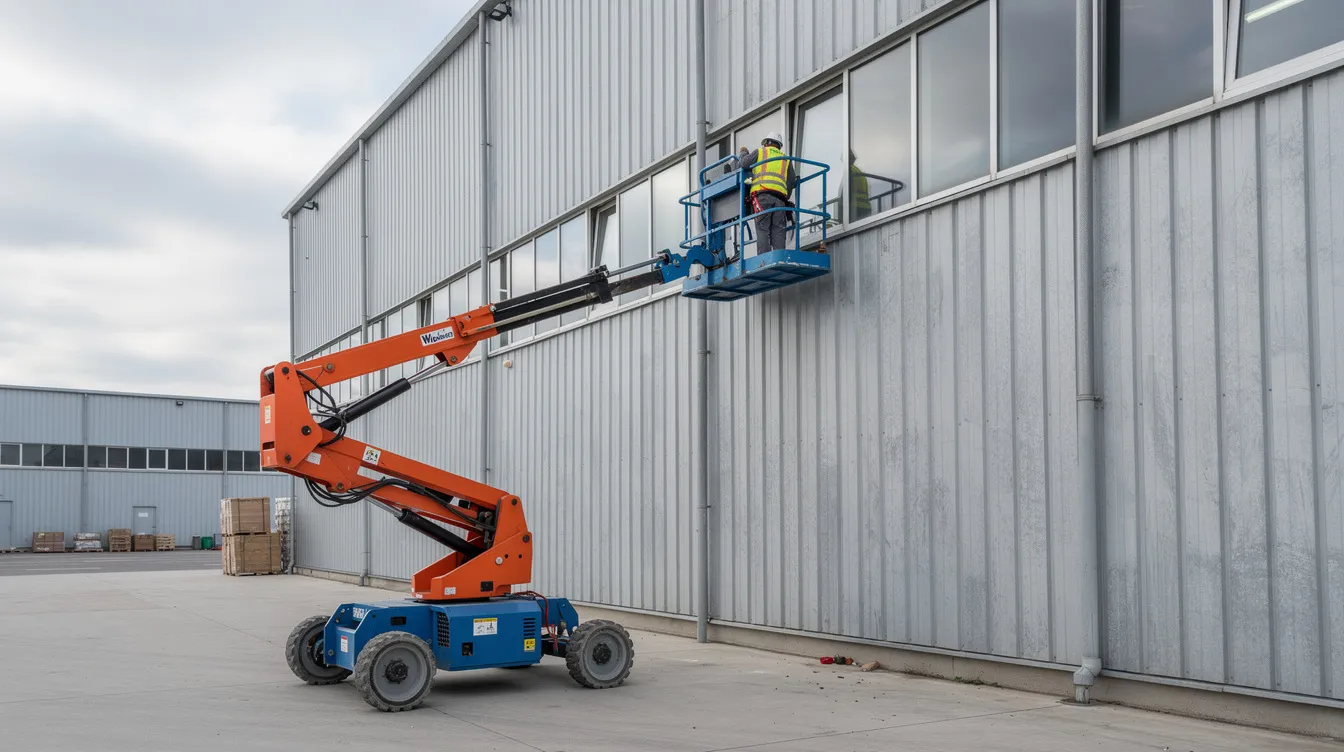
Stage 2: close range inspection of at least 10% of each elevation. Using rope access, MEWPs, or gondolas, FIs physically probe metal cladding laps, precast joints, corrosion at brackets, canopy fixings, and similar elements. Tools include tapping rods, borescopes, and moisture meters. This is the thorough inspection stage that drones cannot replace.
-
Additional testing. Where the CP identifies risk, NDT may be deployed: ultrasonic thickness checks on corroded steel platforms, pull-out tests on anchor bolts for pipe-racks fixed to façades, or thermal imaging behind panels to detect water ingress.
-
Defect classification and risk assessment. The CP categorises every defect as Safe, Repair, or Unsafe. Particular attention goes to areas above circulation routes, forklift lanes, and external fire escape paths. Early detection of common facade defects (spalling concrete, loose tiles, corroded fixings, failed sealant) prevents escalation.
-
Report preparation and BCA submission. The CP prepares and endorses the inspection report, including recommended rectification priorities, and submits it to BCA within 6 months of the notice date. Unsafe conditions trigger immediate notification to the Commissioner of Building Control.
Inspection Methods and Access Strategies for Industrial Sites
The CP selects access methods based on industrial hazards, site layout, and building management constraints. Rope access and MEWPs suit tall warehouse walls and tank farms. Drones handle initial scanning of long façades over truck yards or drains. Temporary platforms allow checking the underside of canopies at loading and unloading bays.
Coordination with site operations is not optional. Close-range checks may require lock-out of certain truck lanes or gantry crane zones, and building management or the facilities team typically arranges access windows, occupant or tenant communication where relevant, and disruption control during close-range checks. Hot-work and permit-to-work procedures apply near flammable materials. The CP and FI must follow MOM work-at-height regulations and any site-specific industrial safety protocols. For façade access near process equipment, the CP coordinates with the plant’s HSE team to schedule inspection windows that avoid production conflicts.
What a PFI Report for an Industrial Building Typically Includes
The report format follows BCA’s prescribed structure, but the content reflects industrial façade complexity:
-
Executive summary of façade condition and any “Unsafe” items, with emphasis on areas above public or worker circulation zones.
-
Building particulars: address, GFA, building type (e.g., single-storey warehouse with mezzanine office, 6-storey flatted factory), TOP/CSC year, and height.
-
Description of facade systems: precast panels, reinforced concrete walls, aluminium cladding, sandwich panels, glazing to office blocks, canopies, parapets, external staircases, curtain walls, and external M&E attachments.
-
Methodology: access methods used, drone flight summary (if applicable), sample size for close-range checks, NDT tests if deployed.
-
Defect register: tables organised by grid and elevation, listing defect type (corrosion, spalling, loose sheeting, cracked sealant, facade deterioration), severity classification, and recommended action.
-
Annotated façade elevations marking defect clusters, particularly above vehicular circulation and main entrances.
-
Recommendations covering immediate safety measures, short-term façade repairs, and longer-term rehabilitation strategies for proactive maintenance.
BCA relies on the CP’s professional judgement documented in this report to verify regulatory compliance.
Choosing the Right PFI Team for an Industrial Building
Legal requirements set the floor; practical selection determines the quality of the inspection and the usefulness of the report. Owners must confirm their chosen consultant has both façade credentials and industrial experience, not just general building knowledge.
Key Criteria When Selecting a Competent Person (Façade)
Before appointing a CP, verify:
-
The individual is listed on BCA’s register of Competent Persons (Façade) and currently registered with PEB or BOA.
-
They hold the BCA/IES Certificate in Façade Inspection (not expired or lapsed).
-
They have a demonstrated track record on industrial facilities: factories, logistics hubs, petrochemical plants, data centres, or similar settings.
-
They can coordinate with HSE teams, plant shutdown schedules, and hazardous area classifications.
-
They can show you sample redacted PFI reports for industrial buildings so you can gauge depth and clarity.
Responsibilities for performing a PFI project depend on the project type and land ownership. JTC Corporation is the main government agency for developing industrial infrastructure in Singapore, and JTC-managed estates may have additional submission or coordination requirements. Standard industrial buildings are developed by private developers or government-linked master developers, and each ownership structure affects who receives the BCA notice and who must initiate the appointment.
Questions to Ask Potential PFI Consultants
These questions separate qualified PFI specialists from general contractors or surveyors:
-
“Are you acting as the CP (Façade) and are you registered with BCA for this role?”
-
“How many industrial or warehouse PFI projects have you completed in the last 3 to 5 years?”
-
“Do you have in-house facade inspectors and rope access teams, or do you sub-contract them?”
-
“How will you minimise disruption to loading bay and production operations during close-range inspections?”
-
“Can you also support authority submission, PE endorsement for rectification works, and follow-up inspections?”
-
“What is your approach to facade testing requirements for metal cladding and heavy attachments?”
Clear, specific answers to these questions indicate a consultant who understands both the regulatory compliance process and the operational reality of industrial sites.
How AEC Technical Advisory Delivers PFI for Industrial Buildings
Our team includes PE(Civil/Structural) professionals who meet BCA’s Competent Person (Façade) requirements and hold the Certificate in Façade Inspection. We regularly handle industrial projects; logistics warehouses, flatted factories, and process plants across Jurong, Tuas, Pioneer, and other industrial estates.
We provide one-stop support: PFI scoping, access planning, building facade inspection, defect diagnosis, PE endorsements, and authority submissions. Our in-house civil, structural, geotechnical, and M&E engineers coordinate remedial designs (e.g., strengthening corroded canopies or cladding sub-frames) when facade deterioration requires structural intervention.
AEC Technical Advisory can also integrate PFI with related services such as periodic structural inspection, structural checks on racks and platforms via our warehouse loading assessment capability, and fire safety evaluations. For owners managing multiple compliance deadlines, this consolidation reduces coordination overhead and inspection costs.
Common Mistakes Industrial Owners Make About Who Can Do PFI
Misunderstanding who holds the authority to conduct PFI is a frequent reason for delay, doubled costs, and extended non-compliance for factory and warehouse owners.
Mistake 1: Assuming Existing Term Contractors Can “Sign Off” PFI
Maintenance contractors often know the building well. They may have replaced cladding panels, repaired canopies, or resealed joints for years. None of that qualifies them to act as CP or FI without separate PE/RA registration, façade certification, and BCA listing. The outcome of this mistake: BCA rejects the PFI report, the owner must re-engage a registered CP, access equipment is mobilised a second time, and the non-compliance period extends.
The fix is straightforward. Engage a registered CP early. Let your term contractor support with access, scaffolding, and eventual repair, but keep statutory sign-off with the qualified professional.
Mistake 2: Buying “Drone-Only” Façade Checks as PFI
Some providers market drone scans as full PFI. BCA requires a CP-led inspection and reporting process, plus close range inspection of at least 10% of each elevation’s surface area through physical contact or probing tools. Drone imagery, regardless of resolution, does not satisfy the close-range requirement.
For industrial sites, this gap is particularly dangerous. Hidden corrosion behind metal cladding, degraded anchor bolts supporting heavy pipe racks, or deteriorated fixings on canopies over loading bays cannot be detected from images alone. The solution: ensure any drone provider works under a CP with a formal PFI scope, and confirm the scope includes physical close-range checks with qualified facade inspectors.
Mistake 3: Appointing a CP with No Industrial Experience
Some CPs handle residential and office towers exclusively. Industrial façade elements present different risks: chemical exposure accelerating corrosion, heavy plant loads on walls, exhaust stacks creating thermal stress on adjacent cladding, and silos or tanks interfacing with building envelopes. A CP unfamiliar with these conditions may miss checks at exhaust stack interfaces, underestimate corrosion rates on exposed steel brackets, or propose rectification methods incompatible with industrial operations.
Prioritise CPs who can demonstrate case studies for factories, multi-storey warehouses, or process plants. Ask for examples of façade deterioration they have encountered in industrial settings.
Conclusion and Next Steps
Only BCA-recognised Competent Persons (PE or RA with the Certificate in Façade Inspection), supported by accredited Façade Inspectors and properly qualified teams, can legally carry out periodic facade inspection for industrial buildings in Singapore. The CP plans, supervises, classifies defects, and endorses the report. The FI performs hands-on checks under the CP’s control. Drone operators, access contractors, and NDT specialists support, but they cannot replace the CP or FI.
Choosing the right professional protects worker and public safety, avoids BCA penalties of up to S$10,000 for owners and up to S$50,000 for non-compliant CPs, and minimises disruption to operations.
For industrial building owners ready to act:
-
Confirm your building’s age and height against PFI thresholds, or refer to your latest BCA Facade Inspection Notice.
-
Check BCA’s register for eligible Competent Persons (Façade) and prepare key documents: approved plans, maintenance records, and previous inspection reports.
-
Shortlist and interview CPs with proven industrial project experience using the question list above.
-
Plan inspection windows around peak production and shipping periods; coordinate access well in advance with your operations team.
-
Engage a consultant such as AEC Technical Advisory to handle PFI scoping, inspection, authority submission, and remedial design as a single package.
For broader compliance planning, industrial building owners may also want to explore façade inspection vs structural inspection differences, building owner legal obligations, and structural assessments for heavy equipment and racking.
FAQ: Who Can Carry Out PFI for an Industrial Building in Singapore?
Can my in-house facility engineer carry out PFI?
No. In-house staff cannot act as CP unless they are separately registered as a PE or RA, hold the Certificate in Façade Inspection, and are appointed as CP for the specific building. They may assist with site access, historical records, and coordination, but they cannot perform the statutory sign-off. Facade Inspectors also cannot be directly employed by the building owner.
Must the Competent Person for my industrial building be based in Singapore?
Yes. The CP must be registered with Singapore’s Professional Engineers Board or Board of Architects and listed as a BCA-recognised CP (Façade). Foreign-only registrations do not satisfy the requirement. As of September 2021, 149 Competent Persons were registered in Singapore; the current list is maintained and published by BCA.
Is a drone survey alone enough to satisfy PFI requirements?
No. Drones can support the 100% visual inspection component, but BCA requires a CP-led process that includes close range inspection of at least 10% of each elevation through physical probing or contact. Defect classification and a formally endorsed inspection report submitted to BCA are mandatory. A drone-only package does not meet facade inspection requirements.
Can my current façade repair contractor sign the PFI report?
Only if they have a registered CP (Façade) and qualified facade inspectors in-house. If they do not, they are limited to performing rectification works based on the CP’s report. The CP must also be independent; if the contractor constructed or performed major A&A works on the building facade, they may fail the independence test under Section 29 of the Building Control Act.
How do I verify that someone is truly authorised to act as CP for my factory’s PFI?
Check the individual’s name against BCA’s published Competent Person (Façade) listing. Confirm their PE or RA registration through the Professional Engineers Board or Board of Architects respectively. Request their façade inspection certificate and ask for sample redacted PFI reports from past industrial projects. For FIs, verify accreditation through the Joint Accreditation Committee (JAC).
Can AEC Technical Advisory act as Competent Person for my industrial building’s PFI?
Yes, where project scope and capacity allow. AEC Technical Advisory has PE(Civil/Structural) professionals with façade inspection certification and direct experience in industrial facilities including warehouses, flatted factories, and process plants. We can discuss project-specific needs, façade access constraints, industrial safety coordination, and authority submission support. Contact us to confirm availability for your building’s inspection cycle.