
Introduction
Singapore uses Eurocodes as its primary structural design framework, published locally as SS EN standards and paired with Singapore National Annexes that adapt every critical design parameter to local conditions. Understanding how these Eurocodes adapted for Singapore differ from both the default European recommendations and legacy British Standards is essential for any engineer, developer, or design manager working on buildings and other civil engineering works in the city-state.
The core mechanism is straightforward: Singapore adopted the Eurocodes but modifies Nationally Determined Parameters (NDPs) through its National Annexes, which significantly affect the design of concrete structures, steel structures, and foundations. These NDPs cover partial safety factors, imposed loads, wind actions, durability requirements, and geotechnical design approaches – collectively reshaping how every building structure is analysed, detailed, and submitted for approval.
This article focuses on SS EN 1990, 1991, 1992, 1993, and 1997 with their Singapore National Annexes, with particular emphasis on differences from the legacy British Standards (BS 8110, BS 5950, BS 8004) that previously governed structural design in Singapore. It does not attempt exhaustive manual calculations for every design scenario but instead provides the practical understanding that structural engineers (local and foreign), design managers, and foreign developers need to navigate authority expectations and real-world design impacts. The article includes suggestions for diagrams and figures – such as load factor comparison charts, wind terrain illustrations, and cover-thickness cross-sections – that support visual communication of these concepts.
By the end of this article, you will understand:
-
How Singapore National Annexes localise Eurocodes through Nationally Determined Parameters
-
Where Singapore’s NDPs diverge from EN recommended values and the UK National Annex
-
How these changes affect reinforced concrete design, steel structures, and foundation engineering compared with British Standards
-
What this means for project approvals, cost estimation, and risk management
-
A practical workflow for applying SS EN with NAs on Singapore projects
Understanding Eurocodes and Singapore National Annexes
Eurocodes (EN 1990–1999) form a comprehensive suite of European structural design standards covering the basis of design, actions on structures, and the design of concrete, steel, timber structures, masonry structures, composite steel and concrete structures, geotechnical aspects, earthquake resistance, and more. Singapore’s implementation – the SS EN series – mirrors the Eurocode text while coupling each part with a locally developed national annex that specifies parameters for the country’s unique conditions. This section establishes how that system works and why it matters for every project in Singapore’s construction industry.
What Are Eurocodes and SS EN Standards?
Eurocodes are a family of European standards for the structural design of buildings, bridges, and other civil engineering structures. The key parts relevant to building design include:
-
EN 1990 – Basis of structural design (the head code governing reliability, load combinations, and design philosophy)
-
Eurocode 1 (EN 1991) – Actions on structures (dead loads, live loads, wind, traffic loads, thermal actions, and accidental actions)
-
Eurocode 2 (EN 1992) – Design of concrete structures
-
EN 1993 – Design of steel structures
-
Eurocode 7 (EN 1997) – Geotechnical design
-
Eurocode 8 (EN 1998) – Design of structures for earthquake resistance and seismic actions
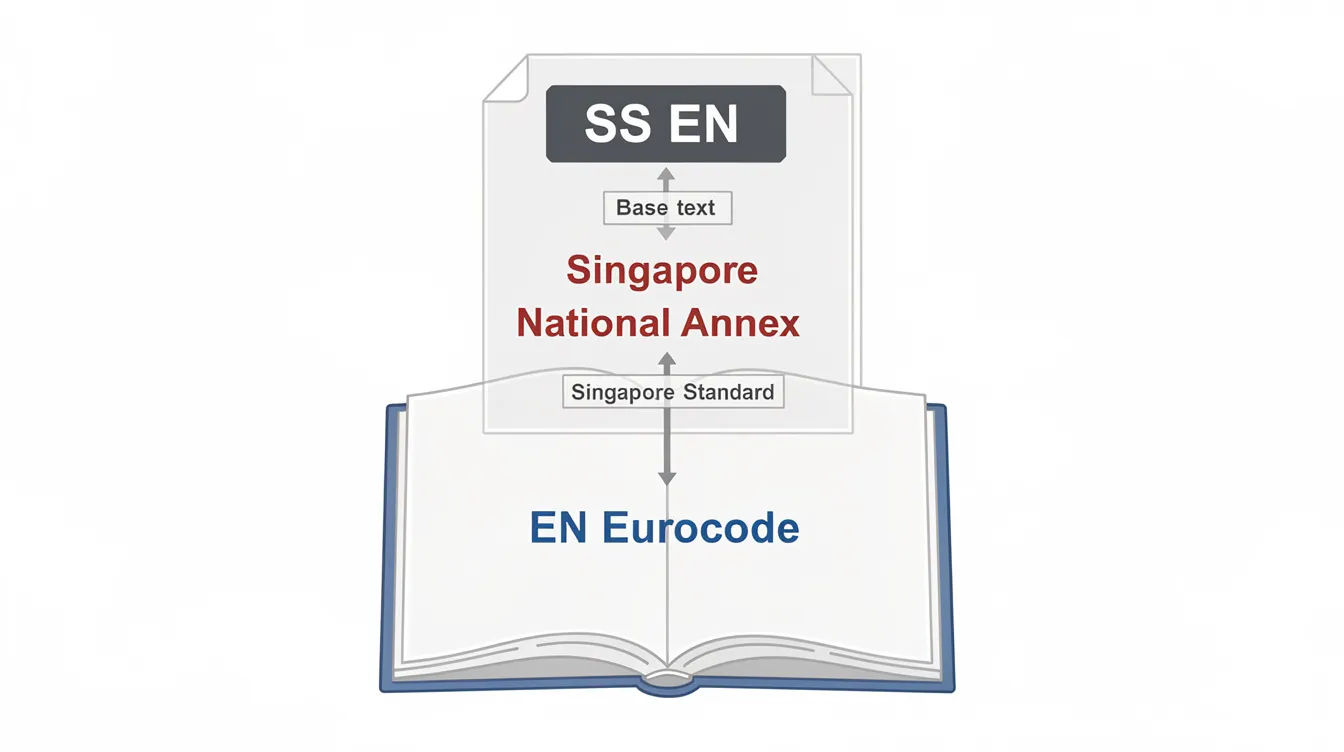
Singapore publishes these as SS EN codes – for example, SS EN 1992-1-1 for Part 1 of the concrete design standard. Each SS EN document is an identical implementation of the European base text, but it is always accompanied by a Singapore National Annex that specifies parameters, methods, and complementary rules for local use.
The transition to Eurocodes began in October 2006, with formal implementation of Eurocodes starting on April 1, 2013. The co-existence period for Eurocodes ended on April 1, 2015, after which the Eurocode suite was fully adopted in Singapore. This evolution involved extensive training for engineers since 2006 to ensure a smooth shift from the previous codes.
Role of Singapore National Annexes (NAs)
A Singapore National Annex is a document containing Nationally Determined Parameters (NDPs), nationally chosen methods, and non-contradictory complementary information that together adapt a Eurocode part to Singapore’s regulatory and environmental context. Singapore National Annexes define Nationally Determined Parameters that adapt Eurocodes to local conditions.
Typical contents of a national annex include:
-
Partial safety factors (γ) for actions and materials
-
Combination factors (ψ) for variable loads
-
Climatic data such as wind speed and thermal actions relevant to Singapore’s tropical climate
-
Exposure classes and durability parameters
-
Nationally chosen alternative rules where the Eurocode offers options
-
Reference to complementary Singapore standards (e.g. SS 544 for concrete durability)
The Singapore National Annexes are mandatory for structural design plans submitted to the Building and Construction Authority (BCA). The BCA’s Approved Document pairs each Eurocode part with its corresponding Singapore National Annex, ensuring that engineers do not mix old standards with the new codes and NAs. Singapore has developed numerous National Annexes, comprising 34 NAs across 40 Eurocode parts including multiple for Eurocodes 1, 2, and 3. The National Annex was developed by a technical committee of experts, and the Singapore National Annex is based on the UK National Annex while incorporating modifications for local practice.
The key NAs discussed in this article are: NA to SS EN 1990, NA to SS EN 1991-1-1, NA to SS EN 1991-1-4 (wind), NA to SS EN 1992-1-1 (concrete), NA to SS EN 1993-1-1 (steel), and NA to SS EN 1997-1 (geotechnical design).
From British Standards to Eurocodes in Singapore
Singapore’s structural design practice was historically rooted in British Standards – BS 8110 for reinforced concrete, BS 5950 for steel structures, and BS 8004 for foundations. The adoption of Eurocodes replaced these previous British Standards in Singapore through a staged migration process: a co-existence period allowed both systems, but from April 2015, SS EN with Singapore NAs became the sole basis for structural design submissions.
The philosophical change is significant. British Standards were largely prescriptive, with fixed rules and safety factors that were simple to apply but offered limited flexibility. Eurocodes introduce a semi-probabilistic, performance-based framework where Limit State Design ensures structures meet both safety and serviceability through the Partial Factor Method, which accounts for uncertainties in design. SS EN 1990 requires verification against Ultimate Limit States for safety, while also addressing Serviceability Limit States systematically.
Foreign developers and overseas design teams often struggle with this transition. New terminology – characteristic versus design values, partial factors γ and combination factors ψ, cylinder versus cube concrete strength notation – creates confusion. Load combinations under Eurocodes are more numerous and more nuanced than under BS practice. The general rules for how actions combine, how material resistances are checked, and how documentation is structured are all fundamentally different from what many engineers trained under British Standards expect.
This gap between legacy practice and current requirements makes understanding Singapore NAs not just a technical necessity but a compliance and commercial imperative – a point the following sections address in detail.
How Singapore National Annexes Modify Eurocode Actions and Reliability
Before any material-specific design begins – whether concrete design, steel detailing, or foundation sizing – the basis of design (SS EN 1990) and actions on structures (SS EN 1991) are already localised through Singapore NAs. These upstream decisions cascade through every subsequent calculation, making them the starting point for understanding how Eurocodes standards function in Singapore practice.
Safety Levels and Partial Factors in Singapore (SS EN 1990 NA)
SS EN 1990 is the foundational document for structural design in Singapore. It employs a semi-probabilistic approach for safety, establishing reliability classes, design working life assumptions, and the partial factor framework that all other eurocodes reference.
The NA to SS EN 1990 is legally binding for structural design and specifies parameters that define Singapore’s safety levels. For persistent and transient design situations under the most commonly used “Set B” for buildings:
-
Permanent unfavourable action: γ_G = 1.35
-
Permanent favourable action: γ_G = 1.00
-
Leading variable action: γ_Q,1 = 1.50
-
Accompanying variable action: γ_Q,i = 1.50
-
Reduction factor for favourable permanent actions: ξ = 0.925
These values are broadly aligned with many European countries but differ in specific nuances from both the EN recommended values and the UK National Annex. Under legacy BS practice, typical load factors were γ_D = 1.4 for dead loads and γ_L = 1.6 for live loads, with simpler combination rules. The Eurocode approach with ψ combination factors provides more refined – and often more economical – design for cases with multiple variable actions, but demands significantly more analytical rigour and documentation effort.
|
Parameter |
BS (legacy) |
SS EN 1990 Singapore NA |
|---|---|---|
|
Dead load factor (unfavourable) |
1.4 |
1.35 |
|
Live load factor (leading) |
1.6 |
1.50 |
|
Combination factor for accompanying live |
Not explicitly differentiated |
ψ₀ applied (e.g. 0.7 for residential) |
|
Favourable permanent reduction |
Not systematically applied |
ξ = 0.925 |
The indicative design working life for building structures is at least 50 years, affecting durability and cover decisions throughout the design. These partial factor choices directly influence member sizes, reinforcement quantities, and steel tonnage – making them the most fundamental NDPs in the entire system.
Dead, Live, and Roof Loads in Singapore (SS EN 1991 NA)
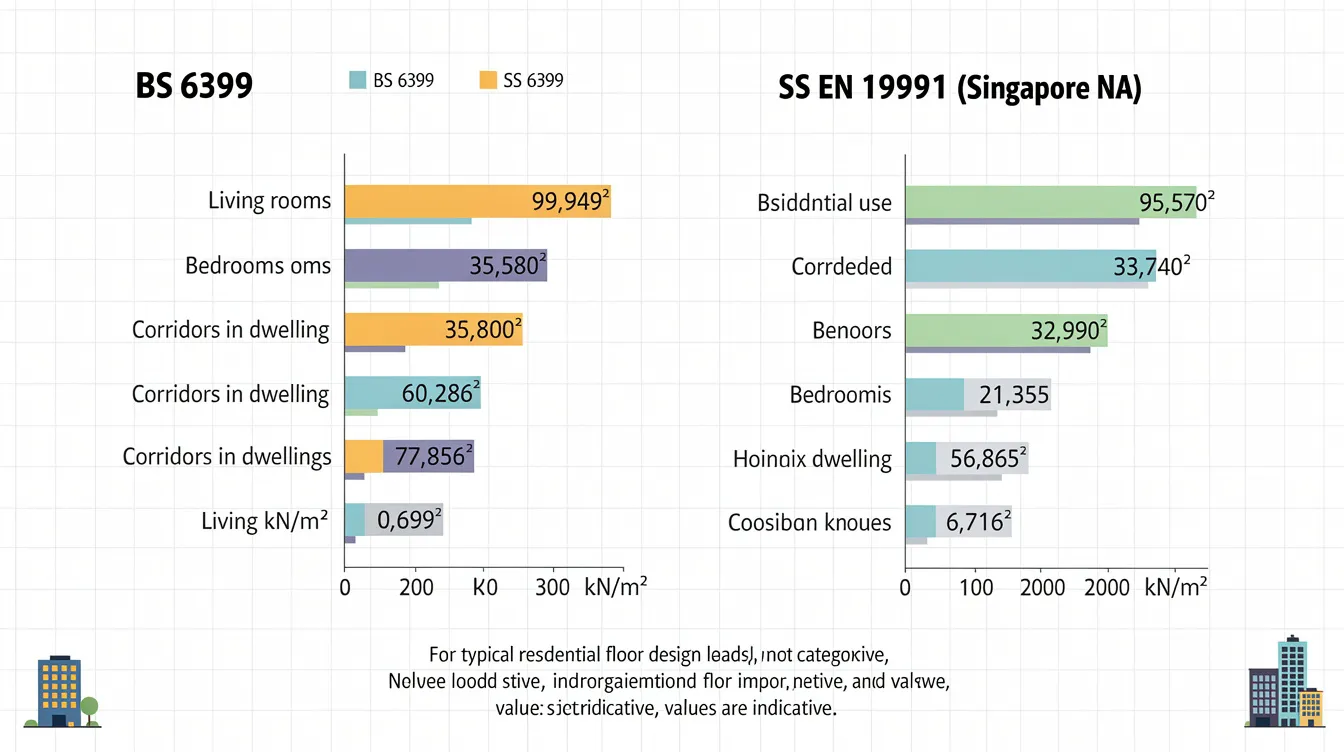
The NA to SS EN 1991-1-1 specifies parameters for imposed loads tailored to Singapore’s usage categories. Typical characteristic imposed loads (q_k) include:
-
Self-contained dwelling unit: 1.5 kN/m²
-
Corridors in residential blocks: 2.0 kN/m²
-
Balconies: 2.5 kN/m²
-
General offices: 2.5 kN/m²
-
Retail shop floors: 4.0 kN/m²
-
Equipment/pump rooms: ≥5.0 kN/m² or higher
Singapore-specific considerations include carpark loading, crowded assembly areas, and rooftop usage – M&E platforms and roof gardens on high-rise buildings are common and require careful category assignment.
The combination factors (ψ₀, ψ₁, ψ₂) for live loads are critical for ULS and SLS combinations. For domestic/residential and office areas (Category A/B): ψ₀ = 0.7, ψ₁ = 0.5, ψ₂ = 0.3. For storage areas (Category E): ψ₀ = 1.0, ψ₁ = 0.9, ψ₂ = 0.8. These factors mean that in multi-action combinations, accompanying variable loads are reduced substantially for typical occupancy categories – a refinement absent from BS 6399-era practice.
Legacy BS 6399 values were similar in magnitude for many categories (residential approximately 2 kN/m², offices approximately 2.5 kN/m²), but the Singapore NA introduces more sub-categories and more precise splits (e.g. balconies versus residential corridors) that require careful attention during design.
Wind Actions in a Tropical Urban Environment (SS EN 1991-1-4 NA)
Singapore’s NA to SS EN 1991-1-4 reflects the city-state’s unique wind climate: a dense, low-latitude urban environment without typhoons but subject to thunderstorm-driven gusts and monsoon winds.
The NA simplifies terrain and roughness categories by standardising most structures to terrain category II (suburban or rural equivalent), except for low-rise roof structures (≤25 m height) within 2 km of the coast, which must use sea terrain (Category 0). The altitude correction factor is omitted – a practical simplification given Singapore’s limited elevation variation.
This approach contrasts with many EN defaults or the UK National Annex, where terrain might vary significantly across a project region, and where multiple roughness categories can substantially affect wind pressure, exposure factors, and gust allowances. In Singapore, high-rise building envelope design in the CBD or elsewhere tends to use NA values that produce moderate, consistent wind loads rather than highly variable inputs driven by open terrain assumptions.
National Annexes provide specific parameters for wind loads and thermal actions relevant to Singapore’s tropical climate, ensuring that façade design, cladding fixings, and structural frame wind resistance are all calibrated to realistic local conditions rather than generic European or UK values.
Concrete Design Under SS EN 1992 with Singapore National Annex
SS EN 1992-1-1 with the Singapore National Annex has replaced BS 8110 as the governing standard for the design of concrete structures. This transition brings changes in strength notation, cover requirements, durability classification, and detailing rules that affect every reinforced concrete element in a building structure. The focus here is on topics most relevant to building projects: strength classes, durability and exposure, crack control, and how these translate to practical differences in reinforcement and member dimensions.
Concrete Strength Classes and Material Factors
Eurocode 2 uses a dual notation for concrete strength – cylinder/cube (e.g. C30/37 means 30 MPa characteristic cylinder strength, 37 MPa cube strength). This differs from BS 8110’s grading system, which referenced cube strength alone (e.g. Grade 30 = 30 MPa cube). Foreign design teams accustomed to BS notation must be careful: a “C30” under Eurocode corresponds to a different physical strength than a “Grade 30” under BS 8110.
Singapore’s NA defines maximum concrete strength classes: for shear-dominant applications, the cap is C50/60; for normal flexural or compression design, classes up to C90/105 are permitted. Material partial safety factors retain the EN default values for persistent and transient design: γ_c = 1.50 for concrete and γ_s = 1.15 for reinforcement steel.
|
BS 8110 Grade |
Approximate Eurocode Class |
Typical Singapore Use |
|---|---|---|
|
Grade 30 |
C25/30 |
Residential slabs, minor elements |
|
Grade 35 |
C28/35 |
General building elements |
|
Grade 40 |
C32/40 |
Columns, transfer structures |
|
Grade 50 |
C40/50 |
High-strength applications |
In practice, Singapore building projects commonly use C30/37 to C40/50 for residential and commercial buildings, with higher classes reserved for heavily loaded elements in tall buildings or industrial structures.
Durability, Cover and Exposure Classes in Singapore
SS EN 1992 introduces a systematic exposure classification (XC for carbonation, XD for de-icing salts, XS for marine chlorides) that Singapore’s NA tailors to the country’s hot, humid, marine environment. The NA defers to SS 544-1:2019 for minimum cover due to durability (c_min,dur), providing fine resolution by exposure class, intended working life, and element type.
Typical exposure class selections for Singapore projects include:
-
Inland residential interiors: XC1 (dry or permanently wet conditions)
-
Sheltered external walls: XC3/XC4 (moderate humidity, cyclic wetting/drying)
-
Coastal façades and marine-exposed elements: XS1/XS2/XS3 (airborne chlorides, submersion, tidal zones)
-
Basement walls and carpark slabs: XC3/XC4, potentially XD1 where chemical exposure occurs
Resulting nominal covers in Singapore are typically 20–25 mm + Δc (deviation allowance) for standard exposure, increasing significantly for severe marine exposure. Under BS 8110, cover requirements were simpler and often lower – meaning that designs migrated from BS to Eurocode practice frequently require thicker cover, adjusted bar spacing, and revised bar bending schedules.
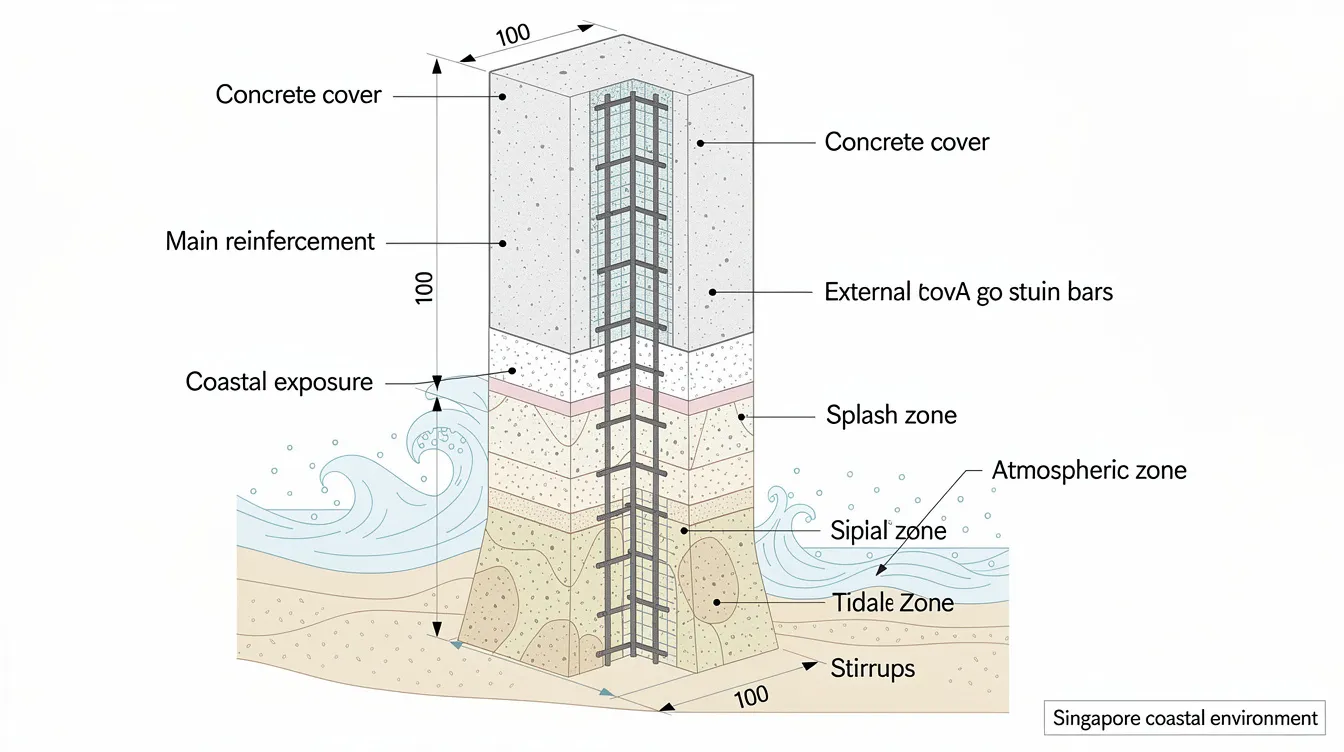
These durability requirements have real cost and coordination implications: architectural tolerances, formwork precision, and bar positions must all account for greater cover, particularly on exposed façades and elements near the coast.
Serviceability: Deflection and Crack Control under Singapore NA
SS EN 1992 treats serviceability limit states more explicitly than BS 8110, with the Singapore National Annex providing guidance on both deflection limits and crack width limits.
The NA specifies maximum crack widths under quasi-permanent and frequent load combinations: for exposure classes X0 and XC1, allowable cracks reach 0.3 mm (quasi-permanent) and 0.2 mm (frequent). For more aggressive classes (XD, XS), similar or tighter limits apply. Prestressed elements with bonded tendons must avoid decompression under specified load combinations.
Common deflection criteria in Singapore practice – span/250 for general members, stricter limits for cantilevers and façade-supporting beams – reflect both NA guidance and local client expectations. The minimum angle of the concrete compression strut in shear design is set by the NA: θ_min = 21.8° (cot θ = 2.5) for standard members, but θ_min = 45° (cot θ = 1.0) where tension co-exists with shear.
In practice, these requirements can lead to slightly larger members or heavier reinforcement than a naïve EN default design would produce, but they deliver increased durability performance in Singapore’s tropical climate – a worthwhile trade-off for structures expected to perform for 50 years or more.
Steel Structure Design Under SS EN 1993 with Singapore National Annex
SS EN 1993 with its Singapore National Annex has replaced BS 5950 for the design of steel structures, affecting member resistance calculations, buckling checks, and connection design for steel frames, trusses, and industrial structures. This section focuses on practical implications for buildings and industrial plants in Singapore.
Steel Grades, Material Factors, and Section Classes
Common steel grades used in Singapore include S275 and S355, with composite steel and concrete construction also widely employed in high-rise buildings. The Singapore NA sets material partial safety factors as: γ_M0 = 1.00, γ_M1 = 1.00, and γ_M2 = 1.10 – the last applying to resistance checks involving ultimate tensile strength (e.g. net section fracture, bolt shear).
Section classification under Eurocode 2 and EN 1993 uses Classes 1–4, replacing BS 5950’s plastic, compact, and semi-compact categories. Some sections that were classified as “compact” under BS 5950 may fall into Class 3 (semi-compact) or even Class 4 (slender) under Eurocode rules, restricting the use of plastic analysis and potentially requiring more conservative elastic design. Local practice in Singapore, including preference for certain rolled sections from regional mills, interacts with these classification rules.
|
Typical Singapore Section |
Likely Eurocode Class |
Design Implication |
|---|---|---|
|
UB 457×191×67 (S355) |
Class 1 |
Full plastic analysis permitted |
|
UB 533×210×82 (S275) |
Class 1 or 2 |
Plastic or limited redistribution |
|
Welded plate girder (S355) |
Class 3 or 4 |
Elastic analysis; effective section may apply |
Stability, Buckling, and Frame Design with Singapore NA
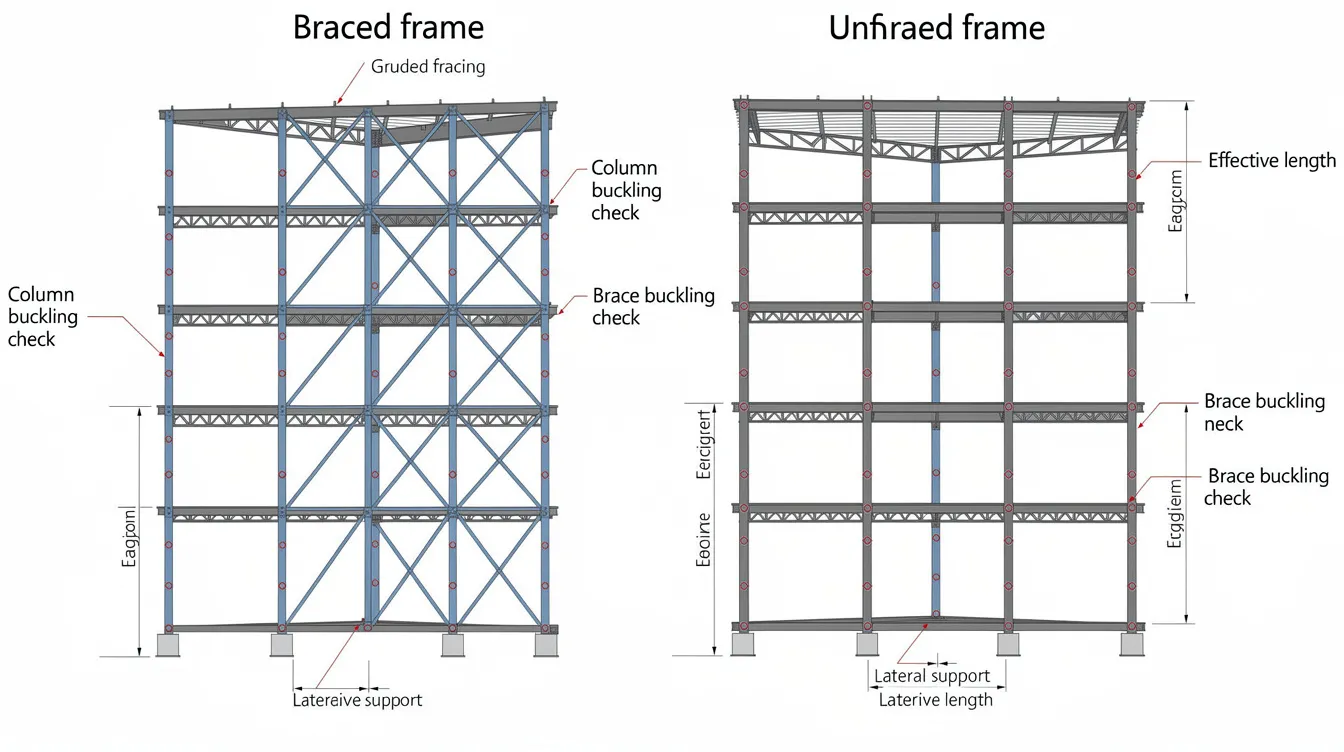
SS EN 1993 checks global stability and member buckling – lateral-torsional buckling (LTB), column buckling, and combined effects – with the Singapore NA defining appropriate buckling curve choices. The NA provides stricter definitions for imperfection modelling: bow imperfection e₀ is calculated using the relationship e₀ = α·(λ̄ − 0.2)·(W/A), with limiting slenderness λ̄_LT,0 = 0.4 for rolled or cold-formed sections, and lower limits for welded sections.
High-rise and long-span steel structures in Singapore often require more rigorous second-order and imperfection analysis than BS 5950-era designs demanded. The execution class requirements are also significant: the Singapore NA maps minimum execution class EXC2 for most building works, with EXC3 for higher-quality requirements including certain connections and where other eurocodes apply (e.g. structural fire design provisions or fatigue-sensitive elements).
Connections and Fabrication: Local Practice vs Eurocode Theory
SS EN 1993-1-8 governs connection design using the component method – a fundamentally different approach from BS 5950’s traditional tabular capacities. The Singapore NA clarifies bolt grades, weld categories, and fabrication tolerances common in local workshops.
The component method requires engineers to analyse each element of a connection (column web panel, end-plate bending, bolt tension, etc.) individually, producing more transparent but more labour-intensive calculations. For detailers and fabricators accustomed to BS 5950 practice, this demands closer coordination between design offices and steel fabrication workshops in Singapore to ensure NA-compliant details that remain buildable and economical.
Foundations and Geotechnical Design Under SS EN 1997 in Singapore
Geotechnical design is one of the areas where Singapore’s National Annexes differ most significantly from EN defaults, driven by local geology, high-rise foundation demands, and extensive experience with deep construction in challenging soils. This section covers geotechnical categories, design approaches, and the piled foundations common across Singapore.
Design Approaches and Geotechnical Categories
Eurocode 7 (EN 1997-1) introduces the concept of Geotechnical Categories (GC1–GC3) and Design Approaches (DA1, DA2, DA3), each specifying different combinations of partial factors for actions, soil parameters, and resistances.
Singapore’s NA mandates Design Approach 1 (DA1) for most building foundations. Alternative Design Approaches (DA2, etc.) are not adopted except in special cases requiring client and authority agreement. Under DA1, two combinations must be checked:
-
Combination 1: Factors primarily on actions (γ_G, γ_Q), with soil parameter factors at unity (Set M1: γ_φ’ = 1.0)
-
Combination 2: Reduced action factors, with soil parameter factors applied (Set M2: γ_φ’ = 1.25; undrained shear strength factor up to 1.4)
For spread footings, resistance factors γ_R;v = 1.0 (vertical bearing) and γ_R;h = 1.0 (sliding) apply under Set R1.
Compared to BS 8004, which used blanket safety factors of approximately 3 for bearing capacity, the Eurocode approach separates uncertainties more systematically. This may reduce conservatism when ground investigation is thorough, but imposes higher safety margins when soil data is limited – increasing foundation depths or pile sizes in practice unless geotechnical investigation reduces uncertainty.
Piled Foundations in Singapore Soils
Singapore’s subsurface conditions – marine clay, Kallang Formation, Old Alluvium, and Bukit Timah Granite – present specific challenges that the NA to SS EN 1997 addresses through pile capacity correlation factors, load test requirements, and safety factors reflecting local empirical experience.
The NA requires correlation factors linking calculated pile capacity to static load test results, with higher partial resistance factors for piled foundations than for shallow footings to account for greater uncertainty. This emphasis on verification through load testing is a notable departure from legacy BS 8004 practice, where simpler capacity calculations with a global factor of safety were often sufficient for authority submissions.
Designers must align site investigation scope with SS EN 1997 NA recommendations – involving the geotechnical PE early and using staged investigation tied to design milestones. This proactive approach to understanding geotechnical aspects often reduces conservatism and leads to more economical foundation designs compared with applying maximum safety factors to poorly characterised ground.
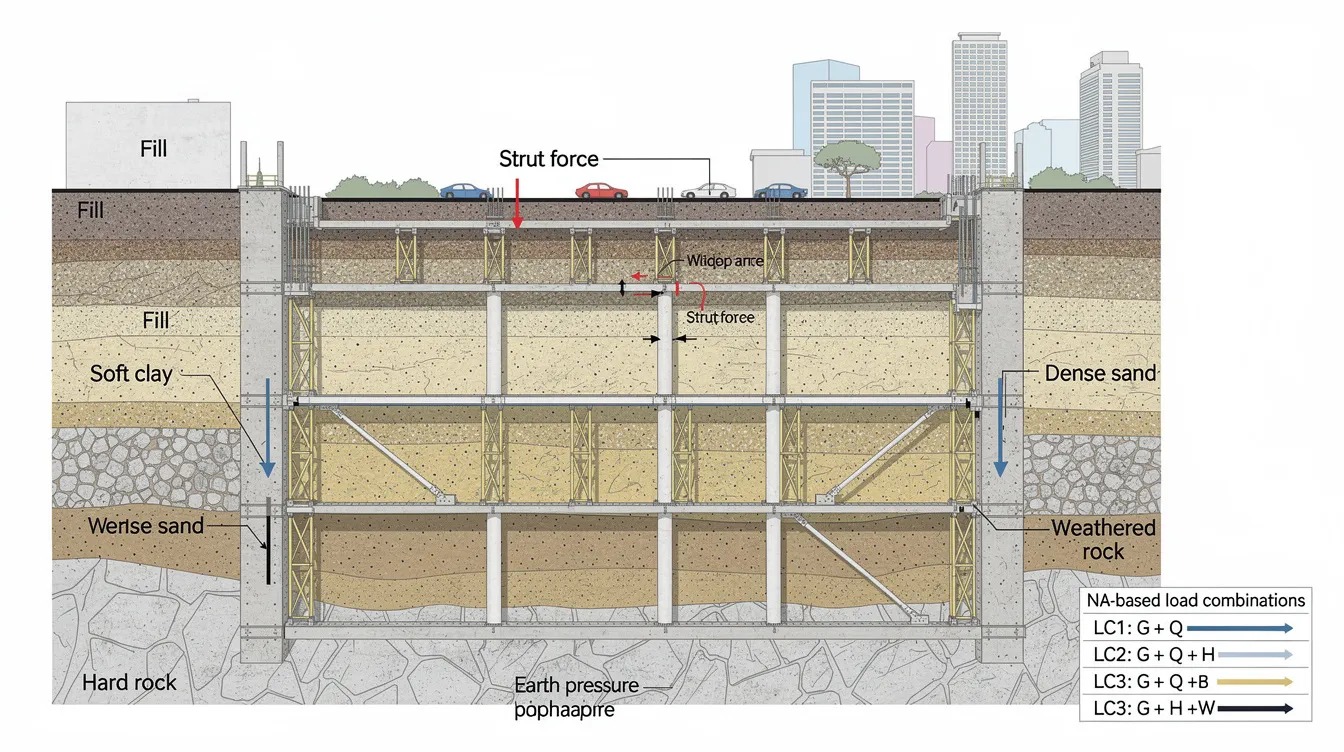
Basements, Retaining Walls, and Excavations
Eurocode-based design with the Singapore NA significantly impacts temporary structures such as sheet pile walls and struts, as well as permanent retaining walls, diaphragm walls, and deep excavations for basements. Load combinations for earth pressures, water pressures, and surcharges follow SS EN 1997 NA partial factor sets, which are more differentiated than BS 8004’s approach.
Authority expectations from BCA, MOM, and LTA for deep excavation submissions require that safety factors, monitoring regimes, and back-analysis procedures all reference SS EN 1997 NA values. The geotechnical PE carries increased responsibility for ground investigation quality and parameter selection under Eurocode philosophy – a significant shift from the more prescriptive BS framework.
Practical Design Workflow: Applying SS EN with Singapore NAs
The preceding sections have covered specific Eurocodes and their Singapore NAs individually. In practice, these all converge in a structured design process that moves from conceptual scheme to detailed design and authority submission. This section ties everything together for structural engineers and design managers working on Singapore projects.
Step-by-Step Design Process for a Typical Building
A realistic workflow for a building project under SS EN with Singapore NAs follows this sequence:
-
Define structural scheme and reliability requirements based on SS EN 1990 and the Singapore NA – select reliability class, design working life, and consequence class appropriate to the building type.
-
Determine dead, live, wind, and other actions using SS EN 1991 parts with Singapore NAs – assign correct imposed load categories, wind terrain parameters, and any special actions.
-
Perform global analysis with appropriate load combinations (ULS and SLS) using NA-defined γ and ψ factors, applying EN 1990 formulas 6.10, 6.10a, and 6.10b as required.
-
Design main RC and steel members using SS EN 1992/1993 with NA values for material factors, cover, detailing, and buckling parameters.
-
Design foundations using SS EN 1997 NA, coordinated with geotechnical investigation data and Design Approach 1 requirements.
-
Check serviceability and robustness, and prepare authority submission calculations and drawings with PE endorsement.
Singapore-specific documentation is required at each stage: the BCA requires calculation reports to clearly state which SS EN codes and NAs are applied, and all structural plans must carry PE endorsement. Integration with BIM and structural analysis software is critical – software packages often default to EN generic values unless the Singapore NA is explicitly selected in the settings, which can cause significant errors if overlooked.
Comparison Snapshot: SS EN with Singapore NA vs British Standards
The overall transition from British Standards to SS EN with Singapore NAs produces measurable differences across projects:
|
Aspect |
Legacy BS (BS 8110/5950/8004) |
SS EN with Singapore NA |
|---|---|---|
|
Design philosophy |
Prescriptive, rule-based |
Semi-probabilistic, performance-based |
|
Load combinations |
Simple (1.4D + 1.6L typical) |
Multiple combinations with ψ factors |
|
Concrete strength notation |
Cube strength (Grade 30) |
Cylinder/cube (C25/30) |
|
Durability cover |
Simpler classes, generally lower cover |
Detailed exposure classes; often higher cover |
|
Pile factor of safety |
Global FOS ~3 |
Partial factors on actions, materials, resistance |
|
Documentation expectations |
Moderate |
Extensive (NA references, PE endorsement, BCA format) |
|
Analysis effort |
Lower |
Higher (more combinations, second-order effects) |
Where Eurocodes with the NA may deliver material savings – through more optimised reinforcement via combination factors – they invariably require higher analysis and coordination effort. The Eurocodes facilitate Singapore’s international construction competitiveness by providing a globally recognised design framework, but the trade-off is increased technical complexity.
Case-Type Illustration: Mid-Rise Residential vs High-Rise Commercial
Consider two stylised project types to illustrate how Singapore NAs influence key structural decisions:
A 25-storey residential block in the heartlands: Wind loads follow terrain category II with moderate base shear. Imposed loads of 1.5 kN/m² for apartments with 2.0 kN/m² for corridors apply. Exposure classes are typically XC1/XC3 for sheltered elements with standard cover of 25–30 mm nominal. Foundations may use bored piles to Old Alluvium, designed under DA1 with correlation factors calibrated to local load test data. The frame system is typically reinforced concrete shear-wall construction.
A 40–50-storey commercial tower in the CBD: Wind actions require careful assessment, potentially with wind tunnel testing for buildings of this height. Imposed loads are higher for retail podiums (4.0 kN/m²) and public assembly. Coastal proximity may trigger XS exposure classes on lower facades, demanding covers of 35–50 mm nominal. Deep basements require diaphragm walls designed to SS EN 1997 NA with extensive monitoring. Steel-concrete composite structures or high-strength concrete (C50/60+) may be employed for columns and transfer elements, with structural fire design coordinated with SCDF requirements.
Common Challenges When Using Singapore National Annexes – And How to Solve Them
Even experienced Eurocode users from Europe or ASEAN member states can encounter Singapore-specific difficulties when applying SS EN and NAs, particularly when designs originate overseas or when teams are transitioning from British Standards. The challenges below represent the most common issues encountered in practice.
Challenge 1: Misalignment Between Overseas Design and Singapore NA Requirements
The problem: Designs produced overseas using generic Eurocode settings or another country’s NA – including the UK National Annex – lead to non-compliance with Singapore authority expectations. Partial factors, imposed loads, exposure classes, and wind parameters may all differ from what the Singapore NA requires.
The solution: Insist on early confirmation of applicable SS EN NAs at the concept stage. Adjust all software settings to the Singapore NA before any analysis runs. Have a Singapore-registered PE review and localise designs before submission. The risk of full redesign and months of delay makes this upfront investment essential. Singapore’s National Annexes ensure that engineers do not mix old standards with the new Eurocodes and NAs – this principle applies equally to mixing different countries’ NAs.
Challenge 2: Confusion Over Load Combinations and Factors
The problem: Teams accustomed to BS-style thinking apply wrong load combinations or misuse γ and ψ factors. The multiple combination formulas in EN 1990 (6.10, 6.10a, 6.10b) with accompanying ψ₀, ψ₁, ψ₂ values are more complex than the simple BS approach.
The solution: Prepare a standardised load-combination reference sheet based on SS EN 1990/1991 NAs for the office, embed it in design templates, and validate against authoritative BCA guidelines and building codes. AEC Technical Advisory can help establish office standards and internal checklists aligned with Singapore practice. Regular cross-checking of combination outputs from software against manual calculations for at least one typical element is strongly recommended.
Challenge 3: Durability and Cover Requirements in a Marine, Tropical Climate
The problem: Imported designs often underestimate cover requirements, omit XS/XD exposure considerations, or fail to account for Singapore’s aggressive chloride environment – leading to BCA rejections or premature deterioration.
The solution: Always reclassify exposure using Singapore NA guidance and SS 544-1:2019. Coordinate with façade and waterproofing design teams early. Adjust cover and bar arrangements at concept stage so architectural drawings do not need late-stage changes. Colour-coded exposure maps for the building envelope are an effective communication tool between structural engineers, architects, and clients.
Challenge 4: Geotechnical Uncertainties and Limited Ground Information
The problem: Eurocode geotechnical philosophy places strong emphasis on investigation quality. Many projects initially under-scope site investigation work, particularly on redevelopment sites where historical data may be unreliable.
The solution: Align SI scope with SS EN 1997 NA recommendations from the outset. Involve the geotechnical PE early and use staged investigation tied to design milestones. This proactive approach often reduces the conservatism that the NA would otherwise impose through maximum partial factor sets – leading to more economical foundation designs and fewer surprises during construction.
Conclusion and Next Steps
Eurocodes adapted through Singapore National Annexes form the backbone of structural design in Singapore, governing how loads are quantified, how concrete structures and steel structures are proportioned, and how foundations are verified for safety – affecting every major project from HDB blocks to CBD towers. The National Annex tailors Eurocodes to Singapore’s local conditions in ways that are both technically rigorous and legally binding.
The central takeaway is clear: understanding and correctly applying Singapore NAs is essential for compliance, cost optimisation, and risk management. This is especially critical for foreign developers and overseas design teams unfamiliar with Singapore’s regulatory environment, where the consequences of non-compliance include submission rejection, redesign, and project delay.
Concrete next steps for your practice:
-
Audit your current design templates and software settings against Singapore NAs – verify that all NDPs are correctly configured.
-
Develop an internal NA quick-reference guide for your project teams covering key partial factors, combination factors, and exposure class selections.
-
Engage a Singapore PE or consultancy like AEC Technical Advisory early in project planning to localise designs and streamline BCA submissions.
-
Train design staff on key differences between British Standards and SS EN with NAs, focusing on load combinations, concrete strength notation, and geotechnical design approaches.
-
Budget for the additional analysis and documentation effort that Eurocodes demand – this is not optional overhead but integral to the process.
Related topics worth exploring include performance-based seismic design for tall buildings, fire design requirements under SCDF, and integration of Eurocode design within BIM workflows for authority submissions. The NA to SS EN 1998-1:2013 establishes earthquake resistance guidelines that are increasingly relevant for certain building types and sites in Singapore.
Additional Resources for Working with Singapore Eurocodes
This section provides a concise guide to the most useful reference materials for engineers and developers working with SS EN and Singapore NAs:
-
SS EN codes and Singapore National Annexes: Obtain from Enterprise Singapore (formerly SPRING Singapore) – the complete set includes SS EN 1990, 1991 (multiple parts), 1992, 1993, 1997, and 1998 with their respective NAs. These are the primary document sources for all NDPs discussed in this article.
-
BCA Approved Documents and practice notes: These pair each Eurocode part with its corresponding NA and provide supplementary guidance on structural submission requirements, including documentation format and PE endorsement expectations.
-
SS 544-1:2019: The complementary Singapore standard for concrete durability, specifying cover and exposure class parameters referenced by the NA to SS EN 1992.
-
Professional training: BCA Academy, IES, and the National University of Singapore offer courses and seminars on Eurocodes and Singapore NAs for structural and geotechnical engineers – essential for teams transitioning from British Standards or other national codes.
-
Internal checklists and template calculation sheets: AEC Technical Advisory develops customised NA application guides for clients, ensuring consistent compliance across project teams and design offices.
These resources map directly onto the design process described in this article: codes and NAs provide the rules, practice notes guide execution, training builds competence, and internal checklists ensure consistency across every project in Singapore’s demanding construction industry.