
Introduction
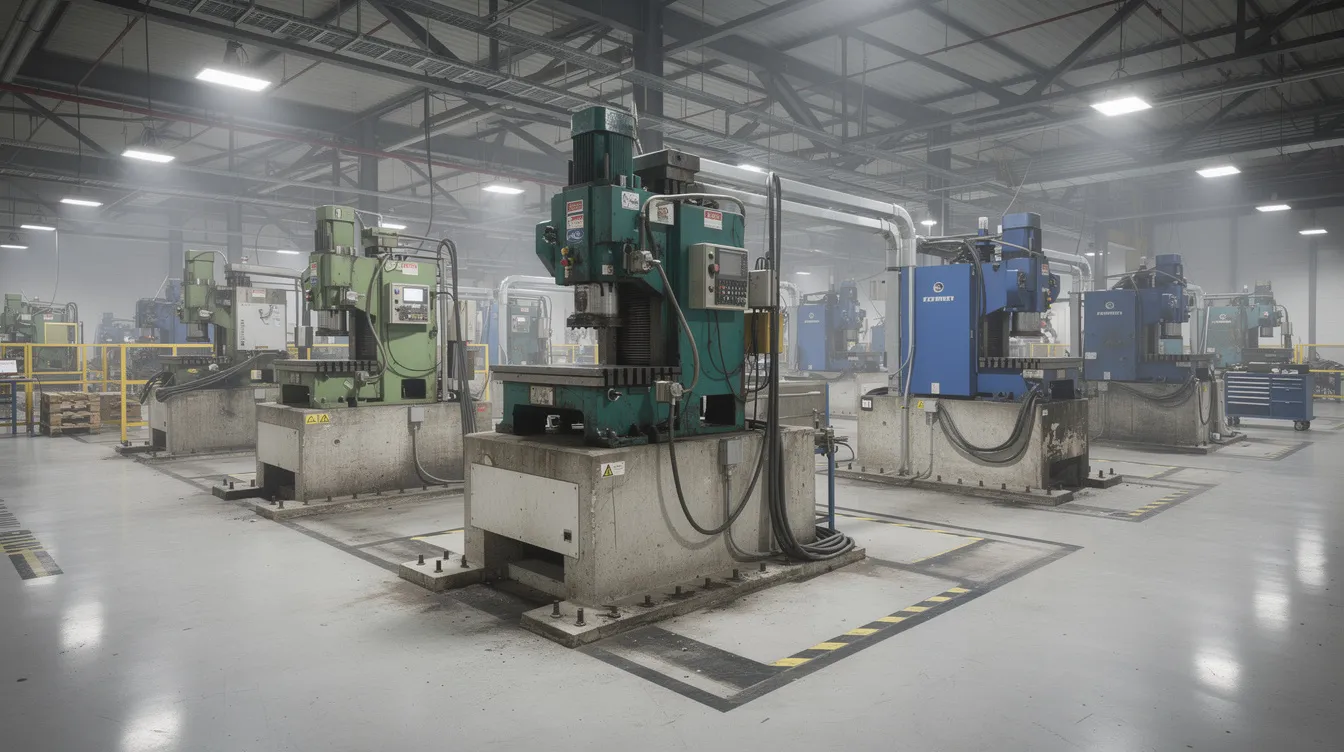
Heavy machinery foundation design in Singapore demands specialized foundation engineering that goes far beyond what conventional building foundations provide. While, unlike conventional building foundations, conventional building foundations primarily resist static loads-dead weight and constant live loads-foundations for heavy machinery must absorb cyclic forces, withstand impact loading, prevent resonance, and maintain precise equipment alignment over decades of continuous operation. A stamping press, compressor, or forging hammer generates significant dynamic forces that propagate through the foundation into the surrounding structure and soil, creating engineering challenges that require a deep understanding of dynamics, geotechnics, and Singapore’s regulatory landscape.
This guide covers the complete machine foundation design process for Singapore’s industrial estates and manufacturing facilities-from dynamic load analysis and geotechnical investigation through BCA and JTC authority submission processes. It is written for structural engineers, facility managers, and industrial project developers who need to design, approve, and construct foundations for heavy equipment in Singapore’s unique operating environment.
Foundation design for heavy machinery requires an integrated engineering approach: the foundation must control static and dynamic loads while complying with SS CP 4:2003, SS EN 1991-3:2010, and JTC industrial building standards, without compromising structural integrity. Dynamic loads and soil conditions are critical considerations in foundation design, and getting either wrong can result in excessive vibration, equipment failure, and costly remediation.
Key outcomes from this guide:
-
Understand dynamic load analysis requirements and how machinery characteristics influence foundation design parameters
-
Master Singapore-specific soil considerations, particularly the Kallang Formation’s soft marine clay
-
Navigate the authority submission process including BCA, JTC, and URA requirements
-
Implement effective vibration control strategies to protect adjacent operations
-
Ensure long-term operational efficiency and overall industrial stability through proper construction and monitoring
Understanding Dynamic Loading Fundamentals
Dynamic loads are time-varying forces-cyclic, impact, or oscillatory-that heavy machinery imposes on its foundation during operation. Unlike static loads from building weight or stored materials, dynamic loads vary in magnitude and frequency during operation, producing fatigue damage, vibration propagation, and potential resonance effects. Every piece of industrial machinery, from compressors and stamping machines to crushers and gantry cranes, generates a distinct dynamic loading signature defined by its operating frequency, force amplitude, and direction of action.
Understanding these forces at the concept design stage is the first step toward a foundation that maintains structural integrity and machinery performance throughout its service life. Dynamic load analysis is essential for heavy machinery foundation design because it determines how the foundation must be sized, reinforced, and isolated to prevent problems that static analysis alone cannot predict.
Types of Dynamic Forces in Industrial Equipment
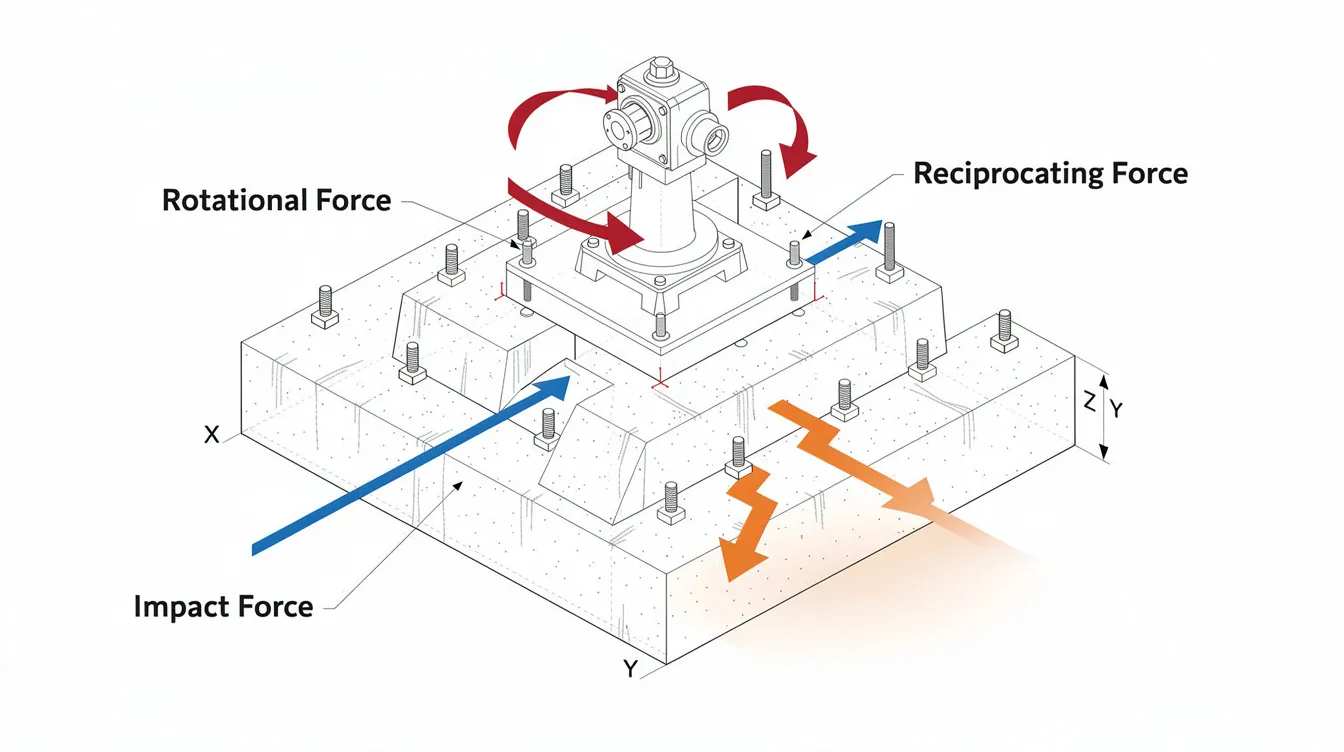
Industrial equipment generates three primary categories of dynamic forces, each requiring different design responses:
Rotational forces arise from motors, compressors, turbines, generators in power plants, and rotating shafts. These create steady periodic loads at the machine’s operating frequency and its harmonics. A compressor running at 3,000 RPM produces a primary excitation at 50 Hz plus higher harmonics that can excite different vibration modes. Rotational forces also generate cyclic torque about the shaft axis, causing torsional vibration that the foundation must resist without twist or warping. Foundations for such equipment must be designed with sufficient torsional stiffness, and anchor bolts must be positioned to resist moment loads.
Reciprocating forces are generated by stamping machines, forging presses, and piston-driven equipment with reciprocating components. These forces alternate between tensile and compressive states, typically at lower frequencies-a 200-tonne stamping press cycling at 60 strokes per minute generates significant dynamic forces with each stroke. The alternating nature of these loads creates fatigue concerns in concrete, reinforcement, and bolted connections. Foundation designs for reciprocating equipment must account for fatigue life, stress reversals, and the large unbalanced forces that can rock or shift the foundation over time.
Impact and impulse forces come from drop hammers, crushers, and similar equipment that deliver short-duration, high-intensity loads. These produce shock waves that propagate through the foundation into the soil and surrounding structure, with peak forces many times the equipment’s static weight. Dynamic loads can cause vibrations that propagate through foundations and into neighboring structures, making impact-loaded machine foundations among the most challenging to design. Reinforced concrete block foundations are commonly used for heavy machinery subjected to impact loads, as the massive concrete provides both inertia and energy absorption.
Resonance and Vibration Control Principles
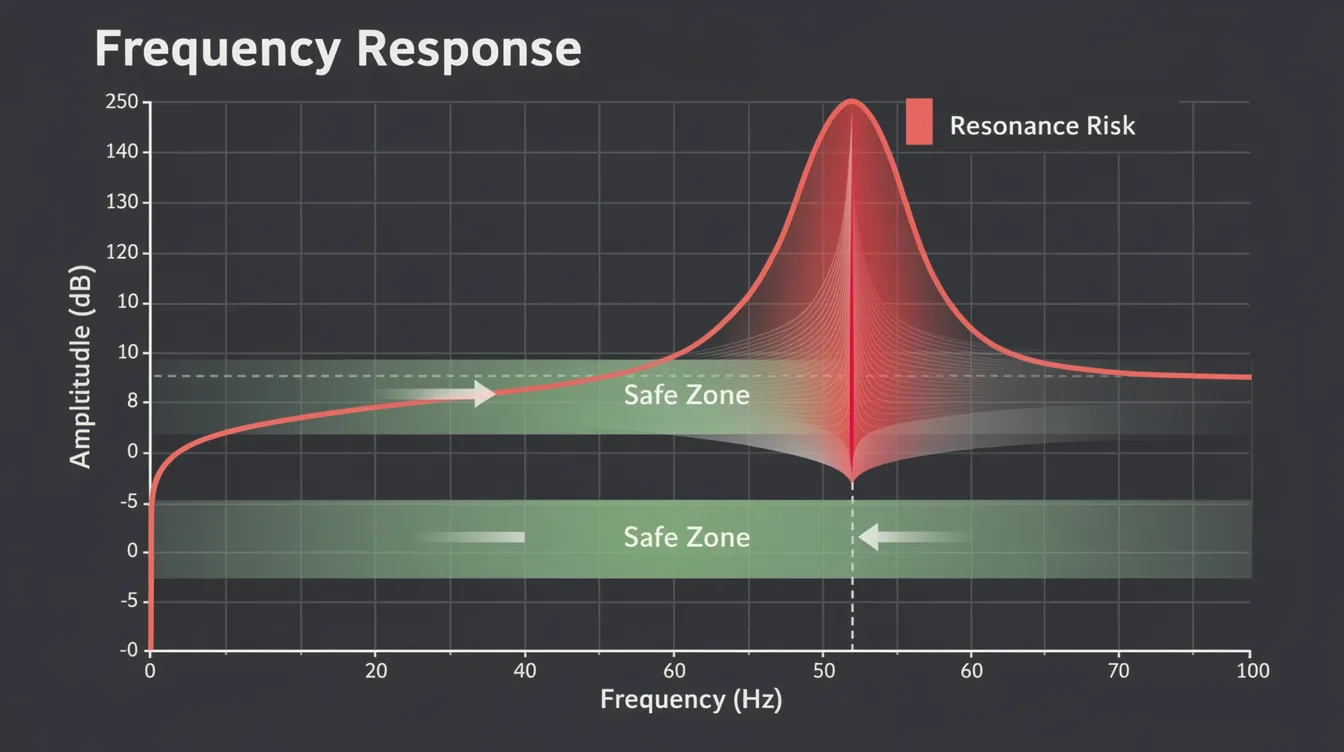
Resonance occurs when machine frequency matches the foundation’s natural frequency, causing dangerous amplification of vibration that can damage equipment, crack foundations, and affect adjacent facilities and broader structural systems. At resonance, even small excitation forces amplify vibration to levels far exceeding design limits, making frequency management the single most important aspect of vibration control.
The critical design requirement is frequency separation: the ratio of operating frequency to the foundation’s natural frequency should be kept either below 0.6 or above 1.5. Within this danger zone (0.6–1.5), the dynamic amplification factor rises sharply, and even well-damped systems experience problematic vibration levels. Structural engineers must perform dynamic analysis to determine natural frequencies and avoid resonance across all operating modes, including startup, shutdown, and harmonic excitations.
Three primary design levers control a foundation’s natural frequency and vibration response:
-
Foundation mass: Increasing foundation mass lowers the natural frequency. Foundation mass should be 3 to 5 times the machine’s mass to ensure the foundation’s inertia dominates the dynamic response. For example, a 200-tonne stamping press typically requires 600–1,000 tonnes of reinforced concrete foundation.
-
Soil stiffness: Higher soil stiffness raises the natural frequency. In Singapore, where soft marine clay dominates many industrial zones, the low soil stiffness tends to produce low natural frequencies that may coincide with low-speed machinery excitation.
-
Vibration isolation systems: Elastomeric pads, spring mounts, and pneumatic isolators decouple the machine from the foundation or the foundation from the surrounding structure, dramatically reducing transmitted vibrations. Damping systems convert kinetic energy into heat to reduce vibrations at and near resonance.
Dynamic analysis is essential to determine natural frequencies and avoid resonance-this analysis forms a required component of the structural design package for any heavy machinery installation in Singapore.
Singapore-Specific Design Requirements
Singapore’s regulatory framework, geological conditions, and dense urban-industrial environment create a unique set of constraints for machine foundation design. Heavy machinery foundation designs must comply with BCA and URA regulations, and the combination of soft marine clay soils, strict authority requirements, and vibration-sensitive neighboring facilities demands thorough regulatory compliance and engineering rigor that exceeds what many other jurisdictions require.
BCA and JTC Compliance Framework
The Building and Construction Authority (BCA) governs structural plan approvals for all building works in Singapore. BCA mandates compliance with SS CP 4:2003 for foundations, which provides recommendations for foundation safety and economy. Although SS CP 4:2003 was formally withdrawn from sale in 2019, it remains widely referenced in practice and accepted under BCA submissions. Regulatory compliance includes adherence to Eurocode standards for concrete structures, and where machinery foundations tie into the wider facility frame, these requirements also interface with the design of supporting steel structures; SS EN 1991-3:2010 (with Singapore National Annex) specifically addresses actions induced by cranes and machinery-including dynamic factors for hoisting, travelling, and buffer impact loads.
All foundation designs must be endorsed by a registered Professional Engineer. This PE endorsement covers structural calculations, dynamic load analysis, and compliance statements. Foundation designs require endorsement before submission to BCA, and the PE takes professional responsibility for the adequacy of the design.
JTC plan consent is required for heavy machinery foundation modifications on JTC industrial estates. JTC reviews structural plans for compliance with industrial estate standards, plot ratio constraints, and lease conditions that may restrict foundation placement or depth. The JTC site plan submission process runs concurrently with BCA approval but involves separate evaluation criteria focused on industrial use and estate management.
Concrete specifications must comply with SS 544 Part 1 for durability and quality. Concrete strength should be Grade 40 or higher for durability in tropical climates, accounting for Singapore’s high humidity, temperature cycles, and potential chloride exposure in marine-influenced environments. Singapore’s environmental conditions necessitate corrosion-resistant materials, particularly for anchor bolts and reinforcement in foundations near coastal or reclaimed land sites.
Submissions must include soil investigation reports and dynamic load analysis. The required documentation checklist comprises:
-
Geotechnical investigation report (QP(Geo) certified)
-
Dynamic load calculations and structural analysis
-
PE-stamped structural drawings with reinforcement and anchor bolt details
-
Compliance statements referencing SS CP 4, SS EN 1991-3, and SS 544
-
Noise and vibration impact assessments
-
Construction methodology and quality control plan
Processing timelines for structural plan applications vary from 7 to 14 days after complete submission, depending on project complexity. BCA CORENET-X is the digital submission platform for all structural plan applications.
Kallang Formation Marine Clay Challenges
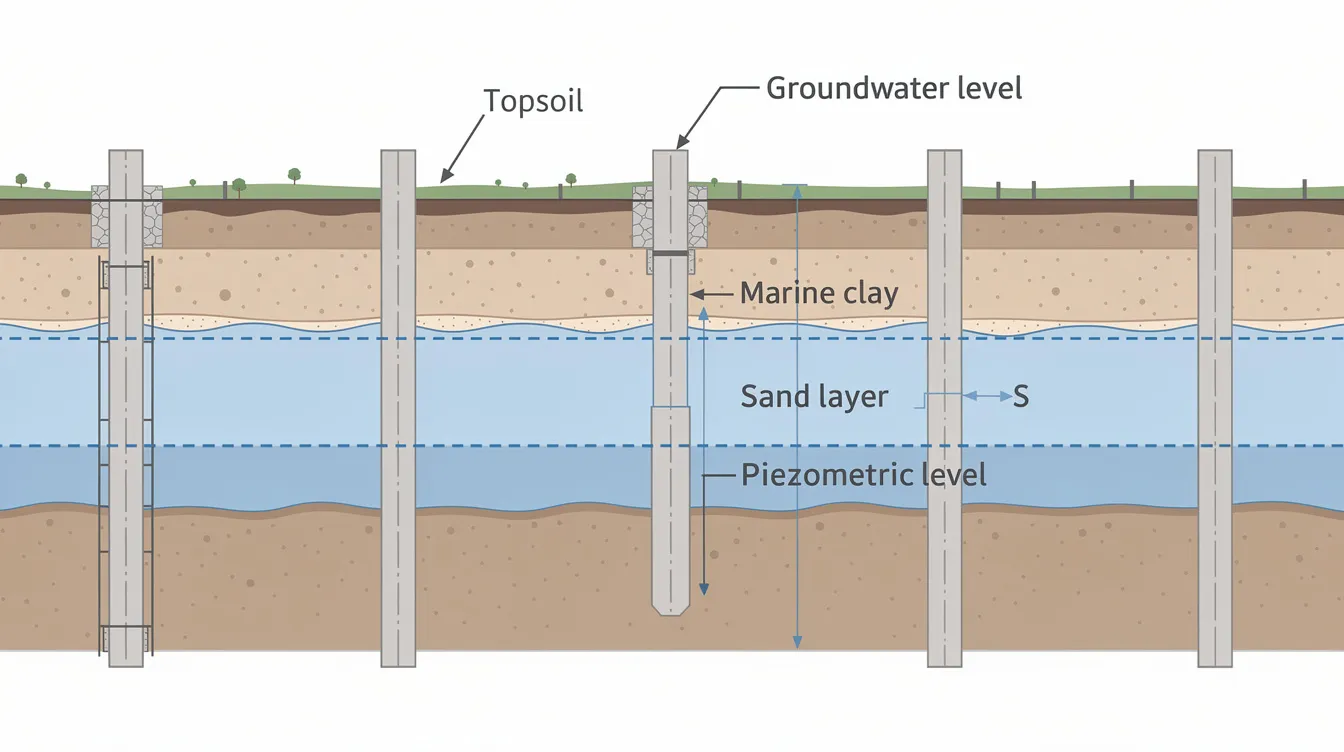
Foundations must account for Singapore’s soft marine clay and varying soil types. The Kallang Formation marine clay underlies much of Singapore’s reclaimed land and industrial zones, presenting the most significant geotechnical challenge for heavy machinery foundations. This soft soil has properties that directly conflict with the requirements for stable, vibration-resistant machine foundations.
Singapore’s Upper Marine Clay has undrained shear strength of 10–30 kPa-extremely low for supporting heavy equipment. The lower marine clay offers slightly better strength at 30–60 kPa but still falls well below what most heavy machinery foundations require for direct bearing. Marine clay thickness in Singapore can exceed 30–40 metres in many industrial zones, meaning that competent bearing strata may lie at considerable depth.
Key soil parameters that affect foundation design:
|
Parameter |
Upper Marine Clay |
Lower Marine Clay |
|---|---|---|
|
Undrained shear strength (Su) |
10–30 kPa |
30–60 kPa |
|
Water content |
60–80% |
40–60% |
|
Bulk density |
14.2–15.7 kN/m³ |
15–16.5 kN/m³ |
|
Vertical consolidation coefficient (c_v) |
0.47–0.6 m²/year |
0.8–1.5 m²/year |
|
Sensitivity |
3–8 |
2–5 |
Vertical consolidation coefficients in upper clay are 0.47–0.6 m²/year, meaning primary settlement occurs slowly over years. Secondary compression (creep) continues even after primary consolidation is complete, potentially causing long-term differential settlement that misaligns precision machinery. Soft marine clay amplifies vibration, affecting foundation stability-the low shear modulus of marine clay provides poor resistance to dynamic loading, and cyclic loading can further degrade soil stiffness over time.
Deep pile foundations are required in areas with soft soils to prevent settlement. Piled foundations transfer loads to deeper, stable soil layers or bedrock, bypassing the problematic marine clay entirely. However, piles through marine clay must also be designed for negative skin friction (downdrag) as the settling clay drags downward on the pile shaft.
Seasonal monsoon effects further complicate the picture. During the northeast monsoon (November–March) and inter-monsoon periods, elevated rainfall raises groundwater levels, reduces effective stresses in the soil, and increases pore water pressures-all of which reduce soil bearing capacity and affect foundation stability during construction and operation.
Urban Industrial Environment Constraints
Singapore’s industrial estates feature closely spaced facilities where heavy equipment vibration from one operation can disturb vibration-sensitive neighbors-semiconductor fabrication, precision engineering, or research laboratories. Vibration isolation techniques are necessary to protect adjacent structures from machinery vibrations. Machine foundations require independent structural design to minimize vibration transfer to the building superstructure and adjoining facilities.
EPMA (Environmental Protection and Management Act) regulations set boundary noise limits for factory premises: approximately 75 dB(A) during daytime, 70 dB(A) in the evening, and 65 dB(A) at night. While Singapore has specific noise legislation, there are no national vibration standards by statute for industrial equipment. In practice, engineers reference BS 5228-2 for construction vibration limits and BS 6472-1 for human exposure to vibration in buildings. Industrial and heavy commercial buildings typically use a threshold peak particle velocity (PPV) of 50 mm/s at frequencies of 4 Hz and above.
Limited construction access in dense industrial estates, restricted working hours, and noise controls during evenings and weekends all influence foundation construction methodology and scheduling. These constraints must be factored into the project timeline from the concept design stage.
Foundation Design Implementation Process
The design and construction of foundations for heavy machinery follows a systematic sequence: geotechnical investigation, foundation type selection and dynamic analysis, authority submission, and construction with rigorous quality control. Each phase builds on the previous one, and shortcuts at any stage create risks to long-term foundation performance and machinery operation.
Geotechnical Investigation and Site Assessment
A thorough geotechnical investigation is the mandatory first step for any heavy machinery foundation project. The investigation must characterize the full soil profile beneath and around the proposed foundation to depths below the expected zone of influence-typically 1.5 to 2 times the foundation width, or through the entire marine clay sequence to residual soil or rock.
Required field testing includes:
-
Boreholes drilled to adequate depth with continuous sampling, identifying all soil layers, the marine clay upper and lower boundaries, and the depth to competent bearing strata
-
Cone Penetration Tests (CPT) providing continuous soil resistance profiles for correlation with strength parameters
-
Field vane shear tests measuring in-situ undrained shear strength at multiple depths within the marine clay
-
Groundwater monitoring to establish seasonal variation in water table levels, particularly important given monsoon effects
Laboratory testing must go beyond standard classification to include dynamic soil properties: cyclic triaxial testing to determine soil behavior under repeated loading, resonant column testing to measure dynamic shear modulus and damping ratio, and oedometer consolidation tests for settlement prediction. These dynamic soil properties must be included in foundation design to accurately model the soil-structure interaction that governs how the foundation-soil system responds to machinery excitation.
The geotechnical investigation report must be certified by a QP(Geo) (Qualified Person for geotechnical works) and include the complete soil profile, strength parameters, consolidation characteristics, and groundwater conditions. This report forms a mandatory component of the authority submission package.
Foundation Type Selection and Design Methodology
Selecting the appropriate foundation type depends on machinery characteristics, equipment specifications, site soil conditions, and vibration control requirements. The three primary foundation systems for heavy machinery each serve different applications:
|
Foundation Type |
Best Application |
Advantages |
Limitations |
|---|---|---|---|
|
Reinforced concrete block |
Fixed heavy equipment (presses, compressors) |
High mass for vibration control, simple construction, durable |
Requires adequate bearing capacity, heavy |
|
Pile-supported foundation |
Sites with soft soil, marine clay |
Reaches stable soil layers, controls settlement |
Higher cost, longer construction, downdrag risk |
|
Raft (mat) foundation |
Multiple machines, moderate loads |
Distributes dynamic load across broader area, reduces differential settlement |
Inadequate for thick marine clay without piles |
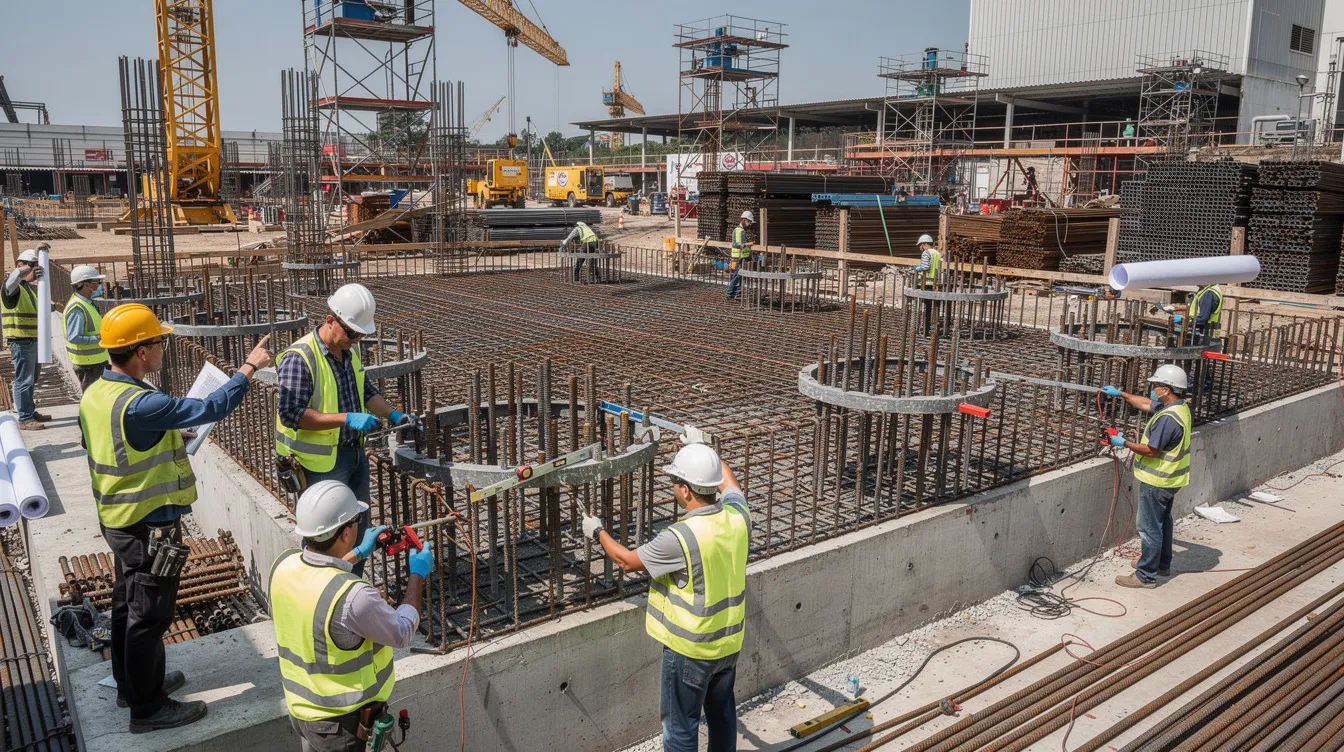
Reinforced concrete block foundations are commonly used for heavy machinery because they provide the mass, stiffness, and anchor points needed for secure machinery installation. Foundation mass should be 3 to 5 times the machine’s mass-this ratio ensures the foundation’s inertia dominates the dynamic response, reducing vibration amplitudes to acceptable levels. Concrete foundations must use minimum Grade 40 concrete, with higher grades (C50/60) considered where high shear stresses or dynamic loading demands warrant them.
Proper anchor bolt design is crucial for the stability of machinery foundations. Anchor bolts must be designed for uplift, lateral dynamic loads, and fatigue under cyclic loading. Embedment depth, anchorage capacity, baseplate flatness, and epoxy grout specification all require detailed engineering to ensure full load transfer without stress concentrations.
Deep foundation systems using bored or driven piles are required wherever soft marine clay cannot provide adequate soil bearing capacity. Piled foundations transfer loads to deeper, stable soil layers, bypassing the weak marine clay. Pile design must account for shaft friction, base bearing resistance, and negative skin friction from settling clay. Soil bearing capacity assessment at depth determines pile length and capacity requirements.
Dynamic analysis using finite element modeling is essential for determining the natural frequencies of the soil-foundation-machine system. The model incorporates soil springs and damping, foundation geometry and mass, machine weight and operating characteristics, and cyclic loading effects on soil stiffness. Foundations should be designed to control differential settlement and alignment-particularly critical for machines with precision alignment requirements like turbines or multi-station presses.
Vibration isolation systems provide an additional layer of protection:
-
Elastomeric pads: Simple, passive isolation effective for moderate frequencies; require careful selection of stiffness and damping properties
-
Spring mounts: Achieve lower natural frequencies and better isolation ratios; require more space and periodic maintenance
-
Floating foundations: The foundation block is physically decoupled from the surrounding structure using isolators on all sides-the most effective approach for high-sensitivity applications but also the most expensive
Vibration isolation systems reduce vibration transfer significantly and should be evaluated for any installation where heavy equipment operates near vibration-sensitive processes. The vibrational impact of heavy machinery should be monitored post-installation to verify that isolation systems perform as designed.
Authority Submission and Approval Process
The authority submission process for heavy machinery foundations in Singapore follows a structured sequence:
-
Pre-consultation: Engage with JTC (for industrial estate sites), URA (for planning permission if required), and NEA/EPMA (for noise and vibration impact assessment). Determine site constraints, lease conditions, and industrial use classification.
-
Commission geotechnical investigation: Engage a QP(Geo) to conduct the site investigation and produce the certified soil investigation report with all required field and laboratory test results.
-
Complete structural design and dynamic load analysis: Produce foundation drawings, dynamic analysis results, vibration control specifications, concrete and reinforcement details, and anchor bolt schedules. Dynamic load analysis is essential for heavy machinery foundations and must demonstrate frequency separation, acceptable vibration amplitudes, and adequate bearing capacity under combined static and dynamic loading.
-
Submit structural plans to BCA via CORENET-X: Include PE-stamped calculations, soil investigation reports, structural drawings, and compliance statements. Simultaneously submit to JTC for plan consent if the facility is on JTC land.
-
Environmental compliance: Submit noise impact assessment demonstrating EPMA boundary compliance. Include vibration monitoring plans where neighboring facilities are sensitive.
-
Construction approvals and inspections: Upon plan approval, proceed with construction under PE supervision with scheduled inspections, concrete testing, and quality control documentation.
Processing timelines for structural plan applications vary from 7 to 14 days depending on project complexity. Complex heavy machinery installations with significant dynamic loading or unusual soil conditions may require additional review cycles. Periodic structural inspections are important for facilities with heavy machinery-BCA requires ongoing structural assessment to ensure foundation performance does not degrade over time.
Common Challenges and Solutions
Industrial projects involving heavy machinery foundations in Singapore consistently encounter three categories of challenges. Addressing these proactively during design, rather than reactively during operation, is essential for long-term industrial stability and machinery performance.
Excessive Vibration and Resonance Issues
Challenge: Machine operating frequency or its harmonics coincide with the foundation’s natural frequency, causing resonance that produces excessive vibration, equipment misalignment, fatigue cracking, and discomfort to nearby workers. This is particularly problematic when installing heavy equipment on existing foundations not originally designed for the specific machinery being installed.
Solutions: Implement comprehensive dynamic analysis during the design phase to identify all potential resonance frequencies across the machine’s operating range, including startup and shutdown transients. Adjust foundation mass and geometry to shift the natural frequency outside the danger zone. Where frequency separation cannot be achieved through mass alone, install vibration isolation systems-resilient pads, pneumatic isolators, or spring mounts-that significantly reduce vibration transfer to the surrounding structure and ground. For existing foundations where resonance is discovered post-installation, tuned mass dampers or retrofit isolation systems can provide remediation.
Vibration monitoring equipment should be installed during commissioning and maintained as part of a predictive maintenance program to detect developing resonance conditions before they cause damage.
Soft Soil Bearing Capacity Limitations
Challenge: The Kallang Formation marine clay has undrained shear strength of 10–30 kPa-far below what most heavy machinery foundations require for direct bearing. The high compressibility, long consolidation times, and creep behavior of marine clay create ongoing settlement risks that can misalign precision equipment over years of operation.
Solutions: Design deep foundation systems using bored or driven piles to transfer loads through marine clay to stable soil layers or bedrock. Account for negative skin friction in pile design, as settling marine clay drags downward on pile shafts, reducing effective pile capacity. For sites where pile lengths would be excessive, consider ground improvement techniques: preloading with surcharge combined with prefabricated vertical drains (PVDs) to accelerate consolidation, cement deep mixing to create strengthened soil columns, or soil replacement in the shallow zone.
Raft foundations distribute dynamic load across a broader area and can be combined with piles in a pile-raft system to optimize cost and performance. Long-term settlement monitoring using geotechnical instrumentation is essential to track foundation movements and trigger corrective alignment adjustments before they impact machinery operation.
Monsoon Construction and Quality Control
Challenge: Singapore’s monsoon seasons bring heavy rainfall that raises groundwater levels, reduces soil bearing capacity, floods excavations, and compromises concrete quality during placement and curing. High ambient temperatures and humidity create additional challenges for achieving specified concrete strengths.
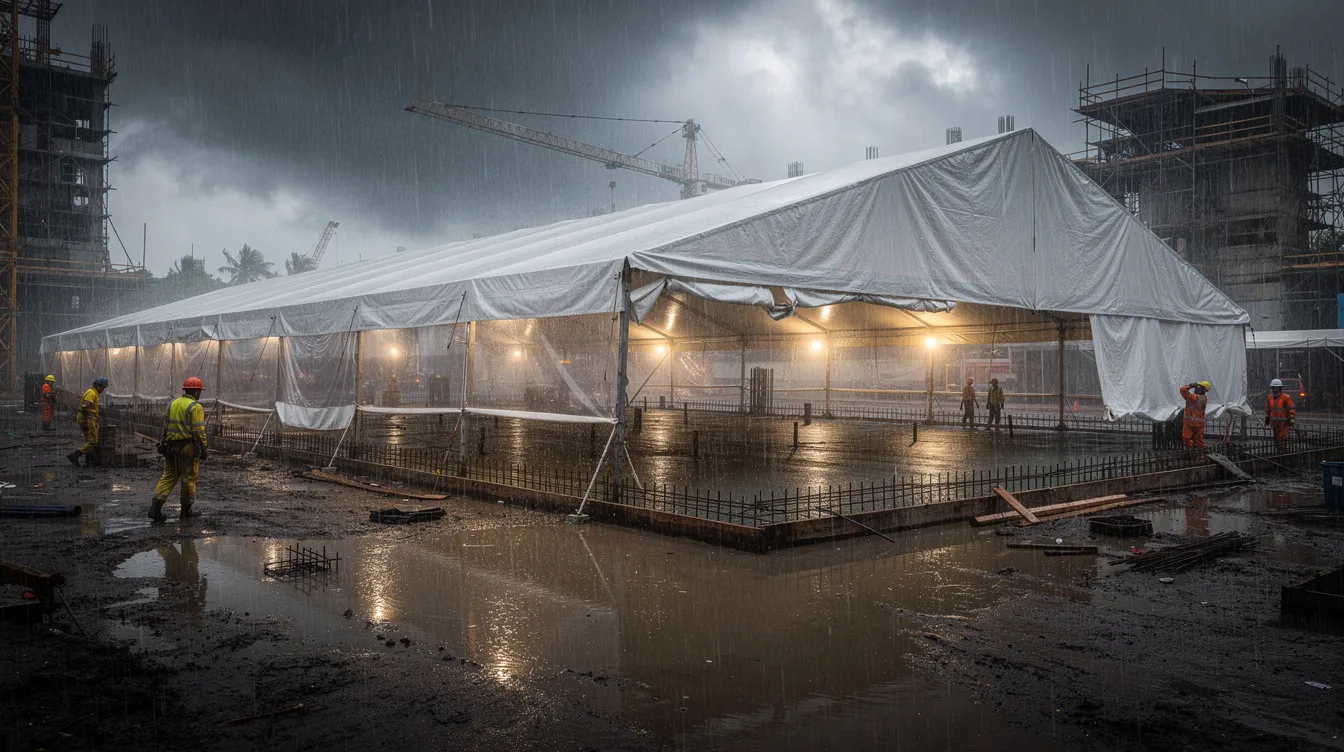
Solutions: Establish covered work areas and controlled curing environments to protect concrete during heavy rainfall periods and ensure proper strength development. Schedule critical pours during drier periods (typically May–September) and avoid major foundation excavations during peak northeast monsoon months when groundwater levels are highest.
Use concrete admixtures designed for tropical conditions-water reducers to maintain workability without excess water, retarders to manage set time in high temperatures, and anti-washout additives to protect fresh concrete from rain exposure. Implement rigorous quality control with frequent concrete cube testing, reinforcement inspection, and anchor bolt embedment verification. Effective drainage design around foundation excavations and dewatering systems prevent groundwater from affecting foundation stability during construction.
Conclusion and Next Steps
Successful heavy machinery foundation design in Singapore requires an integrated approach that combines geotechnical assessment of marine clay conditions, dynamic load analysis matched to specific machinery characteristics, thorough regulatory compliance with BCA and JTC requirements, and quality construction adapted to tropical conditions. Every element-from soil bearing capacity assessment through vibration isolation system selection-must work together to deliver foundations that maintain equipment alignment, control vibrations, and ensure decades of reliable machinery operation.
Immediate next steps for industrial facilities planning heavy machinery installation:
-
Commission a comprehensive geotechnical investigation with a QP(Geo) to characterize marine clay thickness, strength, and dynamic soil properties at your site
-
Engage a registered professional engineer experienced in machine foundation design to perform dynamic analysis and develop foundation design parameters
-
Prepare authority submission documentation including PE-stamped structural drawings, dynamic load calculations, and soil investigation reports for BCA and JTC approval
-
Plan construction sequencing around monsoon conditions and coordinate with neighboring facility operations
Future considerations include MEP coordination with foundation systems, structural health monitoring implementation using vibration sensors and settlement gauges, and expansion planning for additional heavy equipment. JTC’s next-generation industrial estates-including the Jurong Innovation District-demand increasingly sophisticated vibration control and foundation performance as advanced manufacturing moves toward higher precision requirements.
Contact AEC Technical Advisory for professional engineering services including PE endorsements, dynamic load analysis, geotechnical consultancy, and authority submissions for heavy machinery foundation projects across Singapore’s industrial estates.
Additional Resources
-
Singapore Standards: SS CP 4:2003 (foundation design), SS 544 Part 1 (concrete specifications), SS EN 1991-3:2010 with National Annex (actions from cranes and machinery)
-
Authority Portals: BCA CORENET-X submission system, JTC online development applications, URA development control guidelines
-
Professional Requirements: PE registration with BCA, QP(Geo) certification for geotechnical works, AEC Technical Advisory for consultation on industrial foundation projects
-
Technical References: BS 5228-2 (construction vibration), BS 6472-1 (building vibration and human exposure), ACI 351.3R (foundations for dynamic equipment)