
Singapore National Annex to Eurocodes: Key Parameters Engineers Must Use
Introduction
Engineers designing buildings and civil structures in Singapore must use Nationally Determined Parameters (NDPs) from the Singapore National Annexes (NAs) to SS EN 1990, 1991, 1992, 1993, and 1997. These parameters replace the default Eurocode values and cover partial safety factors (γ), combination factors (ψ), imposed loads (qₖ), wind actions, durability and exposure classes, concrete cover, steel material factors, and geotechnical partial factors. Using EN default values or another country’s NA instead of the Singapore NA results in non-compliant submissions that BCA reviewers reject.
There are 34 National Annexes across 40 Eurocode parts adopted in Singapore. Since April 2015, all new structural design submissions must reference these SS EN standards with their Singapore NAs. The BCA requires PE endorsement on all structural plans, and that endorsement depends on correct application of NA-specific parameters. Mixed use of legacy British Standards with Eurocodes is prohibited in Singapore designs.
This article covers the key NA parameters for building structures and typical civil structures (not offshore, nuclear, or seismic-critical works). It is written for structural, civil, and geotechnical engineers, as well as contractors and foreign consultants working on Singapore projects.
After reading this article, you will know:
- Which Singapore National Annexes are mandatory and where each set of parameters is found in the NA documents
- Which NA parameters most affect member sizing, durability, and project cost
- How partial factors, imposed loads, wind actions, concrete design limits, steel material factors, and geotechnical design approaches differ from EN defaults and legacy BS values
- How to configure design workflows and software settings to use Singapore NA values consistently
- Where common errors occur and how to prevent them

Understanding the Singapore National Annex to Eurocodes
A National Annex is a country-specific document published alongside each Eurocode part. It sets the Nationally Determined Parameters: the numeric values, methods, and choices that each country selects where the Eurocode text offers a range or a recommended default. Singapore publishes its Eurocodes as SS EN standards (for example, SS EN 1990:2008+A1:2010) with a corresponding NA that locks in the values engineers must use.
Singapore’s NAs adapt Eurocodes to local conditions: tropical climate, marine exposure, local concrete and steel supply, ground conditions ranging from marine clay to Bukit Timah Granite, and regulatory expectations set by BCA, LTA, PUB, and SCDF. The Singapore NA defines Nationally Determined Parameters for local design needs, covering everything from air density in wind load calculations to minimum pile load test requirements.
Core Eurocode Families Used in Singapore
Five Eurocode families form the basis of structural, civil, and geotechnical design for buildings and common civil structures in Singapore:
- SS EN 1990 sets the global safety format: limit states, partial factors for actions, load combination rules, reliability classes, and design working life. SS EN 1990 is legally binding for structural design in Singapore.
- SS EN 1991 defines actions on structures. Sub-parts cover self-weight and imposed loads (1-1), wind actions (1-4), thermal actions (1-5), and accidental actions (1-7), among others.
- SS EN 1992 governs the design of concrete structures: material models, strength classes, exposure and durability, serviceability limits, and detailing rules. Engineers must comply with SS EN 1992-1-1 for reinforced concrete structures in Singapore.
- SS EN 1993 covers the design of steel structures, including steel grades, section classification, stability checks, and connection design. Singapore uses SS EN 1993 for steel structure design.
- SS EN 1997 addresses geotechnical design: soil and resistance partial factors, foundation design approaches, pile testing requirements, and excavation support.
Almost every numerical input an engineer uses is either taken directly from the relevant NA or modified by it. Ignoring the NA means ignoring Singapore law.
How Nationally Determined Parameters (NDPs) Work
NDPs are the specific numeric values and methodological choices that each country sets in its National Annex instead of using the “recommended” values printed in the Eurocode text. The Singapore NAs specify:
- Partial safety factors for actions and resistances (γ_G, γ_Q, γ_c, γ_s, γ_M0, γ_M1, γ_M2)
- Load combination and reduction factors (ψ₀, ψ₁, ψ₂) for each occupancy category
- Characteristic imposed loads qₖ for residential, office, retail, storage, and assembly areas
- Wind reference velocity, terrain categories, air density, and pressure coefficients
- Durability and exposure classes, nominal concrete covers, and crack width limits
- Geotechnical design approaches and partial factors on soil parameters and resistance
Using EN “default” values instead of Singapore NA values is considered non-compliant. BCA reviewers check for explicit NA references on drawings and in calculation reports.
From British Standards to Singapore Eurocodes and NAs
The transition to Eurocodes began in October 2006 in Singapore, with full adoption completed by April 2015 when BS 8110, BS 5950, and BS 8004 were withdrawn for new designs. Singapore’s structural design transitioned from BS 8110 to SS EN, moving from global safety factors to a semi-probabilistic limit-state framework with explicit partial factors.
Legacy BS load factors were 1.4 for dead loads and 1.6 for live loads; the Eurocode system separates these into γ_G = 1.35, γ_Q = 1.50 with combination factors ψ that vary by occupancy category. Many senior engineers still “think in BS” terms, which leads to specific misunderstandings: underestimating variable loads in combinations, applying insufficient concrete cover (BS 8110 covers were often lower than SS EN 1992 NA requirements for marine exposure), and using single pile safety factors rather than the Eurocode 7 partial-factor framework.
The rest of this article isolates the key NA parameters engineers must know for safe and economical design in Singapore.
Key National Annex Parameters for Loads and Reliability
SS EN 1990 and SS EN 1991 NAs are the foundation of every design: they define the magnitude of actions and how they are combined. Every downstream material and geotechnical check depends on these values. Mis-applying a single ψ factor or using the wrong imposed load category propagates through every member in the building structure.
Safety Levels and Partial Factors (SS EN 1990 NA)
The NA to SS EN 1990 sets target reliability through partial factors on permanent and variable actions. For STR/GEO limit states (Set B), the Singapore NA specifies:
- γ_G = 1.35 for unfavourable permanent actions
- γ_G = 1.00 for favourable permanent actions
- γ_Q = 1.50 for both leading and accompanying variable actions
- ξ = 0.925 (reduction factor applied to permanent actions in the alternative combination expression)
SS EN 1990 requires verification against Ultimate Limit States using these factors. The design working life for typical buildings is 50 years; for monumental structures and major bridges, 100 years.
These values are close to those in the UK National Annex for Set B, but differ from some other European NAs. Engineers familiar with BS will notice that the old 1.4/1.6 split is replaced by 1.35/1.50 with explicit ψ combination factors, which can lead to different governing load cases, particularly for storage areas where ψ₀ = 1.0.
Imposed Loads and Combination Factors (SS EN 1991-1-1 NA)
Singapore’s NA for SS EN 1991-1-1 fixes qₖ values for occupancy categories rather than providing ranges. Key imposed loads engineers must use:
| Category | Description | qₖ (kN/m²) |
|---|---|---|
| A1 | Self-contained dwelling unit | 1.5 |
| A3 | Communal corridor in residential blocks | 2.0 |
| B1 | General office | 2.5 |
| C3 | Corridor / function room | 4.0 |
| C5 | Areas susceptible to overcrowding | 5.0 |
| D1 | General retail | 4.0 |
| E11 | Light storage | 2.0 |
| E13/E14 | Dense storage | 5.0 |
Concentrated loads are also specified per category; for example, general office Qₖ = 2.7 kN.
The ψ combination factors from the Singapore NA determine how accompanying variable actions are reduced in load combinations:
- Category A and B (residential/office): ψ₀ = 0.70, ψ₁ = 0.50, ψ₂ = 0.30
- Category C (congregation areas): ψ₀ = 0.70, ψ₁ = 0.70, ψ₂ = 0.60
- Category E (storage): ψ₀ = 1.0, ψ₁ = 0.9, ψ₂ = 0.8
Correct categorisation of each area matters. Labelling an equipment room as “office” (2.5 kN/m²) instead of the relevant higher category results in under-design. Labelling a corridor as “residential room” (1.5 kN/m²) instead of 2.0 kN/m² creates a similar problem.
Wind, Thermal and Other Climatic Actions (SS EN 1991-1-4 and Related NAs)
Singapore’s wind climate is tropical with thunderstorms and monsoons but no typhoons. The NA to SS EN 1991-1-4 reflects this with a fixed fundamental basic wind velocity (10-minute mean at 10 m height in open terrain) of v_b,0 = 20 m/s. Wind loads must use Singapore-specific National Determined Parameters. The directional factor c_dir = 1.0 and seasonal factor c_season = 1.0 apply uniformly.
Air density for wind load calculations is set at 1.194 kg/m³, lower than the EN default of 1.25 kg/m³. This reduces peak velocity pressure by about 4.5% compared to the default. Turbulence intensity is based on local roughness factors defined in the Singapore NA, with standard urban terrain (roughness length z₀ ≈ 0.05 m) used for most sites. Coastal or low-rise sites may require more open terrain category values.
Altitude corrections are not relevant for flat Singapore. Thermal actions and accidental actions (impact, explosion) are addressed by separate NA parts when relevant to industrial or infrastructure works.
Façade and roof uplift checks are particularly sensitive to these wind parameters. External and internal pressure coefficients (c_pe, c_pi) must be extracted from the Singapore NA for the specific building geometry.
Key Singapore NA Parameters for Concrete Design (SS EN 1992)
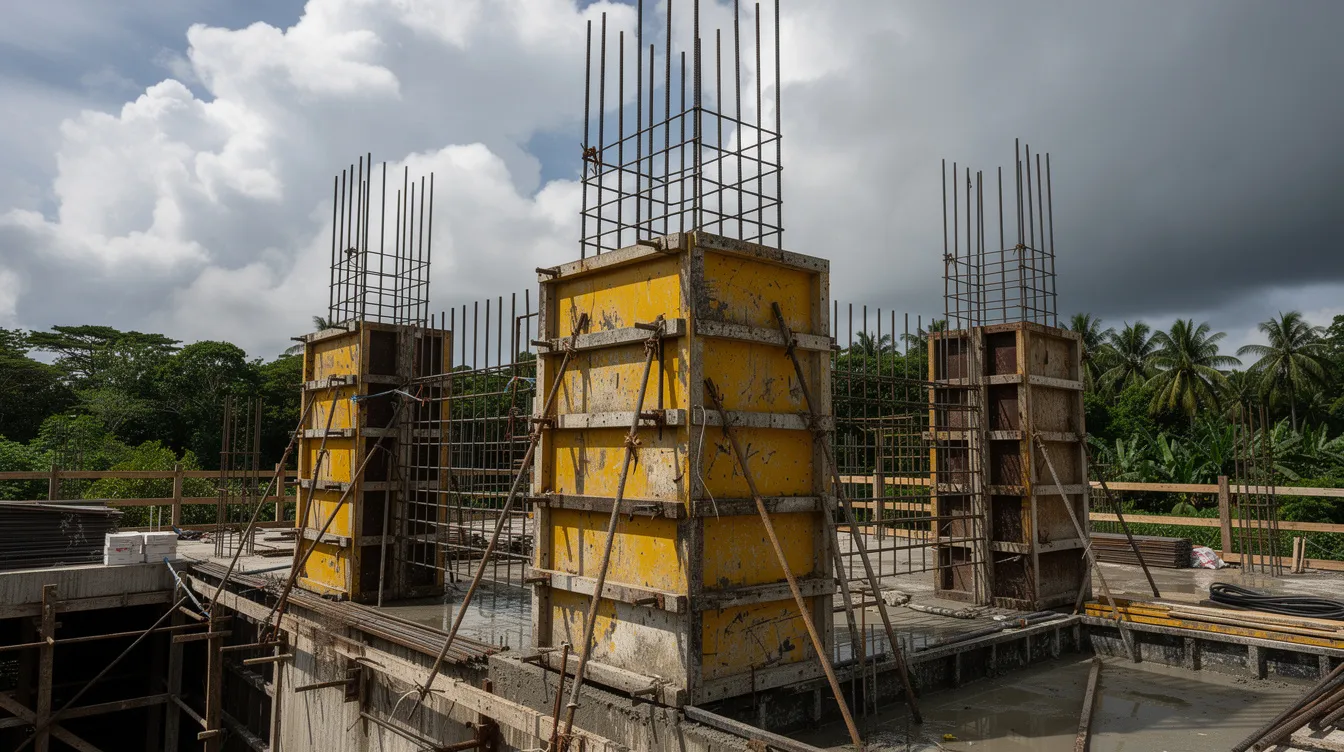
Once global actions are set using SS EN 1990/1991 NAs, the SS EN 1992 NA governs how concrete members are sized and detailed. The parameters with the largest practical impact are strength class limits, material partial factors, durability/exposure classes, nominal covers, and crack width limits.
Concrete Strength Classes and Material Partial Factors
Eurocodes use dual notation for concrete strength (cylinder/cube, e.g. C30/37). Singapore’s NA defines maximum concrete strength classes up to C90/105 for compression and flexure with special verification, but limits shear-related design to C50/60 unless the designer provides additional proof. Typical projects use C30/37 to C40/50 for residential and commercial floors, with C50/60 reserved for columns in tall buildings where axial loads are high.
The NA-confirmed partial safety factors are:
- γ_c = 1.50 (concrete, persistent and transient design situations)
- γ_s = 1.15 (steel reinforcement, persistent and transient)
- γ_c = 1.20 and γ_s = 1.00 (accidental design situations, e.g. fire or robustness checks)
The coefficient α_cc = 0.85 for long-term effects in compression (flexure and axial loading) and α_cc = 1.0 for other phenomena. These values match the EN recommended values but must still be explicitly stated as Singapore NA selections.
For tall buildings, the shear cap at C50/60 means that engineers cannot freely increase concrete grade to reduce section sizes without verifying that shear design remains compliant. SS EN 1992 requires a design working life of at least 50 years, which links directly to durability provisions.
Durability, Exposure Classes and Cover Requirements
Singapore’s climate necessitates strict environmental exposure class selection for concrete. Tropical climates require adjustments in concrete durability specifications and concrete cover. The Singapore NA, read together with complementary Singapore standard SS 544-1:2019, maps exposure classes to local conditions:
- XC1: Internal dry spaces (typical exposure class for inland residential interiors)
- XC3/XC4: Sheltered or exposed external structural members
- XS1/XS2/XS3: Structures within marine or chloride-laden environments; coastal facades, podium decks, basement walls near sea
- XD1/XD2: Chloride exposure other than seawater (e.g. near expressways with de-icing, or industrial chemical exposure)
Minimum cover for standard exposure is typically 20–25 mm for XC1 interiors. For marine exposure classes (XS), covers increase by 10–20 mm depending on aggregate size and severity. The NA also requires minimum concrete quality (maximum water/cement ratio, minimum cement content) for each exposure class. These values exceed what BS 8110 required for equivalent conditions; architects and quantity surveyors need to account for the thicker sections early in concept design.
Serviceability: Deflection and Crack Width Limits
The Singapore NA maintains strict guidelines on minimizing concrete cracks due to environmental exposure. Key serviceability parameters:
- Maximum crack width under quasi-permanent combination: 0.3 mm for most exposure classes (X0, XC1 through XC4)
- Maximum crack width under frequent combination: 0.2 mm for severe exposure (XD, XS classes) or where decompression is required
- Total deflection limit: span/250 for general cases, with tighter limits for cantilevers and façade support beams
Creep and shrinkage coefficients in Singapore are influenced by humidity and temperature; the high ambient humidity (typically 70–90%) affects long-term deflection predictions. Minimum longitudinal reinforcement bar diameter in columns is ϕ_min = 12 mm under the Singapore NA concrete method.
These limits drive early sizing choices. A marine-exposed slab requiring 0.2 mm crack width under frequent combination needs closer bar spacing or deeper sections compared to an identical slab designed to 0.3 mm for an inland building.
Key Singapore NA Parameters for Steel Design (SS EN 1993)
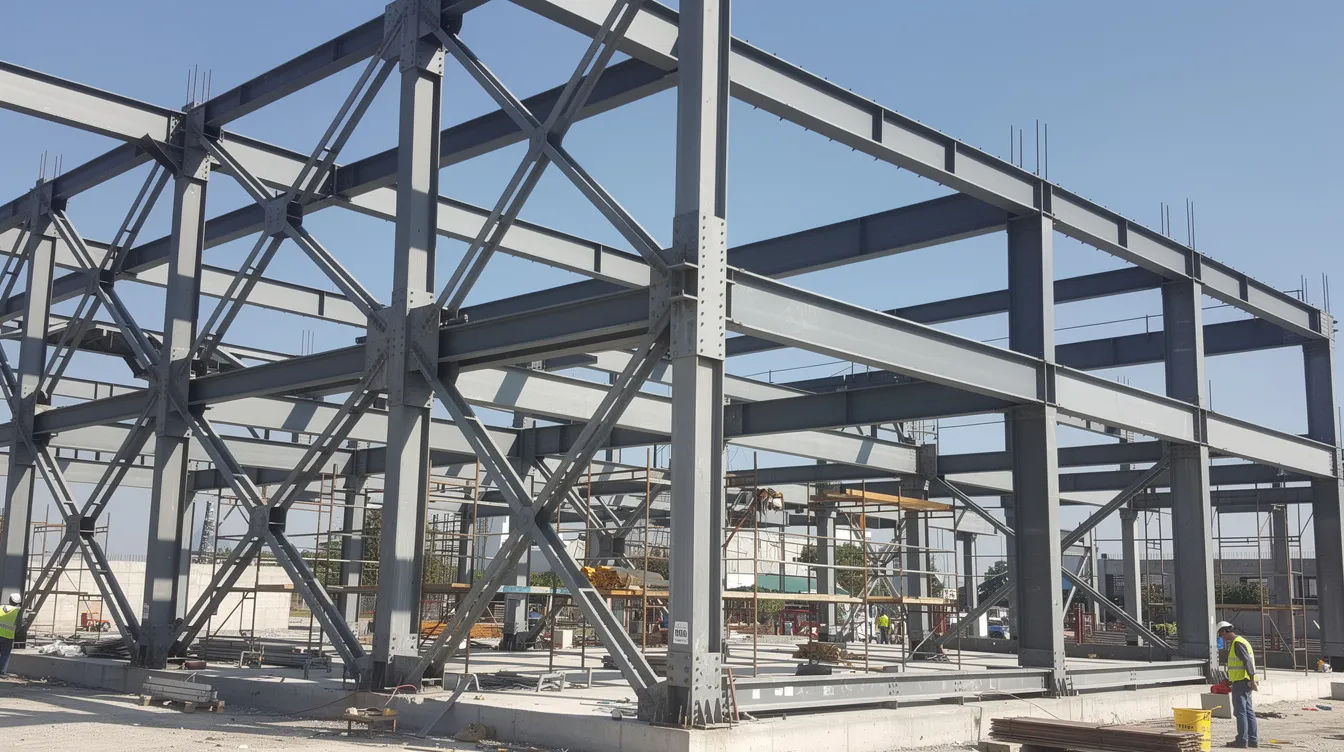
SS EN 1993 1 with its Singapore NA replaced BS 5950 for the design of steel frames, industrial sheds, and composite buildings. The main NA influences relate to material factors, section classification, stability curves, and connection design assumptions.
Steel Grades, Material Factors and Section Classification
Common steel grades in Singapore include S275 and S355, with higher grades (S460 and above) used for specialist applications such as transfer structures in tall buildings. Actual availability of heavy welded sections or high-strength rolled sections must be confirmed with local fabricators before finalizing design.
The Singapore NA specifies the following partial resistance factors:
- γ_M0 = 1.00 (cross-section resistance)
- γ_M1 = 1.00 (member instability / buckling checks)
- γ_M2 = 1.10 (tension fracture and connections)
The γ_M0 and γ_M1 values match the EN default. The γ_M2 value of 1.10 is lower than the EN default of 1.25, which means connection designs in Singapore require less additional capacity than in many European countries but still represent a step change from BS 5950 practice.
Eurocode section classification (Class 1 through 4) determines whether plastic design is permitted. The NA provides clarifications for local production tolerances and welding practices. More sections may fall into less favourable classes compared to BS classification, affecting effective section properties for semi-compact and slender sections.
Stability, Buckling Curves and Imperfections
The Singapore NA guides selection of buckling curves for columns and beams, distinguishing between hot-rolled and welded sections. SS EN 1993 requires checks for lateral torsional buckling; the NA specifies λ_LT,0 and β factors for the LTB check, along with buckling curve selection based on section geometry.
For initial geometric imperfections, the NA defines bow imperfection values (e₀) using the imperfection factor α and relative slenderness λ per clause 5.3.2. Second-order (P-Δ) analysis becomes mandatory when the elastic critical load ratio α_cr falls below 10 for elastic analysis or below 15 for plastic analysis.
The Singapore NA mandates execution class EXC2 for most steel structures. Higher execution classes (EXC3) apply to long-span roofs, critical high-rise elements, and structures where failure consequences are severe. Execution class affects fabrication tolerances, inspection requirements, and weld quality standards.
Connection Design Parameters and Local Practice
SS EN 1993 1-8 NA influences bolt grades, weld categories, resistance factors, and detailing practices. Key connection-related parameters from the NA include preferred bolt strength classes (8.8 and 10.9 are standard), surface friction assumptions for slip-critical joints, and weld quality/inspection levels.
The component method for connection design, while complex, is the standard EN approach. Coordination between designers and local fabricators is essential: NA-compliant designs must be practical for shop drawing production and site erection. Bolt hole tolerances, weld access geometry, and connection plate thicknesses must reflect local workshop capabilities.
Key Singapore NA Parameters for Geotechnical Design (SS EN 1997)
Singapore’s ground conditions vary from soft marine clay (Kallang Formation) to stiff Old Alluvium and hard Bukit Timah Granite, making the NA to SS EN 1997 crucial for foundations and deep basements. The transition from BS 8004 to SS EN 1997 changed how soil parameters, resistance factors, and pile design are handled.
Design Approaches, Partial Factors and Geotechnical Categories
Singapore’s NA mandates Design Approach 1 for foundations. No other design approach (DA2 or DA3) is permitted for building foundation design. Design Approach 1 checks two combinations for foundation safety:
DA1 Combination 1 (Set A1 + M1 + R1): factors applied primarily to actions, with soil parameters at characteristic values.
- γ_φ′ = 1.0, γ_c′ = 1.0, γ_cu = 1.0
DA1 Combination 2 (Set A2 + M2 + R1): factors applied to soil parameters, with reduced action factors.
- γ_φ′ = 1.25, γ_c′ = 1.25, γ_cu = 1.4
Partial resistance factors for spread foundations are γ_R;v = 1.0 (bearing) and γ_R;h = 1.0 (sliding) under standard conditions.
Geotechnical Categories in Singapore range from GC1 to GC3. Most multi-storey buildings fall under GC2, which triggers specific site investigation scope requirements and design documentation. GC3 applies to high-risk projects with unusual ground conditions or deep basements adjacent to sensitive structures.
Pile Design and Load Testing Parameters
Singapore’s NA specifies higher partial resistance factors for piled foundations when load test data is unavailable. Piled foundations require correlation factors linking capacity to load tests; reducing these factors requires static or bi-directional load test results that confirm capacity. Geotechnical engineers typically recommend at least one static pile load test for every 50–100 piles or for each pile size/soil stratum encountered.
For uplift limit states (UPL), higher soil parameter partial factors apply: γ_φ′ = 1.25, γ_c′ = 1.25, γ_cu = 1.4. These values directly increase required pile lengths and diameters when no test data supports capacity assumptions.
Negative skin friction in Singapore’s soft clays and group effects in closely spaced pile configurations are addressed by engineering judgment within the NA framework. The 2018 Amendment A1 to the NA to SS EN 1997-1 updated soil parameter partial factors and resistance factors, so engineers must confirm they are referencing the current version.
Basements, Retaining Systems and Excavations
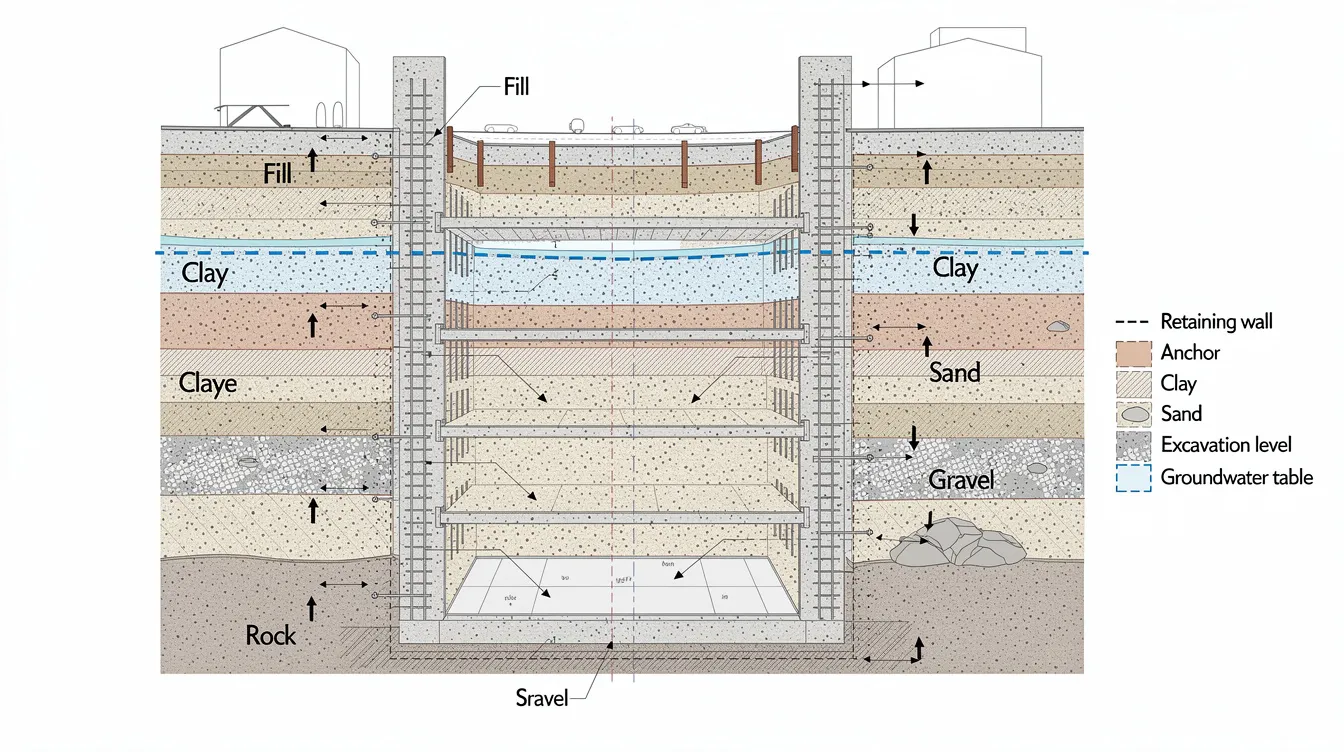
Deep basements in Singapore’s dense urban environment require careful application of NA partial factors to earth and water pressures. For retaining systems and excavations, the NA distinguishes between temporary and permanent conditions, with different partial factors for each.
Surcharge loads from adjacent roads, MRT tunnels, or buildings must be included as variable actions with appropriate ψ factors. Requirements for instrumentation, the observational method, and back-analysis apply when deformation control is critical.
These parameters interact with MOM and LTA guidelines for deep excavation safety and adjacent structure protection. A diaphragm wall design for a 4-level basement adjacent to an MRT tunnel applies stricter movement limits than a 2-level basement in open ground, with corresponding adjustments to the geotechnical design process.
Practical Design Workflow Using Singapore National Annex Parameters
Following a disciplined workflow ensures NA parameters are consistently applied and documented. The steps below trace how a typical building is taken from concept to authority submission using SS EN with Singapore NAs.
Step-by-Step Use of NA Parameters in a Typical Building Project
- Establish design basis: Select structural form, consequence class, and design working life per SS EN 1990 NA. Document the applicable NA version on the project design basis document.
- Determine actions: Apply SS EN 1991 NAs to assign dead, imposed, wind, and other actions. Map every room type to the correct occupancy category and confirm qₖ and ψ factors. Produce a load zoning plan.
- Global analysis: Run frame/slab models using FEA software configured to Singapore NA partial factors and combinations. Verify that load combination libraries match NA Table NA.A1.2(B) values.
- Member design: Size concrete and steel elements using SS EN 1992/1993 NAs. Apply correct strength classes, covers, crack width limits, buckling curves, and material partial factors.
- Foundation design: Apply SS EN 1997 NA Design Approach 1 with both combination sets. Reference local SI data and pile test results to select appropriate partial and correlation factors.
- Documentation and submission: State all SS EN and NA references on drawings and in calculation reports (e.g. “Design per SS EN 1990:2008 + NA:2010 and amendments”). Obtain PE endorsement for BCA/URA/LTA submissions.
Snapshot Comparison: Singapore NA vs Default Eurocode Values
| Parameter | Singapore NA | EN Default / UK NA | Design Consequence |
|---|---|---|---|
| γ_G (unfavourable permanent) | 1.35 | 1.35 (EN/UK same) | No difference for this factor |
| γ_Q (variable) | 1.50 | 1.50 (EN/UK same) | Consistent across jurisdictions |
| ξ (reduction factor) | 0.925 | 0.925 (UK); varies in other NAs | Affects alternative combination expression |
| Basic wind velocity v_b,0 | 20 m/s (fixed) | Varies by country/region | Uniform wind design across Singapore |
| Air density | 1.194 kg/m³ | 1.25 kg/m³ (EN default) | ~4.5% lower wind pressure |
| γ_M2 (steel connections) | 1.10 | 1.25 (EN default); 1.10 (UK) | Less conservatism than EN default |
| γ_c (concrete) | 1.50 | 1.50 (EN default) | Consistent with EN |
| Max concrete class for shear | C50/60 | Not restricted in EN | Limits use of ultra-high-strength concrete |
| Geotechnical design approach | DA1 only | Country-specific | Two combination checks required |
| γ_cu (undrained strength, M2) | 1.4 | 1.4 (EN recommended) | Consistent with EN recommendation |
Singapore’s NA results in slightly higher durability demands (thicker covers, stricter exposure class mapping) and more explicit geotechnical checks compared to many European applications. Optimization opportunities exist when engineers fully understand the NA rules, particularly in reducing pile lengths with adequate load test data and selecting the right exposure class for each element.
Illustrative Scenario: Applying NA Parameters to Two Building Types
Scenario A: 12-storey inland residential block with RC flat slabs and bored piles
Occupancy categories A1 (dwelling units, 1.5 kN/m²) and A3 (communal corridors, 2.0 kN/m²) apply, with ψ₀ = 0.70. Wind category uses standard urban terrain with v_b,0 = 20 m/s; no wind tunnel study is needed for a 12-storey block. Exposure class XC1 applies to interior slabs (minimum cover 20–25 mm) and XC3/XC4 to external balconies. Geotechnical Category GC2 applies; DA1 with both combinations governs pile design in Old Alluvium. One static load test per pile type confirms capacity and allows use of lower correlation factors.
Scenario B: 30-storey coastal commercial tower with composite steel-concrete frame, deep basement and diaphragm walls
Office floors use Category B1 (2.5 kN/m²), retail podium uses D1 (4.0 kN/m²), and assembly/function areas use C3 (4.0 kN/m²). Wind engineering for a 30-storey tower at the coast requires careful terrain category selection (potentially more open than standard urban) and may warrant wind tunnel testing for façade pressures and occupant comfort. Exposure classes XS1/XS2 apply to coastal-facing elements, requiring higher concrete cover (30–45 mm depending on aggregate size and severity), higher minimum concrete grade, and 0.2 mm crack width limit under frequent combination. Steel frame elements use SS EN 1993 1 with γ_M0 = 1.00, γ_M1 = 1.00, γ_M2 = 1.10. The deep basement with diaphragm walls falls under GC3, requiring detailed geotechnical design with DA1 partial factors and comprehensive instrumentation.
Early recognition of these NA-driven parameters informs feasibility studies, cost plans, and structural scheme selection. The coastal tower’s durability and geotechnical requirements add 10–15% to structural cost compared to an equivalent inland project.
Common Pitfalls with Singapore National Annex Parameters and How to Avoid Them
Many errors arise not from complex analysis but from incorrect or inconsistent NA parameter choices. This is especially true for teams accustomed to other NAs or to British Standards. Below are recurring issues encountered when reviewing third-party designs, with practical remedies.
Using Non-Singapore NA or Default EN Values
A common scenario: an overseas consultant uses the UK National Annex or EN defaults for loads, wind, or durability. The design passes internal QA but fails Singapore review because the air density, exposure class mapping, or geotechnical design approach does not match the Singapore NA.
Solutions:
- At project start, fix the applicable NA set as “Singapore NA only” in contracts and design briefs
- Configure all analysis and design software libraries to Singapore NA partial factors and combinations; verify the settings before running any load cases
- Engage a Singapore-registered PE early to audit NA settings in the model
Misclassification of Imposed Loads and ψ Factors
Mis-labelling areas leads to unsafe or unnecessarily heavy designs. Treating a dense storage area (5.0 kN/m²) as light storage (2.0 kN/m²) under-designs the floor by 60%. Treating a residential corridor (2.0 kN/m²) as a congregation area (4.0 kN/m²) wastes material.
Action points:
- Use a standard matrix that maps common room types in Singapore buildings to SS EN 1991-1-1 NA categories
- Double-check ψ factors in combination sheets for each variable action type; storage areas with ψ₀ = 1.0 differ from office areas with ψ₀ = 0.70
- Include a load zoning plan in drawings to communicate assumptions to contractors and authorities
Underestimating Durability and Marine Exposure
External or coastal elements sometimes receive inland exposure classes (XC1/XC3) and inadequate cover, leading to premature corrosion. Singapore’s coastline, reclaimed land areas, and proximity of many sites to the sea make exposure classification a risk management issue.
Remedies:
- Establish exposure maps for each project early, endorsed by the PE and shared with architects and QSs
- Cross-check SS EN 1992 NA exposure class decisions against SS 544-1:2019 and site location relative to the coast or expressways
- Include cover requirements clearly in rebar schedules and general notes
Geotechnical Parameters Based on Inadequate Site Investigation
Eurocode 7 with the Singapore NA assumes quality site investigation. Poor SI forces conservative soil parameters and larger partial factors in practice, increasing pile lengths, sizes, and cost. Engineers sometimes attempt to use DA1 Combination 2 to reduce factors without providing sufficient test data.
Solutions:
- Plan SI scope with the geotechnical PE to match the Geotechnical Category and expected foundation type
- Use staged SI and preliminary pile/load tests to refine NA-based parameters and optimise design through value engineering
- Document geotechnical design assumptions clearly in reports and submission documents
Engineers must also consider Singapore-specific seismic design implications despite low seismicity; Eurocode 8 provisions may apply to specific structure types or when required by the technical committee reviewing the submission.
Conclusion and Next Steps
Singapore National Annexes to Eurocodes define the mandatory parameters engineers must use for loads, safety factors, durability, steel design, and geotechnical design. Correct application ensures safety and regulatory compliance while avoiding the cost penalties of both under-design (rejection) and over-design (unnecessary material). Structural engineers must follow the standards outlined in Eurocodes adapted for Singapore; there is no discretion to substitute default EN or legacy BS values.
Actionable next steps:
- Audit current office templates and design software to confirm all NA parameters (γ, ψ, qₖ, covers, geotechnical factors) are set to Singapore values
- Develop internal quick-reference sheets for imposed loads, wind parameters, exposure classes, and pile factors drawn directly from the NAs
- Incorporate NA checks into QA procedures for every major project milestone
- Verify that all calculation reports and drawings explicitly reference the applicable SS EN and NA versions, including amendments
- Engage specialist consultants for peer review, NA configuration of analysis models, or full structural and geotechnical design support for Singapore projects
Related topics worth exploring include structural fire design under SS EN 199x NAs, integration of Eurocodes into BIM workflows, and transitioning legacy BS-based construction details to NA-compliant equivalents.
Additional Resources on Singapore Eurocodes and National Annexes
The following resources help engineers locate official NA documents, training, and practical tools:
- Official NA documents: Purchase SS EN codes and Singapore NAs from the Enterprise Singapore (formerly Spring Singapore) standards e-shop. Always confirm you have the latest amendment.
- BCA practice notes: BCA Approved Documents and circulars relating to SS EN adoption and NA use are published on the BCA website and updated periodically.
- Professional development: IES and BCA Academy offer courses on Eurocodes and Singapore NAs for structural and geotechnical engineers. These cover the evolution from BS to SS EN and practical application of NDPs.
- NA-compatible tools: Standardised load combination spreadsheets, cover/exposure charts, and SI planning checklists help ensure consistent NA application across project teams.
- Reference guides: Detailed guides on wind load calculation to SS EN 1991-1-4, pile load testing methods, and slope stabilisation to SS EN provide worked examples aligned with Singapore NA requirements.
Maintain an updated digital library of NAs and check regularly for revisions or amendments that may change key parameters. The 2018 Amendment A1 to SS EN 1997-1 NA is one example of how parameter values can shift between editions.